In short
- Portugal celebrated 37,714 weddings in 2025, 3.0% more than in 2024; 81.1% of opposite-sex weddings were civil only and 18.6% Catholic, and the average age at first marriage was 36.1 for men and 34.6 for women (INE).
- The party after the ceremony is the copo de água — literally “glass of water” — which the Priberam dictionary defines as the party or meal that celebrates a wedding.
- A typical Portuguese wedding party is a long meal at round tables, opened to dancing by the couple’s waltz, with popular music and conga lines (comboios); the menu follows the region — suckling pig in the Bairrada, seafood in the south (Casamentos.pt).
- Summer weddings start late to dodge the heat: Casamentos.pt suggests a ceremony around 18:00 in July or August, and around midday for a winter daytime wedding.
- August and September are the busiest months — about 5,000 weddings each in 2025 — and February the quietest, with about 1,700 (INE, preliminary monthly figures).
In this guide
If you are marrying in Portugal with Portuguese guests — or you simply want to know what a wedding here usually looks like — this is the shape of the day: a ceremony, a shower of rice and petals, and then a long, generous meal that turns into a party. Below are the numbers behind it, the customs you are likely to meet, a few regional ones, and what each means for the way the day is photographed.
Who marries in Portugal, and how?
INE, the national statistics office, counted 37,714 weddings in 2025, 1,081 more than in 2024 (+3.0%). Of these, 36,651 were between people of the opposite sex and 1,063 between people of the same sex. The count includes residents of other countries who married in Portugal.
Most Portuguese weddings are now civil. Of the opposite-sex weddings in 2025, 81.1% (29,728) were civil only and 18.6% (6,809) were Catholic — a Catholic share 16.7 percentage points lower than in 2016. People also marry later: the average age at a first marriage was 36.1 for men and 34.6 for women.
| Month (2025) | Weddings, about | Note |
|---|---|---|
| September | 5,000 | The busiest month |
| August | 4,900 | A close second (and the busiest in 2024) |
| July | 4,300 | |
| June | 3,900 | |
| May | 3,900 | |
| February | 1,700 | The quietest month |
These are INE’s preliminary monthly figures, rounded; ten years of them are in weddings in Portugal in numbers. For the weather and light behind those months, see the best months to marry, region by region.
What is a copo de água?
Ask a Portuguese guest where the party is and they will say the copo de água (also written copo-d’água) — literally a “glass of water”. The Priberam dictionary gives two meanings: a spread of sweets and liqueurs offered to the guests of a solemn occasion, and, today, simply “the party or meal with which a wedding is celebrated”. In other words, everything after the ceremony: the welcome, the meal, the cake and the dancing.
It is usually served at round tables, and the menu follows the region: in the Bairrada it is common to serve leitão (roast suckling pig); in the south, more seafood (Casamentos.pt). The first slice of the wedding cake is always shared by the couple.
How a Portuguese wedding day unfolds
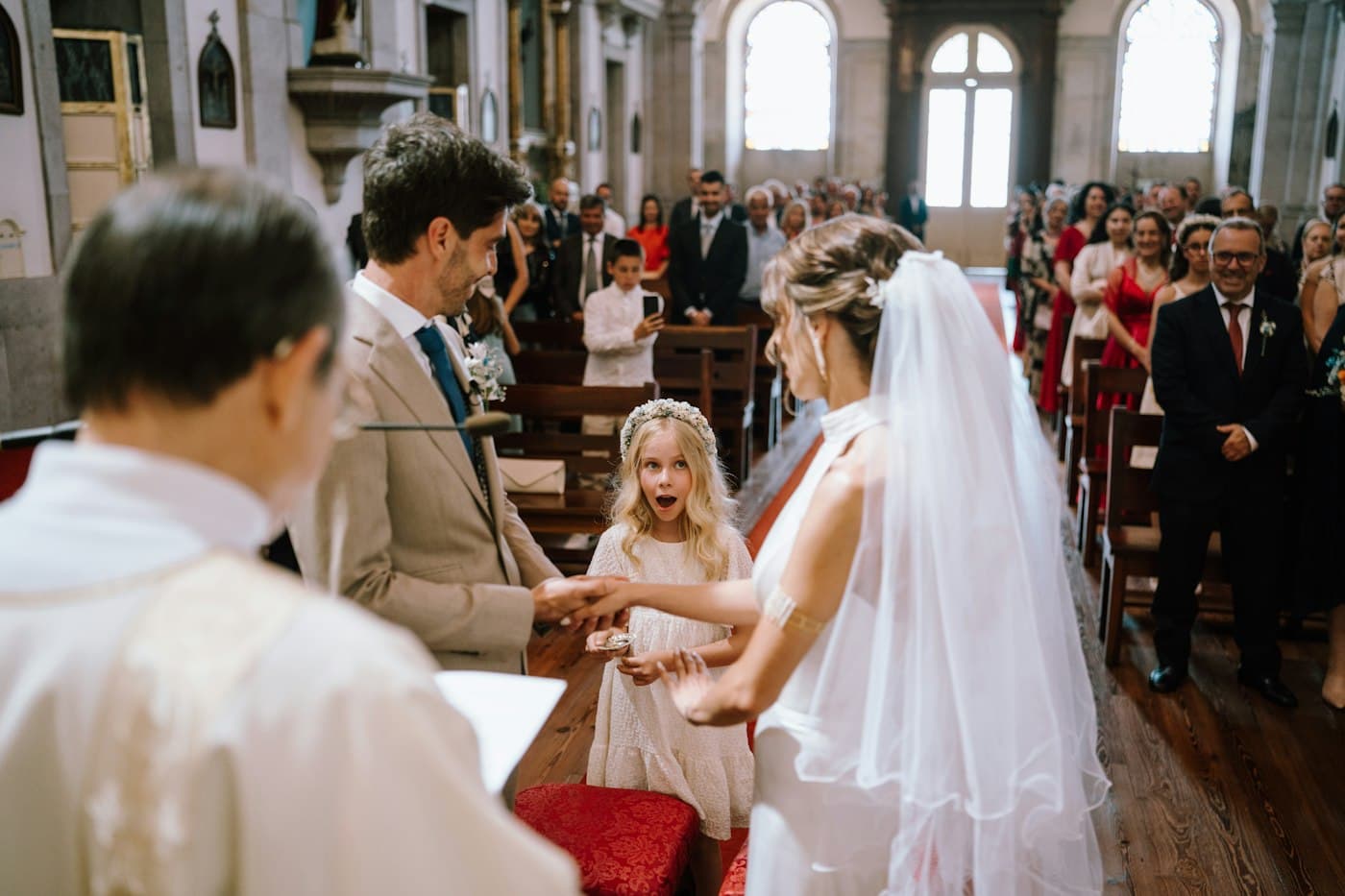
- The ceremony. The religious ceremony is still the one Casamentos.pt calls the most traditional, but as INE’s numbers show, most couples now marry civilly — at a Conservatória, or with a registrar at the venue.
- Rice and petals. As the couple come out, guests throw rice and rose petals “to wish them a full life” (Casamentos.pt). Some churches want this done outside: the Diocese of the Algarve asks for the final celebrations, “rice and petals”, to happen entirely outside the church.
- The copo de água. The long meal at round tables, course after course, with time to talk in between.
- The cake, its first slice shared by the couple.
- The dancing, usually opened by the couple’s waltz, then popular music and one or more comboios — conga lines that snake through the room.
What time does it start?
It depends on the season. Casamentos.pt suggests starting around 18:00 at the height of summer, in July or August, when the afternoon heat is at its worst; daytime weddings in winter around 12:00; and, for a daytime wedding, the copo de água starting by 15:00 at the latest. A late summer start puts the portraits right in the soft light before sunset — the wedding-day timeline has sunset times by month.
| Summer (July–August) | Winter, daytime | |
|---|---|---|
| Ceremony | Around 18:00 | Around 12:00 |
| Why | Avoids the hottest hours | Uses the short daylight |
| For the photos | Portraits fall in the golden hour after the ceremony | Portraits soon after the ceremony, before the light fades in the afternoon |
Customs you are likely to meet
- The couple’s waltz opens the dancing.
- Comboios. Popular music and conga lines are, in Casamentos.pt’s words, always part of the typical Portuguese wedding.
- The garter auction (o leilão da liga). The bride slowly raises the hem of her dress until the garter shows, while guests make offers; the highest bid wins it — though, as Casamentos.pt notes, “it is always the groom who ends up with the garter”. It calls it a “tradition” in quotation marks, very common today; some couples keep it symbolic or give the money to charity.
- Round tables and a long meal. Several courses, plenty of time between them, and the party growing out of the table rather than replacing it.
- Regional food. Leitão in the Bairrada, seafood in the south — ask your caterer what their region does best.
Traditions by region
| Region | Tradition | What it is |
|---|---|---|
| Minho (Vila Verde) | Lenços de namorados | Embroidered sweetheart handkerchiefs. A girl of marrying age embroidered one in cross-stitch and sent it to the young man she had chosen; if he wore it in public, she had her answer (Porto e Norte tourism) |
| Alto Minho (Viana do Castelo) | The traje de noiva | The Alto Minho’s bridal costume, paraded with the mordoma and lavradeira costumes and “true works of art in gold” at the Romaria d’Agonia every August (Câmara Municipal de Viana do Castelo). For great occasions, Viana’s wealthier women wore black velvet embroidered with glass beads (Crossing Portugal) |
| Lisbon | Casamentos de Santo António | Every 12 June, on the eve of Saint Anthony’s day, the city marries a group of couples — 16 in 2026, at the town hall at 11:30 and in the Sé (the cathedral) at 14:00. A tradition from the 1950s, interrupted in 1974 and revived by the Câmara Municipal 29 years ago; 431 weddings since then (EGEAC, 2026) |
| Bairrada | Leitão at the copo de água | Roast suckling pig is a common wedding dish (Casamentos.pt) |
| The south | Seafood | More seafood on the wedding menu (Casamentos.pt) |
The Santo António weddings are a city event, not a venue you can book: couples apply months ahead (the 2026 deadline was 20 March), and Visit Lisboa describes the tradition as a way of giving couples who could not otherwise afford it the chance to marry. If your date falls around 12–13 June in Lisbon, expect the city in full festival mode — and plan travel and photo locations with that in mind.
What foreign couples can borrow
You don’t need Portuguese guests to bring some of this into your day. A few ideas that travel well:
- A long table meal instead of a quick dinner and an early party — the Portuguese rhythm suits a destination wedding where guests have travelled far to be together.
- The rice-and-petals exit, if your church or venue allows it — ask where it can happen, and whether they prefer petals only.
- A regional menu: leitão in the centre, seafood on the coast, the local wine of wherever you are.
- A lenço de namorados embroidered with your names or date — as a gift between you, wrapped around the bouquet stems, or framed afterwards. Vila Verde’s embroiderers still make them.
- A late summer ceremony, around 18:00, for the heat and for the light.
What it means for the photographs
- The day is long. A Portuguese-style copo de água runs from the afternoon into the night. Decide which parts you want photographed — the waltz and the first comboios happen early in the dancing — and book the hours to match. The wedding-day timeline shows how coverage hours map onto the day.
- Tell guests about the exit. For the rice and petals, the photographer needs to be outside first, facing the door; a quick word from whoever leads the ceremony gets guests ready on both sides.
- Round tables make table-by-table group photos easy to plan, if you want them — say so in advance and agree when.
- The garter auction is loud, funny and very Portuguese; if you would rather not have it in your gallery, tell your photographer.
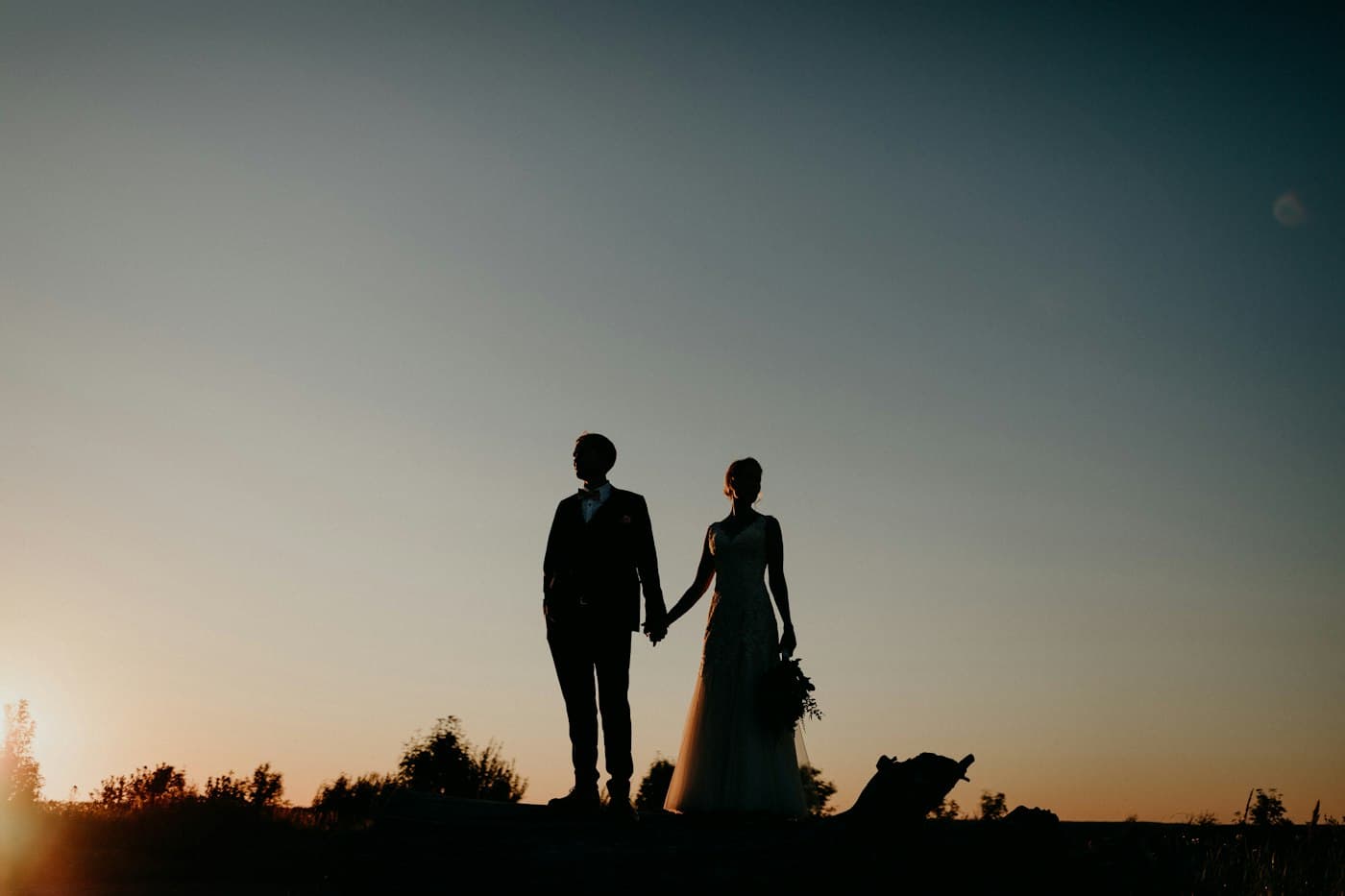
- A summer 18:00 ceremony gives you portraits in the warm light straight afterwards, before the meal — the best of both.
Looking for someone who knows how a Portuguese wedding flows? Browse photographers by region, read what a destination wedding in Portugal costs, or tell us about your day and see who is free.
Questions couples ask
What is a copo de água?
It is the Portuguese name for the wedding party: the meal and celebration after the ceremony. Literally “a glass of water”, the Priberam dictionary defines it as the party or meal with which a wedding is celebrated; it originally meant a spread of sweets and liqueurs offered to guests at a solemn occasion.
What time do Portuguese weddings start?
It depends on the season. Casamentos.pt suggests a ceremony around 18:00 in July and August, to avoid the heat, and around midday for daytime weddings in winter; for a daytime wedding, the copo de água should start by 15:00 at the latest.
What are typical Portuguese wedding traditions?
Rice and rose petals thrown as the couple leave the ceremony, a long meal at round tables (the copo de água), the first slice of cake shared by the couple, the dancing opened by the couple’s waltz, popular music with conga lines (comboios) and, at many weddings today, a garter auction. Menus follow the region — suckling pig in the Bairrada, seafood in the south.
Are most weddings in Portugal Catholic?
No, not any more. In 2025, 81.1% of opposite-sex weddings in Portugal were civil only and 18.6% Catholic, a Catholic share 16.7 percentage points lower than in 2016 (INE). The church wedding is still seen as the traditional one.
When is wedding season in Portugal?
From May to September, with August and September the busiest months — about 5,000 weddings each in 2025, according to INE’s preliminary monthly figures. February was the quietest month, with about 1,700.
What are the Santo António weddings in Lisbon?
A city tradition: every 12 June, Lisbon marries a group of couples — 16 in 2026 — in a civil ceremony at the town hall and a religious one in the cathedral, organised by EGEAC for the Câmara Municipal. It began in the 1950s, stopped in 1974 and was revived 29 years ago; 431 couples have married since. Couples apply months in advance.
What is the garter auction at a Portuguese wedding?
During the party the bride slowly raises the hem of her dress until the garter shows, while guests bid for it, and the highest offer wins; some couples keep it symbolic or give the money to charity. Casamentos.pt calls it a very common “tradition” today and notes that the groom usually ends up with the garter.
Sources
- INE — Estatísticas Vitais 2025 (30 April 2026) (opens in a new tab) · ine.pt
- INE — monthly vital statistics, preliminary data (13 February 2026) (opens in a new tab) · ine.pt
- Dicionário Priberam — copo-de-água (opens in a new tab) · dicionario.priberam.org
- Casamentos.pt — Uma festa de casamento tipicamente portuguesa (updated 8 March 2024) (opens in a new tab) · casamentos.pt
- Casamentos.pt — O melhor horário para o vosso casamento (updated 20 September 2024) (opens in a new tab) · casamentos.pt
- Casamentos.pt — A liga da noiva: tradições e significados (updated 13 February 2024) (opens in a new tab) · casamentos.pt
- Porto e Norte — Artesanato de Vila Verde: lenços de namorados (opens in a new tab) · portoenorte.pt
- Câmara Municipal de Viana do Castelo — Festas e romarias (opens in a new tab) · cm-viana-castelo.pt
- Crossing Portugal — Museu do Traje de Viana do Castelo (opens in a new tab) · crossingportugal.pt
- EGEAC — Casamentos de Santo António 2026 (11 February 2026) (opens in a new tab) · egeac.pt
- Visit Lisboa — Weddings of Saint Anthony (opens in a new tab) · visitlisboa.com
- Diocese do Algarve, Pastoral do Turismo — Casamento língua estrangeira (archived 11 April 2026) (opens in a new tab) · web.archive.org