Founding photographerVerified — Identity verified by Lens & Vows


Tina Y.from €2,400
Dresden & Saxony, Berlin & Brandenburg +40 · Documentary, EditorialBased in the Netherlands · travels to weddings in GermanyWedding photographers in Germany
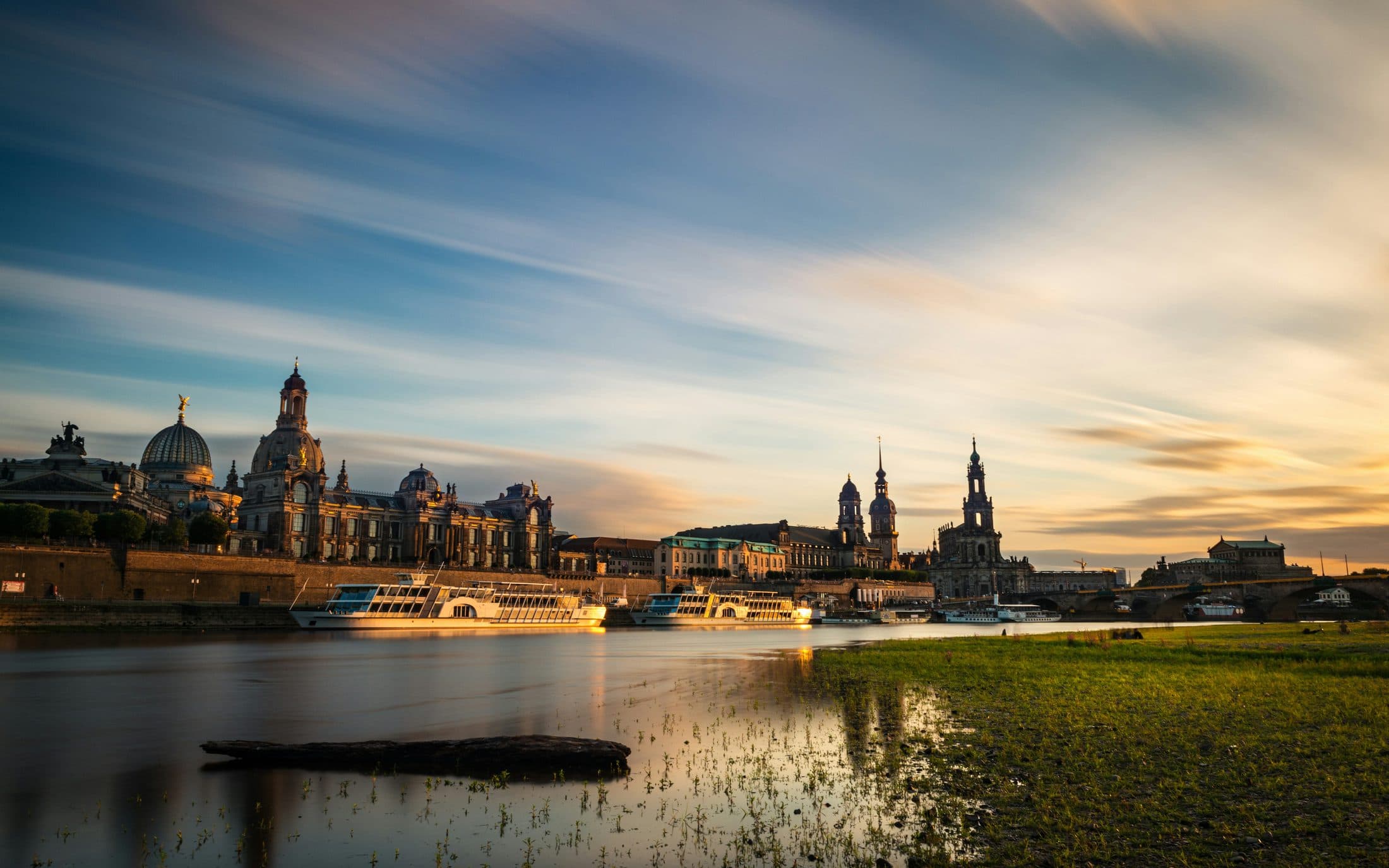
A baroque capital on the Elbe, with Meissen’s castle on its rock downstream, the sandstone towers of Saxon Switzerland upstream and, 113 km away by road, Leipzig’s old trading squares.
The Elbe shapes this region. In Dresden it curves below the terraces and domes of the old town, with the Frauenkirche and the cathedral on the skyline and the Zwinger, the city’s great baroque palace courtyard, just behind. UNESCO listed 18 km of this valley in 2004 and removed it in 2009 because of a new four-lane bridge, only the second site ever delisted; the meadows and palaces are still here. Downstream, the Albrechtsburg, which calls itself Germany’s oldest castle, stands high above the river at Meissen, among vineyard slopes. North of Dresden the baroque Schloss Moritzburg rises from its lake. Upstream the valley cuts into the Elbe Sandstone Mountains, whose rock towers, gorges and table mountains make up Saxon Switzerland, Saxony’s only national park. To the west lies Leipzig, the old trading city.
Couples marry at a registry office in Dresden or Leipzig, in a castle or a fortress, or on one of the Elbe’s paddle steamers, and many take their portraits in a palace garden or among the rocks. In Germany a marriage is legal only before a registrar, at a Standesamt (registry office) or a place it has set aside for weddings; a religious or symbolic ceremony alone isn’t a legal marriage. So couples from abroad who want to choose their own hour and place often sign the papers at home and hold a free ceremony, a freie Trauung, here.

Photographers
They still have dates open here. Their whole weddings and free dates are on their page.
See the photographerBooking through Lens & Vows
Through the year
May, June and September are the easiest months. At the Deutscher Wetterdienst’s Dresden-Klotzsche station, on the plateau north of the city at 228 m, in the 1991–2020 averages, highs reach about 19 °C in May, 22 °C in June and 19 °C in September, with rain (1 mm or more) on about nine days in May and June and eight in September. July and August are the warmest, at about 24 °C, with four and three days of 30 °C or more, and the wettest: 85 and 80 mm of the year’s 637 mm, with about three days in July that bring 10 mm or more. Leipzig is drier, with 532 mm a year at Leipzig/Halle. April has the fewest wet days, about seven, but reaches only 14 °C, as October does. From November to February highs stay between 3 and 8 °C, the sun shines for about two hours a day in December and January, and snow lies on about twelve days in January and ten in February.
Weather station: Dresden-Klotzsche, normals 1991–2020 · Checked 2 November 2026
Places
The kinds of places — ask your photographer which ones they know well.
The classic view is from the Neustadt bank, across the meadows to the old town’s terraces, domes and spires, and the Zwinger’s courtyard, with its Crown Gate and Nymphs’ Bath, is open daily from 8:00 to 19:00 for free. Dresden’s registry office marries couples at its seat on the Goetheallee and in other buildings dedicated as registry offices for the day, among them the Palais in the Großer Garten, Schloss Albrechtsberg and the Landhaus, each with its own capacity and hire cost. For photo permits at the state palaces, ask Schlösserland Sachsen’s press office.
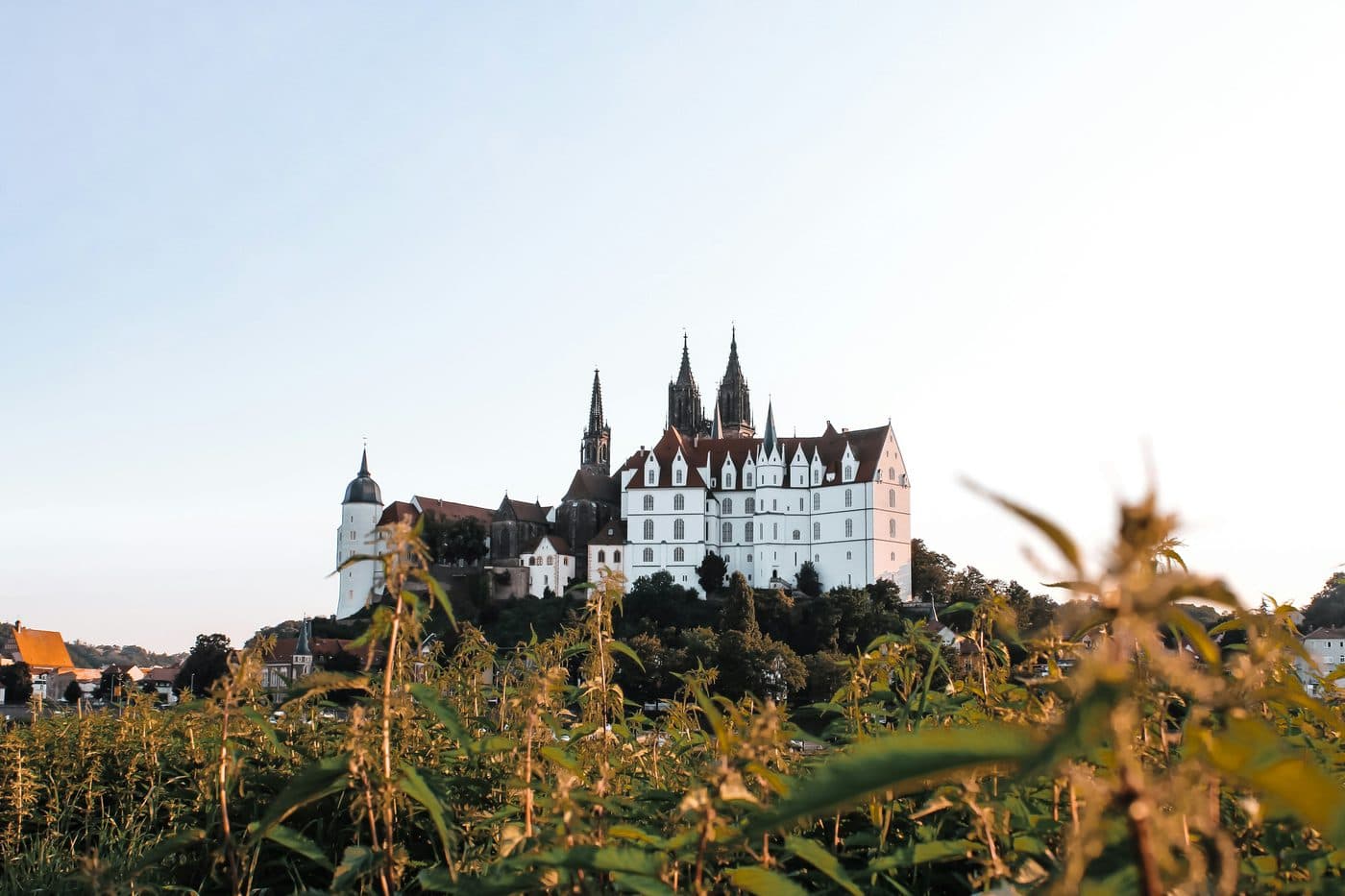
The Albrechtsburg stands over the Elbe beside Meissen’s cathedral, 26 km by road from Dresden. It is open Wednesday to Monday, a photo permit costs €2 a person on top of entry, and its halls are a good answer to rain. Saxony’s tourism board lists it, Schloss Moritzburg, Burg Stolpen and the baroque garden of Großsedlitz among the state’s places to marry; ask each one directly about dates. Moritzburg, 17 km from Dresden, is the one to see from across its water, with the yellow walls and red domes doubled in the lake.
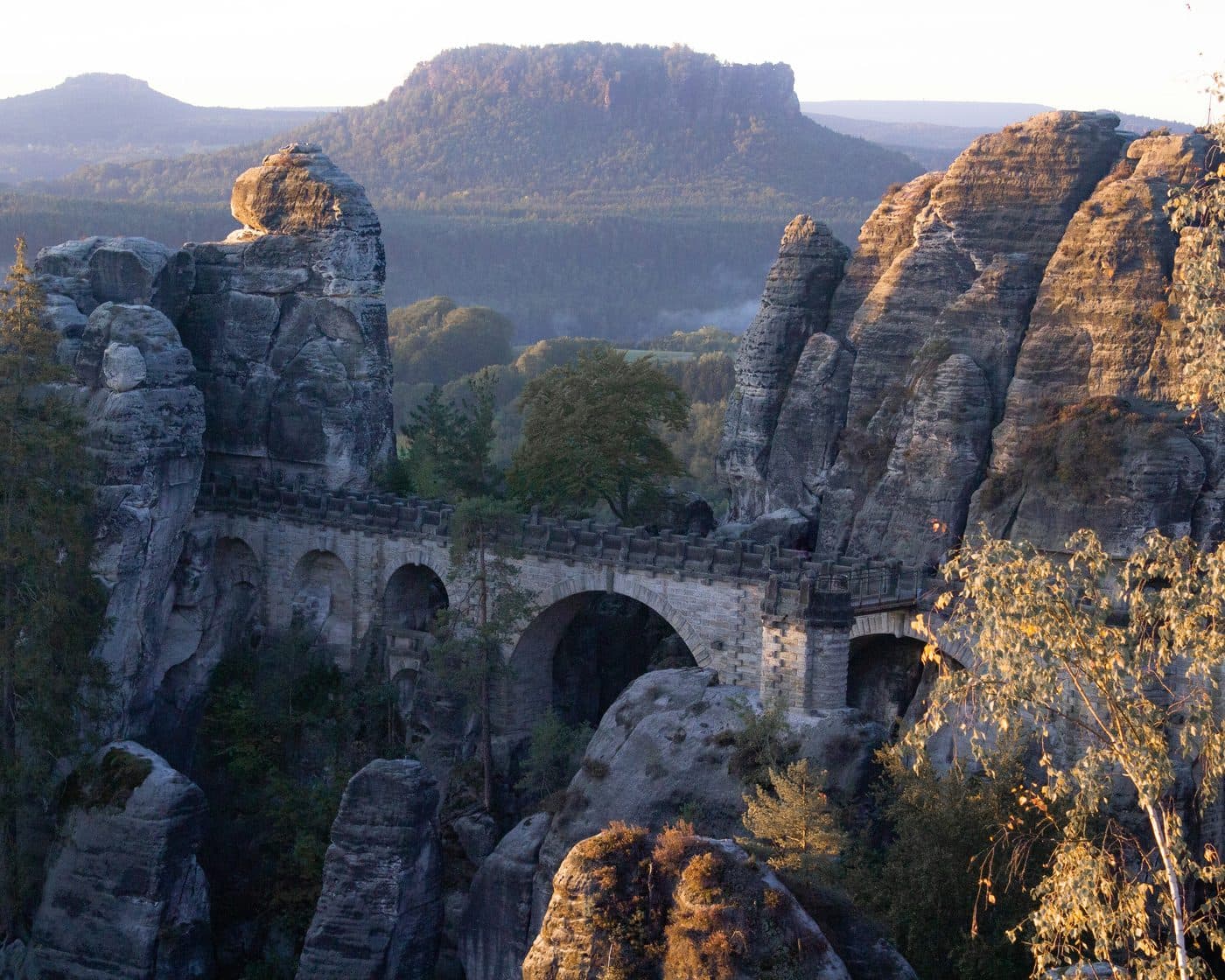
The Bastei’s 76.5 m stone bridge runs through the rock towers above the Elbe, free and open at all hours, with views to the Lilienstein and the Königstein. It lies in the national park, where you must keep to the paths, loud music is banned and organised events of any kind need the park administration’s approval, so a ceremony on the rocks isn’t an option without it; ask too before bringing lights or a crew. A storm on 31 July 2026 brought down trees between the Bastei, Rathen and Hohnstein, so check the park’s path service. Across the river, the Königstein fortress, 247 m above the Elbe, has civil weddings in its Friedrichsburg again since October 2026, booked through Königstein’s registry office, and church and free ceremonies too.
Leipzig’s registry office marries couples at the Stadthaus and in some of the city’s best rooms: the council chamber of the New Town Hall, the casemates of the old Pleissenburg, the summer hall of the Bach Museum, the early baroque Alte Börse of the 17th century on the Naschmarkt, and the Oeser hall of the Gohliser Schlösschen, a rococo house with its own garden. Dates can be booked online up to eight months ahead. For portraits, the old town’s squares are a short walk from most of them.
Light
On summer evenings the low sun, setting far round in the north-west, strikes the old town’s river front from across the water, and the stone turns gold: at midsummer it sets in Dresden at about twenty-five past nine, drops below ten degrees at about eight and leaves dusk until about ten past ten. It sets at about ten to nine in mid-May and at about twenty past seven in mid-September. At midwinter it rises at about five past eight and sets at four, behind the old town when seen from the Neustadt bank, never climbing above 16 degrees. In Saxon Switzerland the best light comes with the sunrise, at about ten to five at midsummer, when it catches the tops of the rock towers and mist can lie in the valleys below. The sun shines for about seven and a half hours a day in July and about two in December.
Travel
Dresden Airport’s station lies under the terminal, with S2 trains every half hour reaching the main station in 21 minutes. From Berlin’s airport Dresden is 172 km by road, and from Prague’s 155 km. Leipzig/Halle Airport is 14 minutes from Leipzig’s main station on the S5 and S5X, every half hour, and 124 km by road from Dresden. The S1 runs along the Elbe from Meissen through Dresden to Bad Schandau, and long-distance trains stop at Dresden and Bad Schandau. The Bastei is about 40 km by road from Dresden: there is parking near the rocks, and from 1 April to 31 October a shuttle from the larger car park 3.5 km away. Under the EU drone rules, the operator of a drone of 250 g or more, or of any drone with a camera, must be registered (in Germany, with the Federal Aviation Office, the LBA) and insured, may fly no higher than 120 m and, from 250 g, must hold the EU competency certificate; the restricted zones are on the government’s dipul map. Drones are banned throughout the national park, taking off and landing is banned in the protected landscape around it too, and flying over homes or in an airport’s control zone needs consent or clearance; check the government’s dipul map before any flight.
Plan
Germany