In short
- France’s classic elopement backdrops are Paris at dawn, the château gardens of the Loire and Versailles, the Étretat cliffs, the Mont-Saint-Michel, the Champagne hillsides, Lake Annecy and Lac Blanc under Mont Blanc, Provence’s lavender, gorges and calanques, the Estérel’s red rock and the Dune du Pilat.
- Only the civil wedding at a town hall counts in French law, and only in a town where one of you or a parent lives (a residence means at least a month’s continuous stay), so for most couples from abroad an elopement in France is a symbolic ceremony, with the legal paperwork done at home.
- At the monuments of the Centre des monuments nationaux — the Mont-Saint-Michel abbey, Azay-le-Rideau, the Palais-Royal in Paris — a wedding photo session costs €150 plus VAT (€180) for two hours, for the couple, one photographer and up to two companions (2024 price grid).
- In 2026 the Calanque de Sugiton needed a free booking every day from 27 June to 30 August and on six other days, and from June to September the prefectures of the south can close forest massifs for fire risk, on a map published the evening before.
- Drones are banned over Paris, the Mont-Saint-Michel, the heart of the Calanques and the Aiguilles Rouges reserve at Lac Blanc; Étretat bans them from 1 April to 31 July, and in any town the open category forbids flights over public space.
In this guide
This is a list of real places, not a mood board: what each looks like, how you get there, when the light is right, which rules we could confirm on an official page, and the region page to read next. A French civil wedding is held at the mairie of a town where one of you or a parent lives, and two foreigners who don’t live in France can marry only at their own consulate — see getting married in France. For most couples from abroad an elopement here is a symbolic ceremony, which is exactly what frees the place and the hour.
Two things decide more than the place itself. The hour: sunrise is the empty version of nearly every famous view — the best time to marry in France goes through the light month by month. The rules: a few portraits rarely need anything; chairs, guests or a drone usually do, and monuments, parks and some towns have permits of their own.
Rules that apply almost everywhere
- Drones. France applies the EU rules: in the open category a drone flies no higher than 120 m, in sight and never over gatherings of people, and the operator must register if it weighs over 250 g or carries a camera (over 800 g it also goes on AlphaTango, with an electronic ID device). In a town, open-category flights over public space are forbidden; over Paris, only licensed companies can ask the Préfecture de police for a derogation. Restricted zones are on the government’s drone map.
- Fire season in the south. Each prefecture decides, on a map published in the early evening, whether its forest massifs are open the next day: in 2026 from 1 June to 30 September in the Bouches-du-Rhône, mid-June to the end of September in the Var, 15 June to 15 September in the Vaucluse and 20 June to 20 September in the Alpes-de-Haute-Provence. Météo-France’s forest-fire forecast gives the danger level two days ahead.
- Monuments. The Centre des monuments nationaux (CMN) has one rate for a non-commercial wedding photo session at its monuments: €150 plus VAT for two hours, for the couple, one photographer and two companions. Chambord, Versailles and the Louvre’s Tuileries garden set their own rules.
- A church blessing. In France a religious wedding may not be celebrated before the civil one, so expect to show your civil marriage certificate from home.
Paris and the châteaux
1. Paris at dawn: the Trocadéro, the Pont Alexandre III and Montmartre
The Trocadéro esplanade facing the Eiffel Tower, the gilded Pont Alexandre III and the steps of Montmartre below the Sacré-Cœur — three of the most photographed views in Paris, and empty only at dawn.
- Permits: any shoot in Paris streets needs at least a declaration — up to ten people with light equipment, streets and bridges only, five working days ahead — and parks, gardens, riverbanks and monuments need an authorisation three weeks ahead. The City’s pages don’t mention weddings: ask Paris Film whether your session counts.
- Places with their own rules: the Trocadéro esplanade, the Tuileries and the Palais-Royal handle shoots themselves. In the Tuileries, professional photos need the Louvre’s written permission, on weekdays only; the Palais-Royal sells the CMN wedding session. The Sacré-Cœur holds no weddings, but its FAQ lets you film outside the railings without asking.
- Light: from the Trocadéro the tower stands to the south-east, so the midsummer sunset behind you lights it (our reading of the map). No drones anywhere in Paris.
- Region: Paris.
2. Château gardens: Chambord, Azay-le-Rideau and Versailles
The formal French garden — clipped box, gravel walks, a château mirrored in water — is what many couples picture. These three have written rules for wedding photos.
- Chambord: photos for an event — the visit rules give wedding photos as the example — need the director general’s prior permission; flash and lights are banned, and tripods need permission too (rules of 22 February 2023).
- Azay-le-Rideau: no shoot without the monument’s agreement; as a CMN monument it charges €150 plus VAT for a two-hour wedding session.
- Versailles: groups gathered for photos are forbidden in the Cour d’honneur and the Gardens, and tolerated for strictly private, non-commercial purposes in the Park and at Trianon (with a Trianon ticket); tripods, lights and professional photos need written permission (rules of 26 March 2026).
- Region: Loire Valley; Versailles is on the Paris page.
Normandy and Brittany
3. Étretat
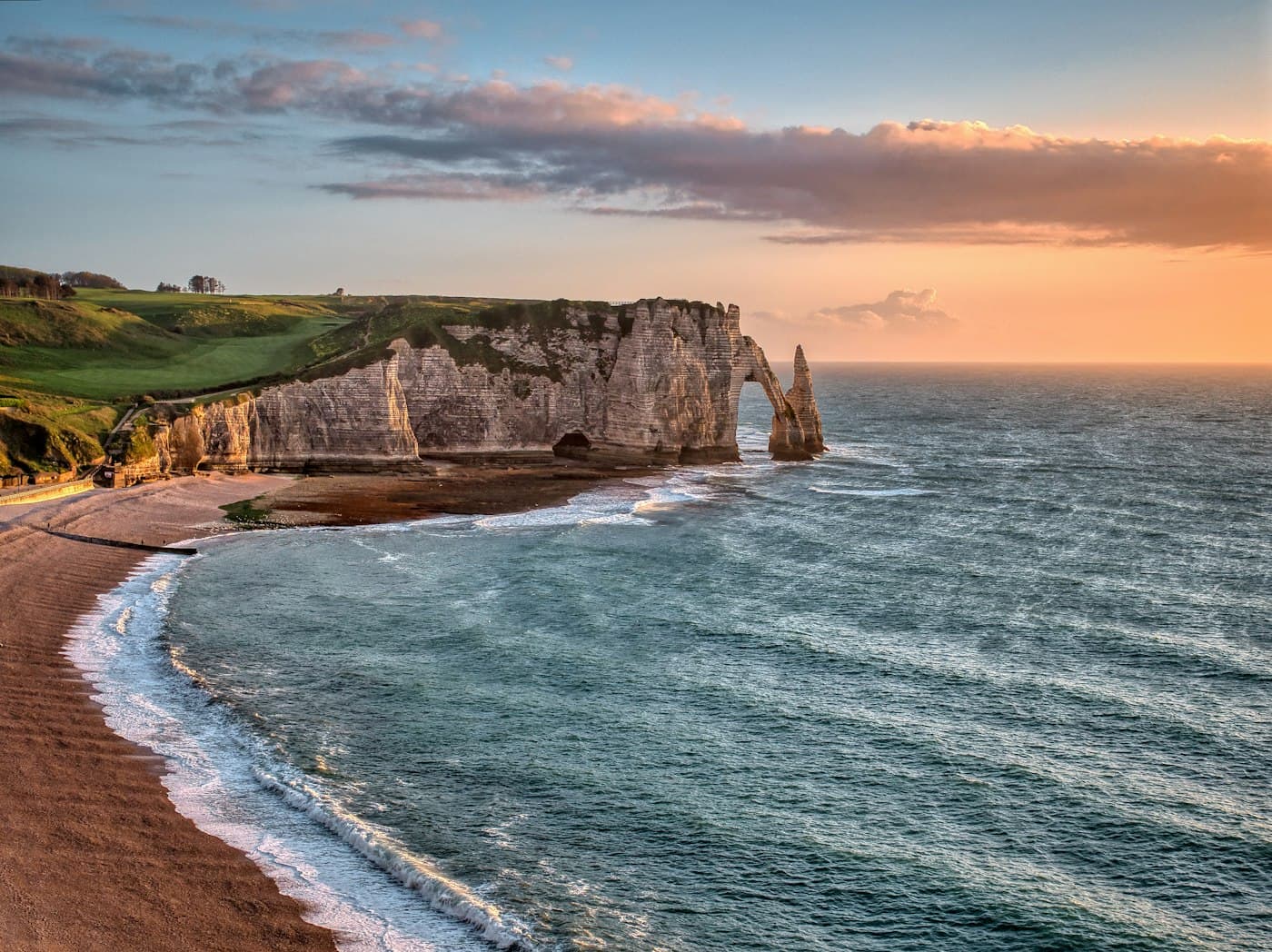
Chalk cliffs on the Normandy coast: the Falaise d’Aval with its arch and needle, the Manneporte beyond, and the Falaise d’Amont with its chapel across the bay — the Amont owned by the Conservatoire du littoral.
- Cliffs and beaches: a town order of 28 April 2025 forbids walking within 5 m of the edge on both cliff tops and closes the tunnels through the points — the Trou à l’Homme among them — and every beach beyond the promenade, so there is no low-tide walk to the Manneporte. In June 2026 ten people cut off by the tide at the Trou à l’Homme were lifted out by helicopter; tide times are on the SHOM’s site.
- Shoots and drones: the town’s filming sheet, written for production companies, allows no shoots at weekends, on public holidays or from 15 June to 15 September, with requests ten working days ahead — ask the mairie whether a couple’s session counts. Drones are banned from 1 April to 31 July, for nesting birds.
- Light: the beach faces north-west; from the Amont you look south-west to the arch, into the evening light.
- Region: Normandy & Brittany.
4. The Mont-Saint-Michel
A granite island crowned by an abbey where Normandy meets Brittany, reached by a 2.2 km bridge-walkway over the sands.
- Getting there: cars stop 2.5 km away — in 2026 parking cost from €10 for three hours in winter to €28 for a summer day — and the free Passeur shuttle stops 350 m from the ramparts.
- Tides: the Mont becomes an island again only on the highest tides, for about an hour — twice in 2026, on the evenings of 14 August and 12 September. The official site advises against going into the bay alone and recommends crossing it with a professional guide.
- The abbey: open 09:00–19:00 from May to August and 09:30–18:00 from September to April; as a CMN monument, it charges €150 plus VAT for a two-hour wedding session. Drones are banned over the Mont, whose west face takes the evening sun.
- Region: Normandy & Brittany.
5. Ploumanac’h and the Pink Granite Coast
Pink granite boulders worn into strange shapes on the north coast of Brittany, with the Sentier des douaniers, the old customs path, winding between them past the Mean Ruz lighthouse.
- Rules: the path, in the Conservatoire du littoral’s care since 1986, must not be left; nothing may be picked or taken, minerals included; no camping, fires or mountain bikes, and dogs on a lead.
- Drones: banned over the Sept-Îles nature reserve offshore, 19,700 hectares of sea since 2023.
- Light: the tourist office suggests sunrise from the Sémaphore car park towards Mean Ruz, with the sun at your back, and sunset from the Ploumanac’h harbour.
- Region: Normandy & Brittany.
Champagne
6. Hautvillers and the Champagne hillsides
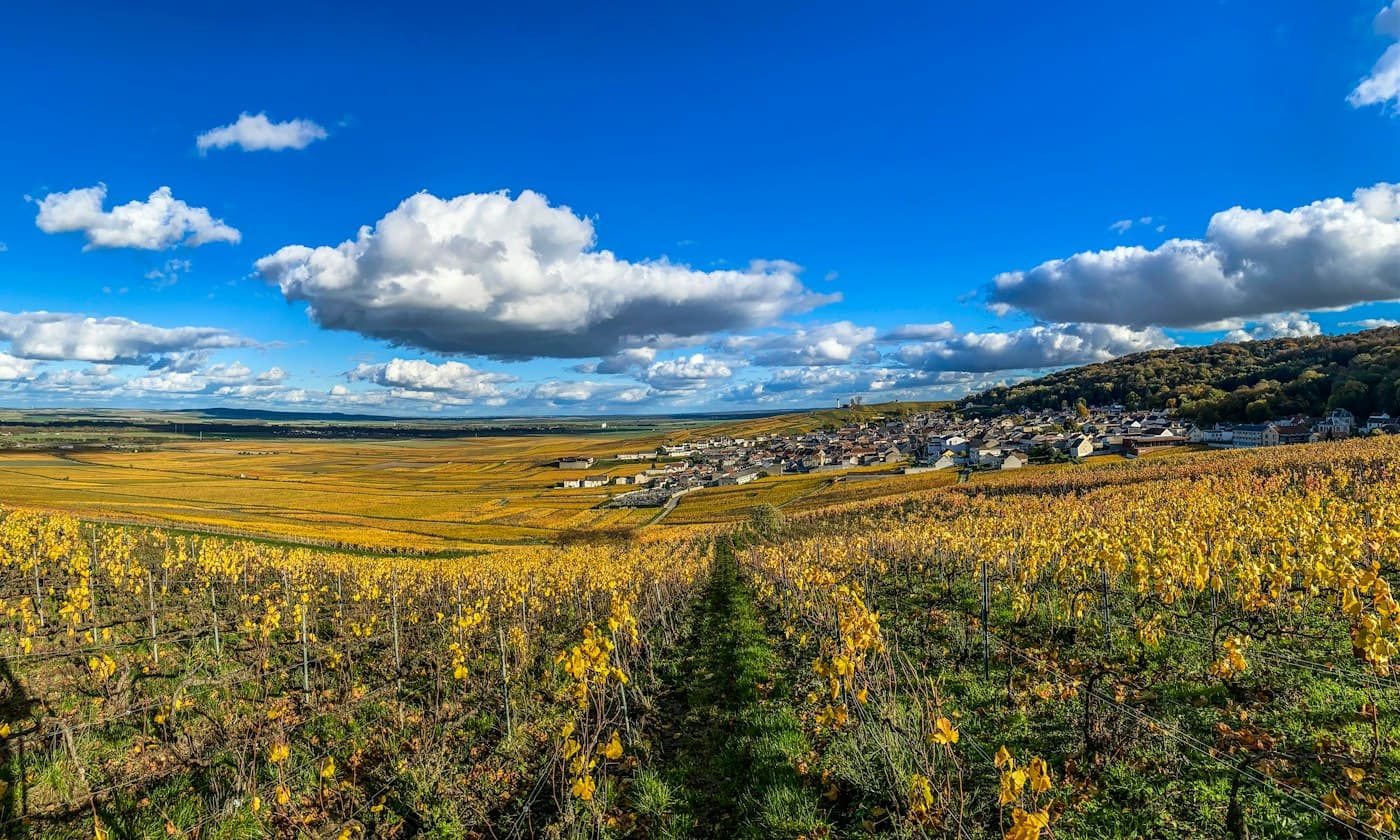
Dom Pérignon lies in the old abbey church of this village on the slopes above the Marne, looking over the vines to Épernay — part of the Champagne Hillsides, Houses and Cellars, a UNESCO World Heritage site since 2015.
- The vines: the Épernay tourist office asks walkers to keep to the paths around the plots, not between the rows; to stand among the vines, ask a grower or a Champagne house.
- Harvest: in 2026 picking opened between 8 and 22 August, village by village — 15 August in Hautvillers (Comité Champagne) — so a late-summer date may fall in the middle of it.
- Light: the slope faces south and gets sun all day.
- Region: Burgundy & Champagne.
The Alps
7. Lake Annecy
An Alpine lake ringed by mountains, with Annecy’s canals and old town at its northern tip and the lawns of the Pâquier, the Pont des Amours and the Jardins de l’Europe along the shore.
- Rules: a town order on the lake shore allows picnics but no furniture — no tables, no chairs — so a seated ceremony needs the town’s permission. We found no Annecy rules for photo sessions, and in town no open-category drone may fly over public space.
- Light: you look south down the lake; the eastern peaks are backlit at dawn and lit at sunset (our reading of the map).
- Region: The French Alps.
8. Lac Blanc — the Chamonix valley
A lake at 2,352 m in the Aiguilles Rouges, facing the Mont Blanc massif across the Chamonix valley, its peaks mirrored on a still morning.
- Getting there: about 1 hour 45 minutes up on foot, with 500 m of climbing, from the Flégère lift (open 20 June to 13 September in 2026).
- Rules: a national nature reserve: no dogs, no overflight (drones included), no camping (bivouac by booking), no fires, no flower picking, no swimming; gatherings and events need permission.
- Higher still: the Aiguille du Midi cable car climbs to 3,842 m (adult return €60.20 to €83 in 2026); no drones on its terraces.
- Light: facing south-east, the peaks are backlit at sunrise and lit at sunset; still water is likeliest early.
- Region: The French Alps.
Provence
9. Gordes and the Abbaye de Sénanque — Luberon
Gordes is a stone village stacked on a hill above the Luberon; a few kilometres north, the abbey of Sénanque sits behind the best-known lavender field in Provence.
- Sénanque: personal photos without a tripod are fine, but shoots with models or professional equipment are forbidden inside and outside the abbey, nobody may enter the lavender (the monks’ harvest), commercial use of its image is banned and drones may not fly over the valley. Admire it; shoot elsewhere.
- Gordes and the Luberon: the village lanes are public, but most of the Luberon is private land, and the Vaucluse regulates access to its massifs from 15 June to 15 September.
- Light: the village faces south over the valley.
- Region: Provence.
10. The Valensole plateau
A high plateau of lavender and wheat between the Durance and the Verdon — the rows to the horizon that most people picture as Provence.
- Bloom: usually from mid-June, peaking in early July; the harvest often starts around 14 July and runs into early August, and the dates shift ten to fifteen days from year to year (Pays de Manosque tourist office).
- The fields are private: each row is a farmer’s income. Stay at the edges or on the paths, pick nothing, bring no vehicle or drone over a farm without permission, and ask before stepping in. Never park on a bend, and move calmly among the bees.
- Light: the tourist office’s tip is the hour after sunrise.
- Region: Provence.
11. The Verdon gorges
A limestone canyon hundreds of metres deep, its river a startling green, opening into the Lac de Sainte-Croix — a protected site since 1990.
- The Route des Crêtes: the loop of clifftop viewpoints, open from late March to late November and driven clockwise; the tourist office suggests before 10:00 or after 18:00 for the light.
- Rules: no combustion-engine boats on the lake; no drones over the Canjuers military camp on the south side, and the park asks pilots to keep off cliffs and ridges from mid-December to the end of August. From 20 June to 20 September the Alpes-de-Haute-Provence can close its massifs.
- Region: Provence.
12. The Calanques — Marseille and Cassis
Limestone inlets of turquoise water between Marseille and Cassis — Sugiton, En-Vau, Port-Pin, Sormiou, Morgiou — in a national park created in 2012.
- Sugiton: in 2026 a free, compulsory booking on 20–21 June, every day from 27 June to 30 August and on 5–6 and 12–13 September, opening three days ahead at 09:00, for up to five people — cancelled if the massif closes for fire.
- Fire and roads: from 1 June to 30 September each massif shows green or red on the prefecture’s map at about 18:00 for the next day (also in the park’s Mes Calanques app); in summer 2026 the Sormiou, Morgiou and Callelongue roads were closed to cars 07:00–19:00.
- Shoots and drones: any professional or commercial shoot needs the park’s permission — at least two weeks ahead, up to four months to answer, and silence means no; fees run €80 to €300 a day by zone. Weddings aren’t named, so write first. Motorised overflight below 1,000 m, drones included, is banned.
- Region: Provence.
The Riviera
13. The Estérel: Cap Dramont and the red rocks
Red volcanic rock dropping into a blue sea between Saint-Raphaël and Cannes: a state forest run by the ONF and a protected landscape since 1996, with Cap Dramont and the little Île d’Or offshore.
- Fire season: from mid-June to the end of September the Var prefecture publishes each massif’s access for the next day before 19:00, from open to closed.
- Night and shoots: older ONF and tourist-office guides say the massif closes from 21:00 to 06:00 all year — we found no 2026 text — and we found no Estérel rule on shoots or drones: ask the ONF before a sunrise or a paid session.
- Light: the coast faces south-east — sunrise over the sea.
- Region: French Riviera.
Bordeaux and the South West
14. The Dune du Pilat
A wall of sand between the pine forest and the ocean at the mouth of the Arcachon bay — 101.7 m above sea level at its highest point in May 2025.
- Rules: leisure drones are banned and professional ones need permission; no fires, no camping, nothing taken, sand included. The car park closes from 02:00 to 05:00, and the staircase up the dune goes up each spring and comes down after All Saints.
- Ceremonies: any event needs the Conservatoire du littoral’s permission, asked three months ahead; commercial shoots are refused, and couples’ sessions aren’t mentioned — ask the site first.
- Light: the site’s summer advice is sunrise or sunset; the ocean side faces west.
- Region: Bordeaux & the South West.
15. Saint-Émilion
A medieval town of pale stone above its vineyards, at the heart of a jurisdiction UNESCO listed in 1999 as a cultural landscape — a world first for a vineyard.
- Rules: the vines belong to the châteaux, so ask one for photos among the rows. The monolithic church is visited only with a guide, with no photos underground; we found no town rules for shoots, so ask the mairie for anything beyond portraits.
- Light: the low evening sun warms the stone and the vines.
- Region: Bordeaux & the South West.
The fifteen at a glance
| Place | Region | Best light | Permit or booking (as of October 2026) |
|---|---|---|---|
| Trocadéro, Pont Alexandre III, Montmartre | Paris | Dawn | Street declaration; no drones |
| Chambord, Azay-le-Rideau, Versailles | Loire, Paris | Opening hours | Chambord: permission; Azay €150 + VAT |
| Étretat | Normandy | Sunset | 5 m from the edge; no drones 1 April–31 July |
| Mont-Saint-Michel | Normandy | Evening | Abbey session €150 + VAT; no drones |
| Ploumanac’h | Brittany | Sunrise, sunset | Stay on the path |
| Hautvillers | Champagne | All day | Keep out of the rows; harvest from mid-August |
| Lake Annecy | Alps | Dawn, sunset | No chairs on the shore without permission |
| Lac Blanc | Alps | Early morning | Nature reserve: no dogs, no drones |
| Gordes & Sénanque | Provence | Evening | No pro shoots and no entry to Sénanque’s lavender |
| Valensole | Provence | Hour after sunrise | Private fields: ask the farmer |
| Verdon gorges | Provence | Before 10:00, after 18:00 | Summer fire closures |
| The Calanques | Provence | Morning, evening | Sugiton booked in summer; park permission for pro shoots |
| The Estérel | Riviera | Sunrise | Var fire map, mid-June to September |
| Dune du Pilat | South West | Sunset | Events: 3 months ahead; no leisure drones |
| Saint-Émilion | South West | Evening | Private vines: ask a château |
Questions couples ask
Where is the best place to elope in France?
It depends on the landscape you want: Paris at dawn or a château garden for classic France; Étretat, the Mont-Saint-Michel or Ploumanac’h for the Channel coast; Lake Annecy or Lac Blanc for the Alps; Valensole, the Verdon or the Calanques for Provence; the Estérel for the Riviera; the Dune du Pilat or Saint-Émilion for the South West. Lavender flowers from mid-June to early July, and the south’s forests can close for fire in summer.
Can we legally get married in France?
Only if one of you, or a parent, lives in the town — a residence means at least a month’s continuous stay when the banns are published — and the wedding is held at the mairie. Two foreigners who don’t live in France can marry only at their own consulate. Most couples from abroad marry at home and hold a symbolic ceremony in France.
Do we need a permit for wedding photos in Paris?
Paris asks for at least a declaration for any shoot in its streets — up to ten people with light equipment, streets and bridges only, five working days ahead — and an authorisation three weeks ahead for parks, gardens, riverbanks and monuments. Weddings aren’t mentioned, so ask Paris Film. The Tuileries and the Palais-Royal have their own rules, and drones are banned over the city.
Can we fly a drone at our elopement in France?
Rarely where it matters. Open-category drones fly no higher than 120 m, in sight, never over gatherings of people or over public space in a town, and the operator must be registered. They are banned over Paris, the Mont-Saint-Michel and Sénanque, in the heart of the Calanques and the Aiguilles Rouges reserve, for leisure on the Dune du Pilat, and at Étretat from 1 April to 31 July.
Can we take photos in the lavender fields?
At Valensole, from the edges: every row is a farmer’s income, so stay on the paths, pick nothing and ask the farmer before stepping in. At the Abbaye de Sénanque, entering the lavender is forbidden, and shoots with models or professional equipment are not allowed. Flowering usually runs from mid-June to early July.
Do we need to book the Calanque de Sugiton?
In high summer, yes: in 2026 a free, compulsory booking on 20–21 June, every day from 27 June to 30 August and on four September days, opening three days ahead at 09:00 for up to five people, and cancelled if the massif closes for fire. A professional shoot also needs the national park’s permission.
Next: what a small day costs — what a wedding photographer costs in France — and our elopement packages in France. Or tell us your date and place and see which photographers are free.
Sources
- Service-public — Civil marriage (opens in a new tab) · service-public.gouv.fr
- Ecology ministry — Drones in the open category (opens in a new tab) · ecologie.gouv.fr
- Météo-France — Forest-fire forecast (opens in a new tab) · meteofrance.com
- Ville de Paris — Filming with a drone (opens in a new tab) · paris.fr
- Ville de Paris — Filming permits (opens in a new tab) · paris.fr
- Louvre — Shoots in the Tuileries (opens in a new tab) · louvre.fr
- Sacré-Cœur de Montmartre — FAQ (opens in a new tab) · sacre-coeur-montmartre.com
- CMN — Price grid for shoots, 2024 (opens in a new tab) · monuments-nationaux.fr
- Chambord — Visit rules, 2023 (opens in a new tab) · cdn1.chambord.org
- Azay-le-Rideau — Shoots (opens in a new tab) · azay-le-rideau.fr
- Château de Versailles — Estate rules, 2026 (opens in a new tab) · chateauversailles.fr
- Étretat — Town order 180/2025 (opens in a new tab) · etretat.fr
- Étretat — Filming permits (opens in a new tab) · etretat.fr
- Préfecture maritime de la Manche — Rescue at the Trou à l’Homme, June 2026 (opens in a new tab) · premar-manche.gouv.fr
- SHOM — Tides at Étretat (opens in a new tab) · maree.shom.fr
- Le Havre Étretat Tourisme — The Amont cliffs (opens in a new tab) · lehavre-etretat-tourisme.com
- Mont-Saint-Michel — Hours and prices (opens in a new tab) · montsaintmichel.gouv.fr
- Mont-Saint-Michel — Getting there (opens in a new tab) · montsaintmichel.gouv.fr
- Mont-Saint-Michel — Tide calendar 2026 (opens in a new tab) · montsaintmichel.gouv.fr
- Mont-Saint-Michel — High tides safely (opens in a new tab) · montsaintmichel.gouv.fr
- Mont-Saint-Michel — Safety rules (opens in a new tab) · montsaintmichel.gouv.fr
- Abbaye du Mont-Saint-Michel — Practical information (opens in a new tab) · abbaye-mont-saint-michel.fr
- Perros-Guirec — Path rules (opens in a new tab) · perros-guirec.com
- Perros-Guirec — Protected sites (opens in a new tab) · perros-guirec.com
- Perros-Guirec — Sept-Îles reserve rules (opens in a new tab) · perros-guirec.com
- Perros-Guirec — Sunrise and sunset walks (opens in a new tab) · perros-guirec.com
- Champagne UNESCO mission — The listed property (opens in a new tab) · champagne-patrimoinemondial.org
- Champagne UNESCO mission — Hautvillers (opens in a new tab) · champagne-patrimoinemondial.org
- Épernay tourist office — Walking in the vines (opens in a new tab) · epernay-tourisme.com
- Comité Champagne — Harvest dates 2026 (opens in a new tab) · maturation.comitechampagne.fr
- Annecy — Lake-shore order (opens in a new tab) · annecy.fr
- Chamonix — Aiguilles Rouges reserve (opens in a new tab) · chamonix.com
- Chamonix — Lac Blanc from La Flégère (opens in a new tab) · en.chamonix.com
- Compagnie du Mont-Blanc — Opening dates 2026 (opens in a new tab) · montblancnaturalresort.com
- Aiguille du Midi — Hours and rates (opens in a new tab) · aiguilledumidi.montblancnaturalresort.com
- Abbaye de Sénanque — Visits and photos (opens in a new tab) · senanque.fr
- Luberon regional park — Visiting natural areas (opens in a new tab) · parcduluberon.fr
- Pays de Manosque — Valensole lavender (opens in a new tab) · paysdemanosque.com
- Verdon Tourisme — Route des Crêtes (opens in a new tab) · verdontourisme.com
- Verdon regional park — The Grand Site project (opens in a new tab) · parcduverdon.fr
- Verdon regional park — Lac de Sainte-Croix (opens in a new tab) · parcduverdon.fr
- Verdon regional park — Drone guide (opens in a new tab) · parcduverdon.fr
- DDT 04 and ONF — Massif access, 2026 (opens in a new tab) · saint-laurent-du-verdon.dlva.fr
- Vaucluse — Massif access map (opens in a new tab) · risque-prevention-incendie.fr
- Calanques National Park — Sugiton 2026 (opens in a new tab) · calanques-parcnational.fr
- Calanques National Park — Booking Sugiton (opens in a new tab) · calanques-parcnational.fr
- Bouches-du-Rhône — Massif access map (opens in a new tab) · risque-prevention-incendie.fr
- Calanques National Park — Fire risk and access (opens in a new tab) · calanques-parcnational.fr
- Calanques National Park — Road closures 2026 (opens in a new tab) · calanques-parcnational.fr
- Calanques National Park — Shoots (opens in a new tab) · calanques-parcnational.fr
- Calanques National Park — Fee grid (opens in a new tab) · calanques-parcnational.fr
- Calanques National Park — Air rules (opens in a new tab) · calanques-parcnational.fr
- ONF — Estérel state forest (opens in a new tab) · onf.fr
- Saint-Raphaël — ONF panel on the Estérel (opens in a new tab) · ville-saintraphael.fr
- Estérel Côte d’Azur — Nature guide, 2018 (opens in a new tab) · esterel-cotedazur.com
- Préfecture du Var — Massif access (opens in a new tab) · var.gouv.fr
- Var — Massif access map (opens in a new tab) · risque-prevention-incendie.fr
- Dune du Pilat — Rules (opens in a new tab) · ladunedupilat.com
- Dune du Pilat — Prices and parking (opens in a new tab) · ladunedupilat.com
- Dune du Pilat — Authorisation requests (opens in a new tab) · ladunedupilat.com
- Dune du Pilat — Visiting tips (opens in a new tab) · ladunedupilat.com
- Dune du Pilat — Height in 2025 (opens in a new tab) · ladunedupilat.com
- Dune du Pilat — The staircase (opens in a new tab) · ladunedupilat.com
- Saint-Émilion tourism — UNESCO (opens in a new tab) · saint-emilion-tourisme.com
- Saint-Émilion tourism — Monolithic church (opens in a new tab) · saint-emilion-tourisme.com