In short
- Couples who don’t live in Ireland can marry there legally — before a registrar, in church or with a humanist celebrant — but every legal wedding needs at least three months’ notice to a registrar (Civil Registration Act 2004, s. 46).
- If you live abroad, the registrar may accept the notice by post (S.I. No. 667 of 2010), but you still meet the registrar together, in person, at least five days before the wedding; the fee is €200.
- Each of you brings a passport, a birth certificate and recent proof of address, translated if not in English or Irish; no official list asks for a certificate of no impediment from home — you sign a declaration before the registrar instead.
- If either of you is not an Irish or EU citizen, you show your immigration status and are interviewed; visa-required nationals apply for a short-stay marriage visa once the registrar has acknowledged the notice.
- The wedding must take place in a building open to the public or the grounds that go with it (s. 51), which is why most clifftop and beach ceremonies in Ireland are symbolic.
In this guide
- Which ways can you marry in Ireland?
- Step 1: three months’ notice — by post, if the registrar agrees
- What to bring to the registrar
- Translations, apostilles and the EU’s multilingual forms
- If one of you isn’t an EU citizen: immigration status, interview, visa
- Divorced abroad? The General Register Office decides first
- Interpreters
- Who can marry you — and a priest or celebrant from home
- Where a legal wedding can take place — and why clifftop vows are usually symbolic
- Less than three months? Only a court can shorten it
- Same-sex couples
- What it costs
- After the wedding: registered in Ireland, then at home
- A timeline, in relative terms
- Where your photographer fits in
- Questions couples ask
- Sources
Ireland asks for no residence: the registrar you notify “does not have to be the Registrar for the district where you live or where you intend getting married” (Citizens Information). It asks for time instead — three months between notice and wedding, and a visit in person before the day. In 2025, 2,056 of the 19,898 marriages registered in Ireland (10.3%) were of couples whose future home was outside the Republic: 748 in England and Wales, 445 in Northern Ireland, 226 in the United States, 147 elsewhere in the EU (CSO). This guide is for them; couples who live in Ireland have their own guide.
Which ways can you marry in Ireland?
| Route | Legal effect | Who marries you | Where | When |
|---|---|---|---|---|
| Civil | Yes | An HSE registrar, before two witnesses aged 18 or over | A registry office, or a venue the registrar approves, in the registrar’s county | Monday to Friday, in office hours — never at weekends or on public holidays |
| Religious | Yes | A minister on the Register of Solemnisers — a Catholic priest, a Church of Ireland rector and many others | Usually their place of worship; always a place open to the public | As the church agrees |
| Secular (humanist) | Yes | A celebrant of a registered secular body, such as the Humanist Association of Ireland | A place open to the public | Any day, at any time |
| Symbolic | None | Anyone you choose | Wherever you are allowed to be | Whenever you like; the legal marriage happens elsewhere |
The three legal routes are “equally valid and binding” (Citizens Information) and start the same way: the State’s notice, then the Marriage Registration Form (MRF), the “marriage licence”. No marriage may be solemnised until your solemniser has examined it (s. 48). Civil registration is run by the HSE, Ireland’s health service.
Step 1: three months’ notice — by post, if the registrar agrees
No marriage is valid unless you both notify a registrar, in person, at least three months before the date (s. 46). The exception for couples abroad: the registrar may accept the notice by post, fax or email if satisfied that you live outside the State and that coming in person “would not be reasonable or practicable”; if only one of you lives abroad, the other delivers it for both (S.I. No. 667 of 2010). It is the registrar’s permission — you contact a registrar “to get permission” (Citizens Information) — and the three months still apply (gov.ie).
- Book your solemniser and place first: the registrar asks for the type of ceremony, the venue’s name and address, the solemniser’s name and your two witnesses’ names and dates of birth (HSE).
- Contact the civil registration service where you will marry. Any registrar can take the notice, but registrars usually only marry couples in their own county (HSE). HSE Live answers calls from abroad on +353 1 240 8787.
- Ask for the postal notification form and return it by post or email (Citizens Information). The fee is €200, not refundable.
- Keep the acknowledgement: the registrar confirms in writing, to both of you and your solemniser, the date the notice arrived (s. 46(5)) — not yet permission to marry, but what a visa application asks for.
- Meet the registrar together, in person, at least five days before the wedding — fewer only if the registrar allows — in business hours, with the originals (s. 46(1)(b)). You both sign a declaration that you know of no impediment and, if all is in order, leave with the MRF, valid for six months from your date (HSE).
- Give the MRF to your solemniser before the ceremony (s. 48(3)).
What to bring to the registrar
| Document (original and a colour photocopy) | Notes |
|---|---|
| Passport, or an EU identity card accepted as a travel document, in date | Both of you (HSE; gov.ie) |
| Birth certificate, original or certified copy | From the EU, no apostille since 16 February 2019; from elsewhere, perhaps an apostille or legalisation (Citizens Information) |
| Proof of address dated within the last three months | A utility bill, says gov.ie |
| PPS number | Only with a current or future Irish address (gov.ie) |
| Final divorce decree; or a late spouse’s death certificate and your marriage certificate | If married before; a foreign divorce goes to the General Register Office |
| Immigration status: a visa or stamp, an Irish residence permit, or a UK passport | If either of you is not an Irish or EU citizen (HSE) |
| The Data Capture Form, in block capitals | Both of you (gov.ie) |
No certificate of no impediment. Unlike Greece, Ireland asks for no certificate from home that you are free to marry: none of the HSE’s, gov.ie’s or Citizens Information’s lists includes one. You each declare it before the registrar, who can still ask for evidence of your names, address, civil status, age and nationality (s. 46(7)). You must both be 18 or over (Citizens Information).
Translations, apostilles and the EU’s multilingual forms
Documents not in English or Irish need translations (HSE). EU public documents “should be accompanied by a Multilingual Standard Form (MSF)” (gov.ie), a translation aid you request from the authority at home that issued the document; under Regulation (EU) 2016/1191 they need no apostille, and with the form a translation can be required only exceptionally, though not every country issues every form (European e-Justice). From outside the EU, a birth certificate “may need an apostille or legalisation” (Citizens Information). No list of approved translators is published, so ask the office whose translations it accepts.
If one of you isn’t an EU citizen: immigration status, interview, visa
In the Act a “foreign national” is neither an Irish nor an EU citizen (s. 2) — since Brexit, British citizens too. If either of you is one, the notice comes with evidence of immigration status (s. 46(3A)), and you both attend an interview, in English or Irish (HSE; Citizens Information). It screens for marriages of convenience: a registrar who suspects one refers it to a Superintendent Registrar, who can refuse the MRF, and the refusal can be appealed to the Circuit Family Court (Citizens Information).
A visa. EEA, Swiss and UK citizens need none (Citizens Information). Visa-required nationals apply online for a short-stay ‘C’ marriage visa after the registrar’s acknowledgement and no more than three months before travelling: €60, a decision generally within eight weeks, no work, at most 90 days. It asks for the acknowledgement or the MRF, proof of a relationship with face-to-face meetings, and civil documents from outside the EEA apostilled or attested by the issuing country’s foreign ministry (Irish Immigration Service; Citizens Information). If you need one, give notice well over three months ahead.
Divorced abroad? The General Register Office decides first
“All foreign divorces will be examined by the General Register Office,” says gov.ie. EU and British divorces are recognised under their own rules; one from outside the EU only if either spouse was domiciled in that country when the case began (Domicile and Recognition of Foreign Divorces Act 1986). Otherwise you fill in a questionnaire for the General Register Office, “whose consent is required before the marriage ceremony can take place”; if it isn’t satisfied, you can add evidence or ask the Circuit Court to rule (Citizens Information). Raise it in your first email, with the final decree and its translation, months ahead.
Interpreters
The interview and the ceremony are in English or Irish. If either of you, a witness or the solemniser can’t follow the ceremony’s language, you must bring an interpreter — not one of you and not a witness — who signs a statement before the ceremony and a certificate after it (s. 51(6)), and who comes “from an independent verifiable translation or interpretation service” (HSE). A bilingual friend can’t interpret and witness at once.
Who can marry you — and a priest or celebrant from home
Only a registered solemniser can marry you (s. 51(1)): an HSE registrar, or a member of a religious or secular body nominated by that body in Ireland. “There is no other provision,” says gov.ie. Registrars marry in office hours (Citizens Information); humanist celebrants “at any time of day, or any day of the week”, for a guideline €450–€600 plus €90 to the Humanist Association of Ireland.
A priest or minister from home needs a body in Ireland behind them. On its written application, the Registrar General can give a named member aged 18 or over a temporary authorisation for one or more marriages or a set period (s. 57); for a Catholic priest, the nominator is the diocesan office of the diocese where you marry (gov.ie; Citizens Information). Ask the parish early — a Tralee parish says its office will help if your priest isn’t registered. A celebrant with no Irish body behind them can’t be authorised: let them lead a ceremony of your own after the legal one.
A Catholic wedding from abroad. Each of you completes the Pre-Nuptial Enquiry Form with your own parish priest, and couples living abroad “should allow plenty of time”, since the papers travel through your diocese to the Irish one (St John’s Parish, Tralee). Expect a long-form baptismal certificate issued within six months of the wedding, proof of freedom to marry — parish letters, a parent’s or sibling’s letter, or an affidavit — and the preparation the priest helping you accepts; Accord suggests booking its course six to nine months ahead. For the Church of Ireland and other churches, ask the rector or minister what they need from abroad.
Where a legal wedding can take place — and why clifftop vows are usually symbolic
Every legal wedding, civil, religious or humanist, must be “in a place that is open to the public” (s. 51(2)(c)): “a building that is open to the public”, or “a courtyard, garden, yard, field or piece of ground that is open to the public and lying near to and usually enjoyed with the building” (s. 51(2A)). A private house or garden is out unless a doctor certifies that one of you is too ill to go elsewhere. For a civil ceremony away from the registry office, the registrar must also approve the place — dignified, clearly identifiable, free to enter, insured, accessible, with “no recent or current connection with any religion” (HSE) — for an extra fee plus travel costs (s. 52(2)), amounts unpublished.
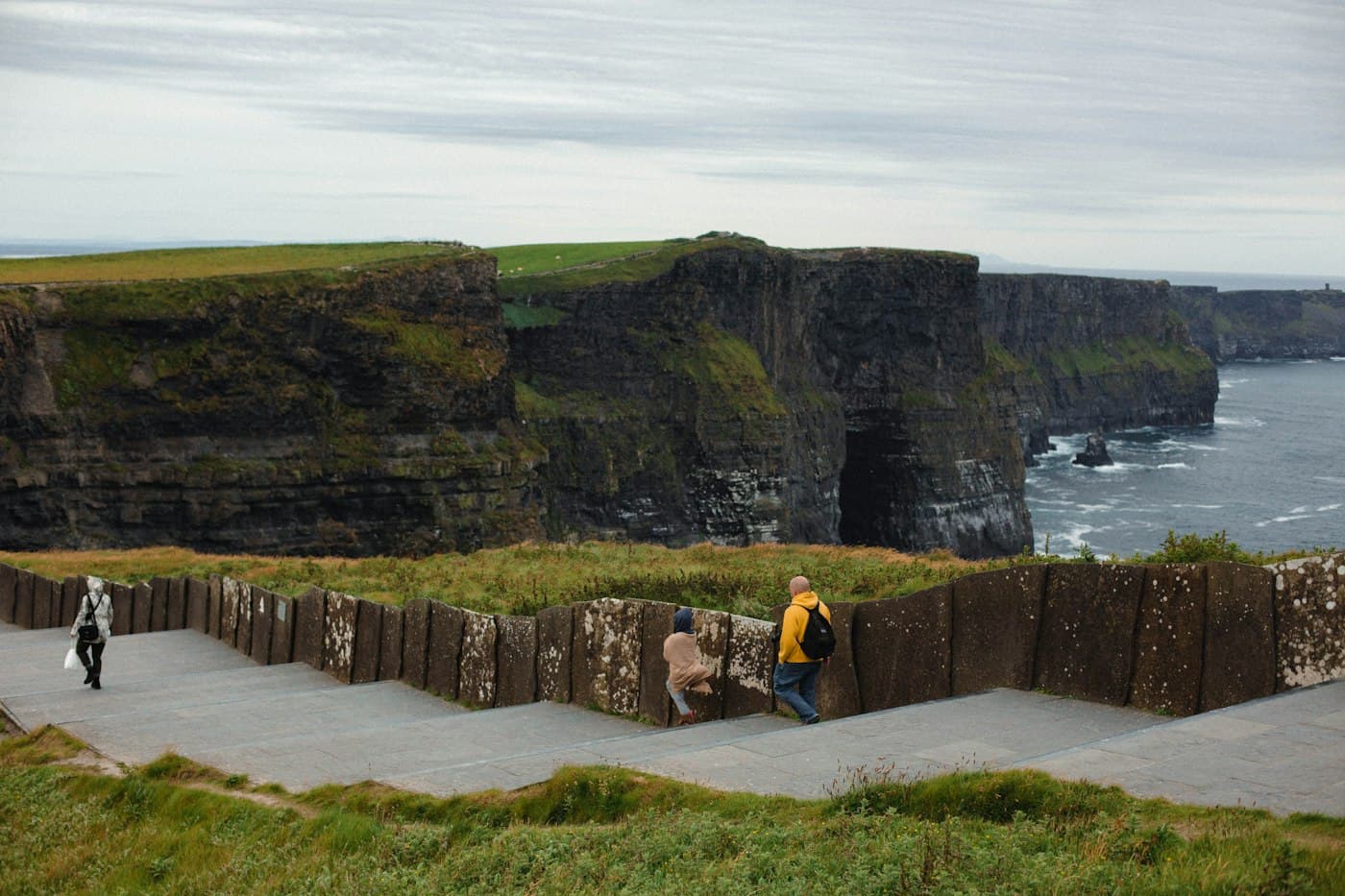
Why clifftop and beach weddings are usually symbolic. A beach, a cliff path or a headland on its own is neither a public building nor ground that goes with one. The Humanist Association reads the rule more widely — “a valid postal address” or “a distinctly identifiable landmark open to the general public”, but not “completely inaccessible, remote outdoor settings” — so your solemniser decides. The safe plan is the legal part indoors in the days before, or at home, and the vows on the Cliffs of Moher, the Kerry coast or a beach on the Wild Atlantic Way. There, the Cliffs of Moher ban drones from April to September; the OPW’s heritage sites want written permission two weeks ahead and ban drones; national parks such as Wicklow’s want a permit for commercial photography.
Less than three months? Only a court can shorten it
The Circuit Family Court or the High Court can waive the three months only for “serious reasons” and in your interests (s. 47); serious illness is the court office’s example. You apply together in the county where either of you lives or works, or where you will marry, and both attend the hearing; there is no court fee; the order may be ready that day or take up to two weeks; then you meet a registrar at least five days before the wedding (Courts Service, 2 April 2025).
Same-sex couples
Same-sex couples have been able to marry in Ireland since 16 November 2015 (Marriage Act 2015), by the same process; 624 did in 2025 (CSO). No certificate from home is asked for, and no official page we read restricts couples whose own country doesn’t allow same-sex marriage — but ask at home whether yours will be recognised. No religious body is obliged to recognise a form of ceremony for two people of the same sex (Marriage Act 2015, s. 7), so the usual route is civil or humanist.
What it costs
| Item | Cost (October 2026) | Source |
|---|---|---|
| Notification of intention to marry | €200, not refundable | S.I. No. 552 of 2020; HSE |
| Civil ceremony at the registry office | No extra fee listed | HSE |
| Civil ceremony at an approved venue | An extra fee plus the registrar’s travel and subsistence — no amount published | s. 52(2); HSE |
| Humanist celebrant | A guideline €450–€600, plus €90 to the HAI; some add 23% VAT | Humanist Association of Ireland |
| Short-stay marriage visa, if you need one | €60 | Citizens Information |
| Court exemption from the three months | No court fee | s. 47 |
| Registering a religious or secular marriage | Free | HSE |
| Marriage certificate | €20, plus postage | HSE; S.I. No. 552 of 2020 |
| Apostille on the certificate, outside the EU | €40 a stamp | Department of Foreign Affairs |
After the wedding: registered in Ireland, then at home
- In Ireland. After a civil ceremony, the registrar registers the marriage. After a religious or humanist one, either of you gives the MRF, signed straight after the ceremony, to any registrar within one month (s. 49); some offices take walk-ins, others appointments (HSE). Flying home soon after? Ask before the day how to hand it in on time.
- The certificate: €20, ordered online, by phone or at some offices, once the marriage is registered (HSE; Citizens Information).
- An apostille, for a country outside the EU: Ireland’s Department of Foreign Affairs, €40 a stamp, walk-in in Dublin or Cork or by post from abroad (3–7 working days) — not at embassies, and only on originals issued by the General Register Office, never a church’s certificate. Within the EU none is needed (Regulation (EU) 2016/1191).
- At home, each country has its own rule: the UK registers no marriage made abroad and recognises one that was lawful where it took place and would be allowed under UK law (GOV.UK); Portugal records its citizens’ marriages abroad by transcription. Ask your registry or consulate before the wedding.
A timeline, in relative terms
| When | Civil | Religious or humanist | Symbolic |
|---|---|---|---|
| As soon as you pick a county and date | Ask the civil registration service about postal notice, a registrar and the venue | Book the solemniser; for a priest from home, ask the Irish diocese | Decide where and when you marry legally |
| Six months or more before | Certificates, translations, apostilles; raise a foreign divorce | Catholic: the Pre-Nuptial Enquiry and the course | Ask the site about permits and drones |
| More than three months before | Send the notice and €200; keep the acknowledgement; a visa if needed | The same notice | — |
| At least five days before, in Ireland | See the registrar together with the originals; collect the MRF | The same; give the MRF to your solemniser | — |
| Within a month after | The registrar registers it; order certificates | Return the signed MRF to a registrar | Nothing to register in Ireland |
Where your photographer fits in
- Registry-office weddings fall on weekdays, in office hours; humanist and church ceremonies on any day the solemniser agrees.
- Witnesses: two, aged 18 or over (s. 51(2)). An eloping couple’s photographer and videographer can sign (Humanist Association of Ireland); an interpreter can’t.
- The signing of the MRF, straight after the declarations, belongs on camera (s. 49(1)).
- Summer Fridays go first: in 2025 Friday was the most popular day to marry and August the busiest month (CSO). On the cliffs, plan for wind, showers and no drone — and read how to choose a wedding photographer.
Questions couples ask
Can foreigners get legally married in Ireland?
Yes, and neither of you needs to live there: a civil, religious or humanist wedding by a registered solemniser is binding. You give a registrar at least three months’ notice — by post, if the registrar agrees — and meet the registrar together, in person, at least five days before.
Can we give notice of marriage in Ireland by post?
Yes, if the registrar is satisfied that you live outside Ireland and that coming in person wouldn’t be reasonable or practicable (S.I. No. 667 of 2010). The three months and the €200 fee still apply, and so does the visit at least five days before.
Do we need a certificate of no impediment to marry in Ireland?
No official checklist asks for one: you each sign a declaration before the registrar. You bring passports, birth certificates, recent proof of address and, if married before, the final divorce decree — translated if not in English or Irish.
Can we have a legal wedding on a beach or a clifftop in Ireland?
Rarely. The law requires a building open to the public or ground lying near to and usually enjoyed with one (Civil Registration Act 2004, s. 51(2A)), which a beach or headland on its own isn’t. The usual plan: the legal wedding indoors or at home, a symbolic one on the cliffs.
Can a priest from our home country marry us in Ireland?
Yes, if a religious body in Ireland applies: the Registrar General can grant one of its members a temporary authorisation for your marriage (Civil Registration Act 2004, s. 57) — for a Catholic priest, through the diocese where you marry. Without it, theirs is a ceremony with no legal effect.
Do we have to register an Irish marriage at home?
It depends on your country: the UK doesn’t register marriages made abroad, Portugal does. An Irish certificate costs €20, and outside the EU it may need an apostille from Ireland’s Department of Foreign Affairs (€40).
Next: the regions — Dublin & Wicklow, Galway & Connemara, Clare & the Cliffs of Moher, Kerry & the South West or all of Ireland — and the wedding day timeline. When you have a date, see the wedding photographers in Ireland or tell us about your day, and see who is free.
Sources
- Law Reform Commission, Revised Acts — Civil Registration Act 2004, ss. 2, 45–49, 51–54, 57–58 (updated to 31 December 2025; up to date as of 13 October 2026) (opens in a new tab) · revisedacts.lawreform.ie
- Law Reform Commission, Revised Acts — Civil Registration Act 2004, s. 46 (notice) (opens in a new tab) · revisedacts.lawreform.ie
- Law Reform Commission, Revised Acts — Civil Registration Act 2004, s. 51 (solemniser, place, interpreter) (opens in a new tab) · revisedacts.lawreform.ie
- Law Reform Commission, Revised Acts — Civil Registration Act 2004, s. 57 (temporary authorisation) (opens in a new tab) · revisedacts.lawreform.ie
- S.I. No. 667 of 2010 — Delivery of Notification of Intention to Marry (Prescribed Circumstances) Regulations (opens in a new tab) · irishstatutebook.ie
- S.I. No. 552 of 2020 — Civil Registration (Fees) Regulations, First Schedule (opens in a new tab) · irishstatutebook.ie
- Marriage Act 2015 (No. 35 of 2015), s. 7 (opens in a new tab) · irishstatutebook.ie
- HSE — How to get married in Ireland (opens in a new tab) · www2.hse.ie
- HSE — Marriage notification appointment checklist (opens in a new tab) · www2.hse.ie
- HSE — Book a marriage notification appointment or civil ceremony (opens in a new tab) · www2.hse.ie
- HSE — Choosing a venue for a civil marriage ceremony (opens in a new tab) · www2.hse.ie
- HSE — Register a marriage (opens in a new tab) · www2.hse.ie
- HSE — Order an Irish marriage certificate (opens in a new tab) · www2.hse.ie
- gov.ie (Department of Social Protection) — Get married in Ireland (last updated 29 June 2026) (opens in a new tab) · gov.ie
- gov.ie — Register of Solemnisers (last updated 5 October 2026) (opens in a new tab) · gov.ie
- Citizens Information — Notification requirements for marriage (edited 24 September 2024) (opens in a new tab) · citizensinformation.ie
- Citizens Information — Legal requirements for marriage (edited 25 April 2025) (opens in a new tab) · citizensinformation.ie
- Citizens Information — Religious and secular marriage ceremonies (edited 10 July 2024) (opens in a new tab) · citizensinformation.ie
- Citizens Information — Civil marriage ceremonies (edited 1 August 2024) (opens in a new tab) · citizensinformation.ie
- Citizens Information — Different types of marriage ceremony in Ireland (edited 17 September 2024) (opens in a new tab) · citizensinformation.ie
- Citizens Information — Bringing a non-EEA partner to Ireland to get married (edited 6 July 2026) (opens in a new tab) · citizensinformation.ie
- Irish Immigration Service — Marriage visa (opens in a new tab) · irishimmigration.ie
- Courts Service — Marriage notification exemptions (published 2 April 2025) (opens in a new tab) · courts.ie
- Department of Foreign Affairs — Authentication and Apostille of Irish public documents for use abroad (opens in a new tab) · ireland.ie
- European e-Justice — Public documents (Regulation (EU) 2016/1191) (opens in a new tab) · e-justice.europa.eu
- GOV.UK — Getting your marriage or civil partnership certificate (marriage abroad) (opens in a new tab) · gov.uk
- CSO — Marriages 2025: main results (5 May 2026) (opens in a new tab) · cso.ie
- Humanist Association of Ireland — Weddings (opens in a new tab) · humanism.ie
- Humanist Association of Ireland — Elopement ceremonies (opens in a new tab) · humanism.ie
- St John’s Parish, Tralee (Diocese of Kerry) — Marriage requirements (opens in a new tab) · stjohns.ie
- Accord — Marriage preparation FAQs (opens in a new tab) · accord.ie
- Cliffs of Moher Experience — Filming at the cliffs (opens in a new tab) · cliffsofmoher.ie
- OPW Heritage Ireland — Filming and photography (opens in a new tab) · heritageireland.ie
- Wicklow Mountains National Park — Photography and drones (opens in a new tab) · wicklowmountainsnationalpark.ie