Getting married in Oslo
Norway’s capital at the head of the Oslofjord: the Opera House’s white marble roof sloping into the water at Bjørvika, Akershus Fortress on its rock above the harbour, the Royal Palace and its park, Frogner Park with the Vigeland installation’s granite and bronze figures, the stave church from Gol on the Bygdøy peninsula, Holmenkollen and the forest lakes of Nordmarka such as Sognsvann at the end of the metro, the islands in the fjord — Hovedøya, eight minutes by boat, and Gressholmen beyond it — and, 39 km to the south, Drøbak on the fjord.
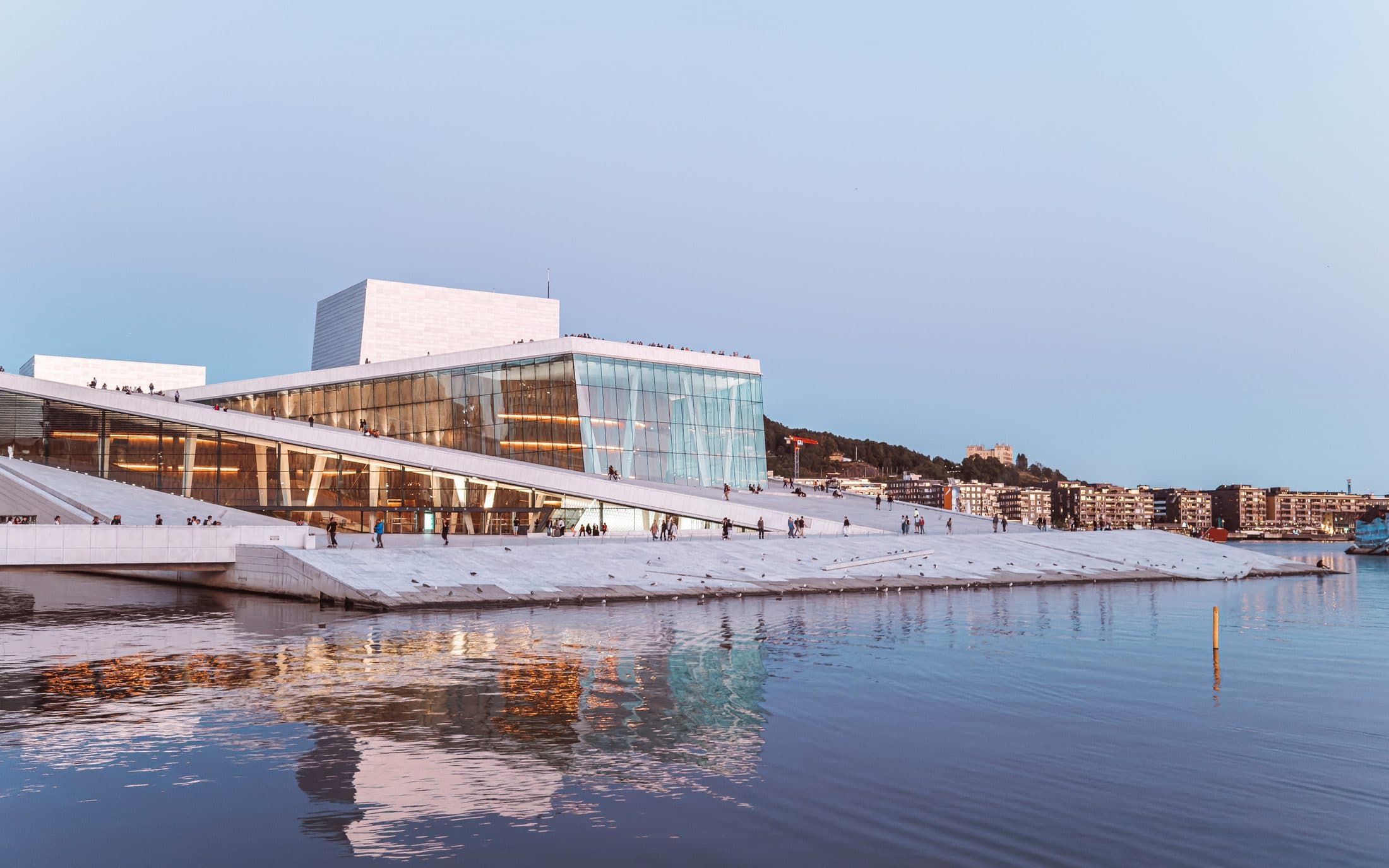
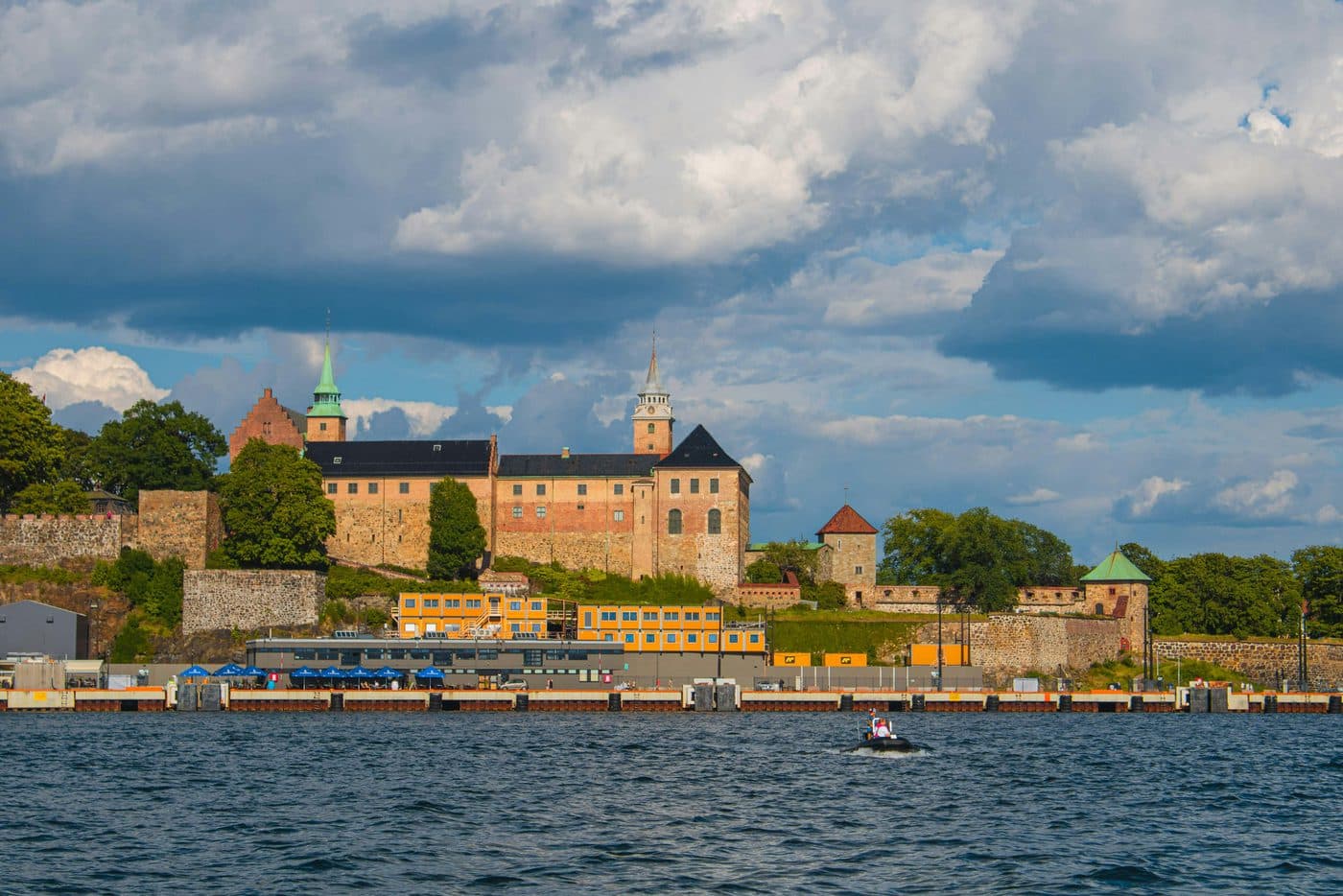
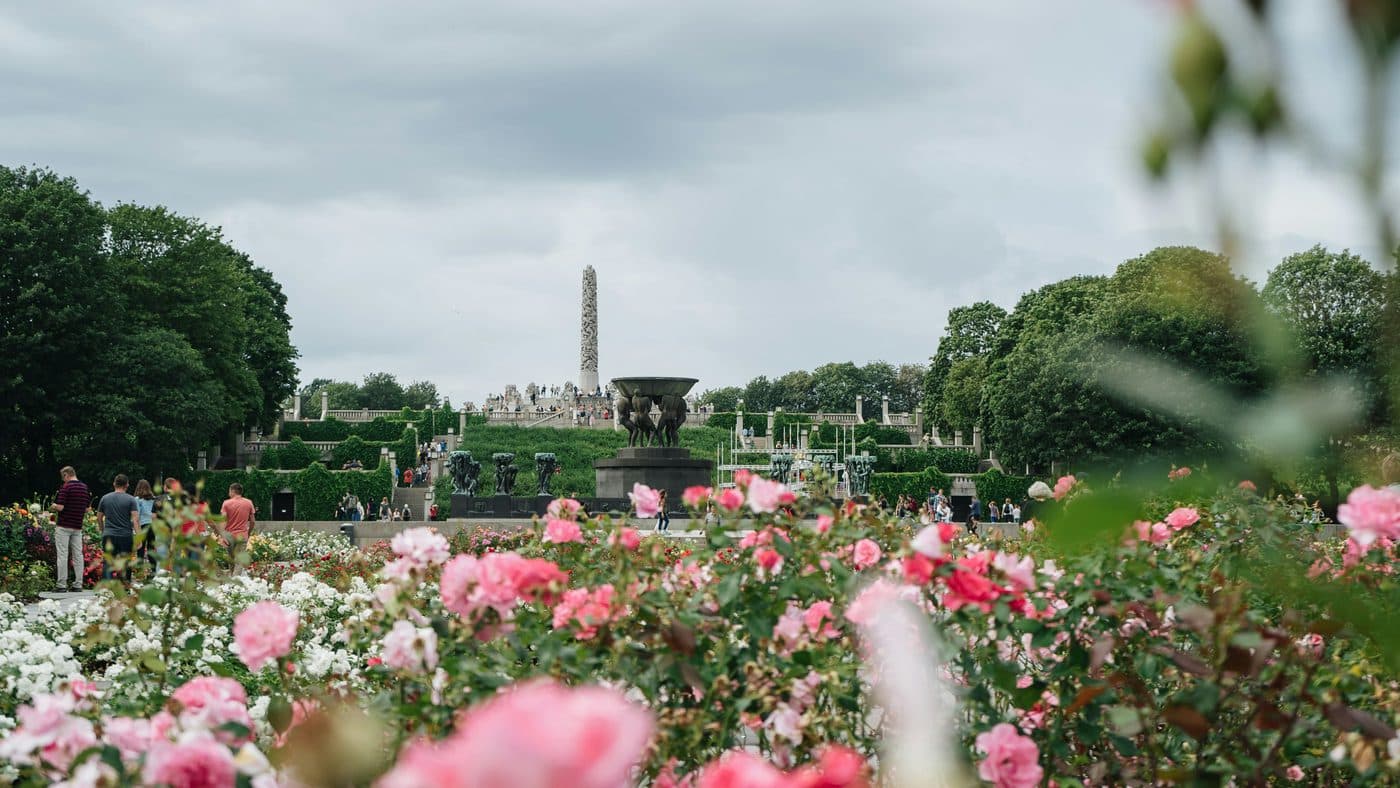
The Opera House was drawn so that its roof would be a platform open to everyone, a new public space in the middle of the city that slopes straight into the Oslofjord, and it is built mainly of white Carrara marble, oak and aluminium. Across the harbour, Akershus Fortress has stood for over 700 years: its castle was begun around 1290, rebuilt as a Renaissance palace, and its walls and lawns are now a free, green recreation area in the centre. The Royal Palace’s park, one of the capital’s first large parks, is open to everyone all year, and its oldest part, the Queen’s Park, grew from a garden laid out in 1751. In Frogner Park, the Vigeland installation holds more than 200 sculptures in granite, bronze and wrought iron, raised mostly between 1940 and 1949, and it never closes. On Bygdøy, the open-air Norwegian Folk Museum keeps the stave church from Gol, built around 1200 and re-erected here in 1884; one of its runic inscriptions can be read as “Kiss me, because I struggle”. North of the city, the forest begins at the end of the metro: Sognsvann, a former drinking-water lake, has a 3.3 km path round it that is lit all night and cleared of snow in winter, and Holmenkollen’s chapel stands near the ski jump. In the fjord, Hovedøya, eight minutes by boat from Aker Brygge, is a nature reserve with two beaches on its western side, the ruins of a 12th-century Cistercian monastery and 19th-century gun batteries looking back at the city.
Couples marry here at the City Hall, where the municipality holds its civil weddings, and on chosen Saturdays in 2027 at the Opera, at Villa Heftye by Frognerseteren and at the Botanical Garden’s Climate House; in the city’s churches, Holmenkollen chapel among them; and, for a wedding of their own, with portraits on the Opera roof, in the palace park, on the fjord islands and by the forest lakes in the long summer evenings. In Norway a marriage is legal when the municipality marries you in a civil ceremony (a mayor, a deputy mayor or someone the council has authorised) or when a priest of the Church of Norway or an officiant of another registered faith or life-stance community marries you, with two witnesses present; couples from abroad can marry here legally once the Tax Administration (Skatteetaten) has tested the conditions and issued a certificate (prøvingsattest), which takes up to five weeks (longer when papers from abroad are checked) and is valid four months, each foreign partner sending a certificate of no impediment from home, apostilled or legalised, no older than four months and in English, in a Nordic language or with a state-authorised translation, and showing a lawful stay in Norway (a visa or visa-free entry counts); each municipality sets its own days, rooms and any fee, so ask the one where you will marry, and since 2009 two people of the same sex can marry, in the Church of Norway too. Oslo City Hall marries couples on Wednesdays, Fridays and Saturdays, in Norwegian or English, bookable up to a year ahead, with the certificate uploaded at least four weeks before; it is free on Wednesdays and Fridays for couples who live in Oslo or abroad and NOK 3,478 on Saturdays (as of November 2026), and two witnesses aged 18 or over come with you.
Through the year
When to marry in Oslo
June to August are the surest months. In MET Norway’s 1991–2020 normals for Oslo-Blindern, the station 94 m up about 4 km north of the Opera, highs reach about 20 °C in June, 23 °C in July and 21 °C in August, with nights of 11 to 13 °C. Rain of 1 mm or more falls on 10 or 11 days a month in summer, and August is the wettest month of the year, with 103 mm, so keep a roof close to any open-air plan. May and September work well, at highs of 17 and 16 °C, nights of 7 and 9 °C and rain on only nine days each.
- January: Quieter
- February: Quieter
- March: Quieter
- April: Quieter
- May: Good with planning
- June: Best
- July: Best
- August: Best
- September: Good with planning
- October: Quieter
- November: Quieter
- December: Quieter
- April and MayApril warms to 11 °C by day, with nights of about 2 °C and rain on about eight days; May reaches 17 °C, with nights of 7 °C and rain on nine. The clocks go forward on the last Sunday of March (28 March 2027), and by mid-May the sun sets at about ten to ten. The fenced Queen’s Park in the palace grounds opens to visitors every day from 18 May, from 07:00 to 20:00.
- June to AugustThe warmest months: highs of 20 to 23 °C, nights of 11 to 13 °C and rain on 10 or 11 days a month, August’s the heaviest. At midsummer the sun rises before four and sets at about a quarter to eleven, and the sky is never fully dark: the sun dips more than six degrees below the horizon only from about half past midnight to ten past two. The City Hall holds no civil weddings in weeks 28 to 30, the second half of July, and the Opera’s civil-wedding Saturday in 2027 is 12 June.
- September and OctoberSeptember stays mild, at 16 °C by day and 9 °C at night, with rain on about nine days; October drops to 10 °C, with nights of 4 °C and rain on eleven days. In mid-September the sun sets at about twenty to eight, in mid-October at about ten past six. The Queen’s Park is open until 1 October, and the clocks go back on the last Sunday of October (31 October 2027).
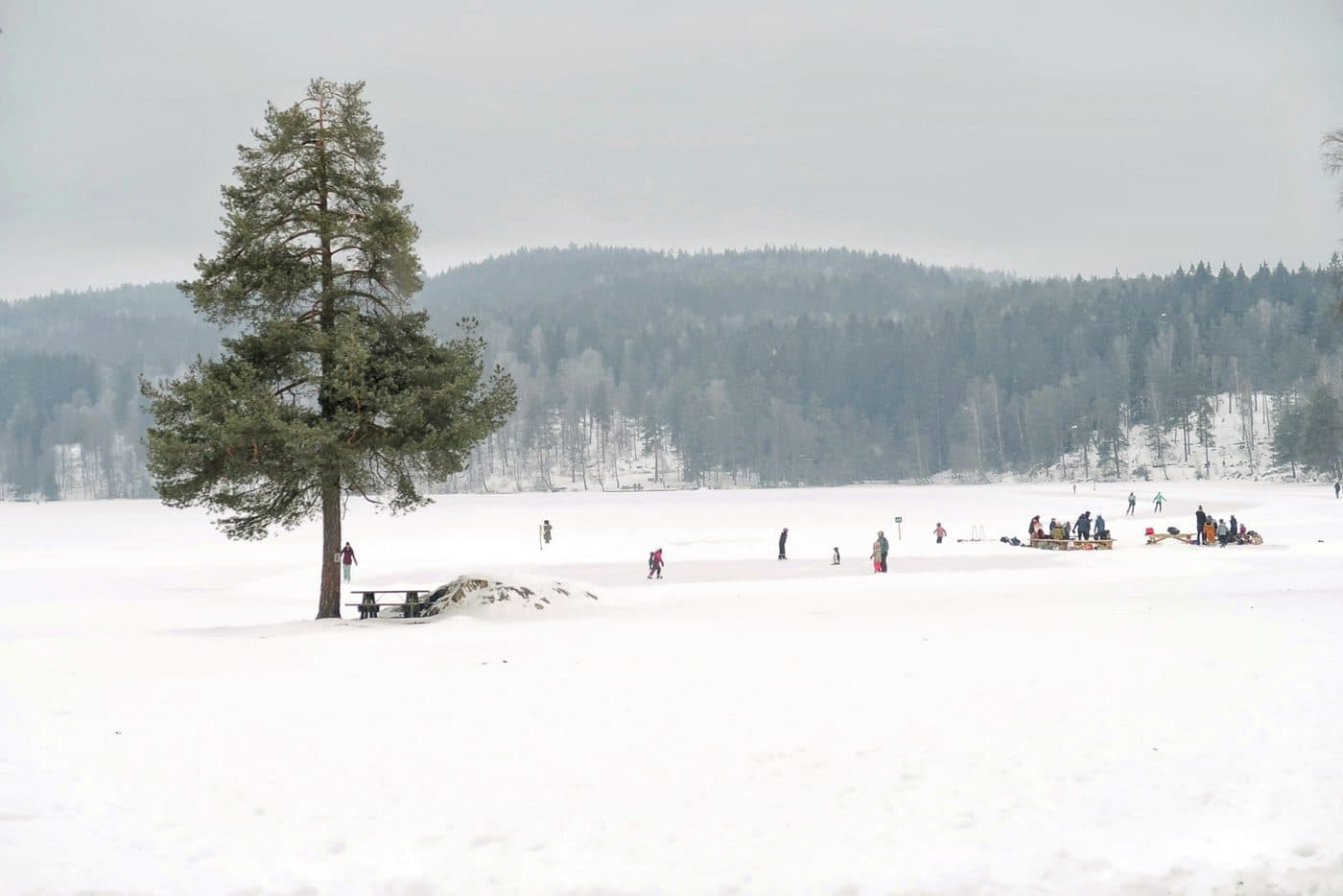
- November to MarchWinter is cold and short of light: highs of about 0 to 1 °C from December to February and nights of about −4 to −5 °C. At midwinter the sun is up only from about twenty past nine to ten past three, never more than about seven degrees high. The path round Sognsvann is cleared and gritted, and when the ice is thick enough the city prepares a skating track and a walking route on the lake itself.
In numbers
Weather station: Oslo-Blindern, normals 1991–2020 · Checked 6 November 2026
Places
Where couples marry here
The kinds of places — ask your photographer which ones they know well.
The Opera House and the City Hall
The Opera allows photos and filming for private use outside the building, on the roof and in the foyer during its opening hours, while photography for commercial use needs an agreement with its commercial department in advance (event@operaen.no) — ask whether your hired photographer counts. In 2027 the city also holds civil weddings at the Opera on two Saturdays, 12 June and 18 September, at Villa Heftye by Frognerseteren on 15, 22 and 29 May, at the Climate House in the Botanical Garden on 8 May and at the National Museum on 11 September, each bookable up to a year ahead. At the City Hall, ceremonies normally take place in the Munch Room, last 10 to 15 minutes and take no more than 30 people, the couple, children and photographers included; photography may be restricted in some rooms because of meetings and events, and balloons, alcohol, rice, rose petals, confetti and soap bubbles are not allowed inside or outside the building. There are no ceremonies on public holidays or in weeks 6, 28, 29 and 30, nor from 8 to 22 September 2027, when the City Hall is taken up by the municipal elections.
Akershus Fortress and the Royal Palace park
Akershus Fortress is free to enter; its main gate is open from 06:00 to 21:00 all year, and the side gates from 07:00 (08:00 at weekends) to 21:00 from May to September and from 07:00 to 18:00 from October to April. Forsvarsbygg, which manages it, asks that any photography be agreed in advance and approved by the fortress’s Commandant’s office (akershus.kommandantskap@mil.no), so write well before a wedding shoot; drones are banned, and so are barbecues and open fires all year. The fortress is the Armed Forces’ main seat and also holds memorials: the execution site, where 42 members of the resistance were shot during the occupation, and the Norwegian Resistance Museum are places of remembrance, not backdrops. In the Royal Palace park, which is open around the clock all year, the Royal Court says ordinary photography is no problem, while filming or rigging for a larger shoot needs a special permit and no income-generating activity may take place in the park, so keep a portrait session small and unobtrusive; the Queen’s Park, fenced and the park’s oldest part, opens daily from 07:00 to 20:00 between 18 May and 1 October.
Frogner Park, Bygdøy and Holmenkollen
The Vigeland installation in Frogner Park is free and open day and night; the park is run by the city’s Agency for Urban Environment (Bymiljøetaten), which asks anyone who wants to film, hold an event or set anything up there to apply first, and no drone may fly over it. Tram 12 and bus 20 stop at the park. At the Norwegian Folk Museum on Bygdøy, photos for private use are free, while pictures to be published or used commercially need the museum’s permission well ahead and carry a fee, from NOK 2,500 per outdoor location plus 25 % VAT (as of November 2026). Near it, the Royal Court has trialled set hours for couples to be photographed in the park around Oscarshall, the small royal palace there, during its visiting season, and is reviewing the scheme: commercial photography and drones are not allowed there, so check its page before you plan a shoot. Also on Bygdøy, Villa Grande, now home to the Holocaust Center, is a place of remembrance and not a backdrop. Up at Holmenkollen, the chapel belongs to Ris parish of the Church of Norway: couples who don’t live in the parish bring their own priest and pay NOK 6,000 to use it (as of November 2026), and book through the church’s online page.
The fjord islands and the forest lakes
Ruter’s island boats leave from Aker Brygge, and the crossing to Hovedøya takes eight minutes. The whole island is a nature reserve with rich geology and flora, much of it also protected as a heritage site: all plants are protected, so no flowers may be picked or branches broken, no tents may be pitched and no fires lit, and barbecues go only on the shared grills and slabs set out for them; anyone wanting to use part of a public outdoor area for an event applies to the Agency for Urban Environment (byleie.no). Sognsvann is at the end of metro line 5, and its lakeshore has sandy bottoms, smooth rocks, grassy slopes and three bathing jetties; the 3.3 km path round the lake is lit after dark all night, at half strength after 23:00. In the forest beyond, the right to roam lets you walk freely, but a gathering that could cause real harm or nuisance needs the landowner’s consent. Drøbak lies 39 km south of the Opera by road, on the eastern shore of the fjord.
Light
How the light falls
The times here are for a flat horizon; in Oslo the hills and the city around the fjord often hide the last minutes. On 21 June the sun rises at about six minutes to four and sets at about a quarter to eleven, far to the north-west; it is still ten degrees up at about a quarter to nine, and the sky stays light until about half past midnight, brightening again from about ten past two. In mid-May it sets at about ten to ten, in mid-July at about twenty-five past ten, in mid-August at about ten past nine, in mid-September at about twenty to eight and in mid-October at about ten past six. At midwinter it is up only from about twenty past nine to ten past three and climbs no higher than about seven degrees, with usable twilight from about twenty past eight to ten past four.
Travel
Getting there
Oslo Airport, Gardermoen, is 52 km by road from the Opera, 58 km from Holmenkollen and 84 km from Drøbak. The Airport Express Train (Flytoget) leaves every 10 minutes and reaches the city centre in 19 minutes. From the Opera, Frogner Park is 6 km by road, the Folk Museum on Bygdøy 7 km, Sognsvann 8 km, Holmenkollen 13 km and Drøbak 39 km. Vy’s trains on the Bergen Line link Oslo S with Bergen in about six and a half hours, the fastest in 6 h 35 min (Entur’s journey planner, February 2027). Drones fly under the EU’s rules — an operator registered where they live (in Norway with the Civil Aviation Authority, Luftfartstilsynet, at flydrone.no; someone living outside the EU registers in the first EU country or Norway they fly in), in sight, below 120 m and never over crowds — and in Norway a pilot from abroad must also notify the National Security Authority (NSM) before filming from the air, check the zones on dronesoner.no (near airports, central Oslo’s restricted area R102, the areas where filming from the air is banned) and have the landowner’s permission to take off and land; drones are as a rule banned in national parks and the large protected landscapes, and in many nature reserves, so ask the area’s managers first. In Oslo, drones are also banned at Akershus Fortress, over the Vigeland installation and in the park at Oscarshall.
Photographers
Photographers in Oslo
No one in Oslo yet
The first photographers in Oslo are joining now. Tell our concierge your date and your plans — it checks who is free and fits.
Plan
Read before you plan
- Getting married in Norway as foreigners: Skatteetaten’s certificate, documents, lawful stay and feesHow couples from abroad marry legally in Norway: no residence needed, the test of the conditions by the Tax Administration (Skatteetaten) and its certificate valid four months, the certificate of no impediment from home with an apostille, translations, a sponsor for each of you, a lawful stay on the day, the municipality’s civil wedding and its fees, church and humanist weddings, same-sex marriage since 2009, the certificate afterwards, and the symbolic route.
- How to choose a wedding photographer: the steps, and the questions to askThe decision in order — whole weddings, style, availability, the package, the contract and deposit, cancellation, delivery and a conversation — then a checklist of questions, with why each one matters.
- A wedding-day timeline for photosFrom getting ready to the last dance, planned around the light.
- Deposits and payment protectionWhat you pay when, and what happens if plans change.
- Which country for a destination wedding? The law, prices, crowds and light, comparedThe legal route for couples who don’t live there, season and crowds, price levels, light, flights, venues and permits for photographs — Portugal, Italy, Spain, Greece, France and Austria compared with official figures, as of October 2026.
- A rain plan that still looks goodCovered spots, umbrellas and what photographers do on grey days.
- Wedding photography contract checklist: what it should say, and how Lens & Vows handles each pointThirteen things a good contract covers — the day and the hours, what is delivered, deposit and balance, cancellation on either side, date changes, illness, image rights, personal data, backups, travel, overtime and complaints — and what our terms say about each.
Norway