Founding photographerVerified — Identity verified by Lens & Vows
Ian P.from €5,506
Vienna, The Wachau Valley +4 · Documentary, EditorialWedding photographers in Austria
A walled medieval town between the Hahnenkamm and the Kitzbüheler Horn, where the registry marries couples in the old Rathaus, a museum, a farmhouse parlour or a castle hall.
Kitzbühel was granted its town charter by Duke Ludwig II in 1271 and walled; from about 1540 its silver and copper mines at the Röhrerbichl boomed, with shafts up to 900 m deep, and early in the 16th century it passed from Bavaria to Tyrol. Its two main streets, the Vorderstadt and the Hinterstadt, are a pedestrian zone today, repaved in granite between 2013 and 2021, between pastel houses with deep eaves. Since the winter of 1931 the Streif, on the Hahnenkamm above the town, has staged one of skiing’s most famous downhill races; across the valley rises the Kitzbüheler Horn, and to the north the jagged Wilder Kaiser.
The registry offers four places to marry: its wedding room in the historic Rathaus, the town museum, a farmhouse museum on the way up the Horn and the vaulted hall of Schloss Kaps. The parish church of St. Andreas stands on its rise at the edge of the old town, and in summer the lifts take you and your photographer from the streets to the meadows at about 1,660 m in eight minutes. Plan for rain all the same: June to August are Kitzbühel’s wettest months.
Photographers
They shoot everywhere in Tyrol & Innsbruck — in Kitzbühel too. Their whole weddings are on their pages.
See the photographerCeremonies
On the first floor of the historic Rathaus in the Hinterstadt, in the middle of the old town, reached by lift: 30 seats and a sound system for your own music, and no charge beyond the usual registry fees. The Standesamt is a joint office serving Kitzbühel and its neighbours; its staff answer on weekdays from 8:00 to 12:00 and ask couples to plan the wedding with them directly.
A granary from the first half of the 16th century, a museum since 1934, with paintings by Alfons Walde. Weddings take place in the hall on the third floor, under the old roof timbers, step-free, for up to 50 seated and 20 standing. A rental fee applies, and only the registry books the dates.
A weathered Salzburg-Tyrolean farmhouse, kept as a museum on the road up to the Kitzbüheler Horn, with its bread oven, beehive hut and barn. The ceremony is held in the original Bauernstube, so small that 25 guests fill it — and you can arrive by horse-drawn carriage. A rental fee applies.
A castle on the edge of town, owned by the Lamberg family since 1679. The registry marries couples in its vaulted hall — about 60 seats plus standing room, a 60-minute slot — and photos in front of the castle afterwards are part of the booking. The rental fee is the highest of the four; the registry books the date.
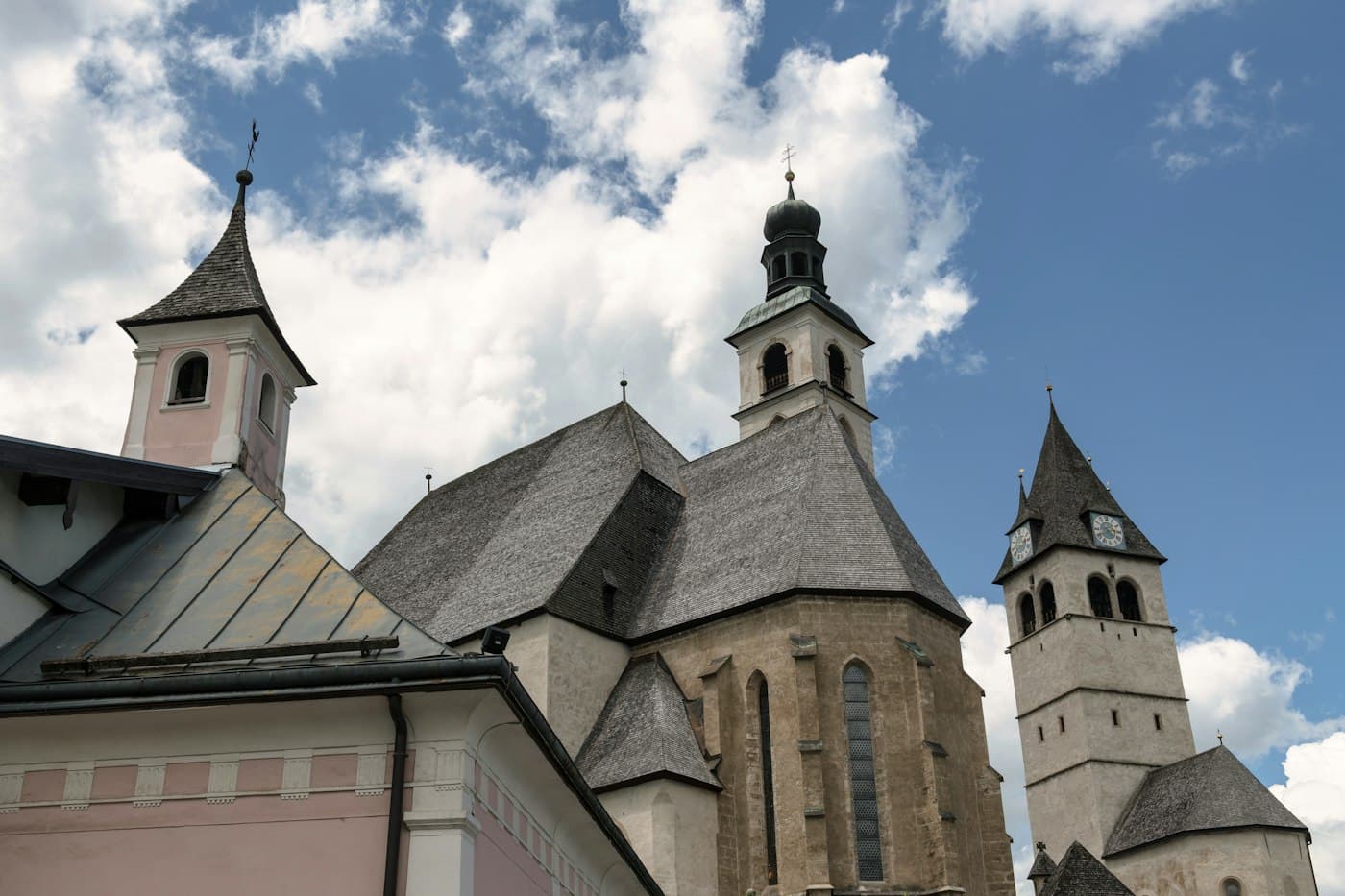
The late-Gothic parish church of St. Andreas, built from 1435 to 1506 and given a Baroque interior in 1785–86, and beside it the two-storey Liebfrauenkirche, with its 48 m tower, both in the middle of a hillside cemetery. Kitzbühel belongs to the Archdiocese of Salzburg: contact the parish at least six months ahead, at least one of you must be Catholic, a marriage-preparation seminar is required, and your home parish issues the permission to marry here. The Protestant Christuskirche, by Clemens Holzmeister, dates from 1962.
Portraits
The pastel façades and granite paving of the old town, with the church towers above. The pedestrian zone applies round the clock, but delivery vans may enter from 6:00 to 10:00 — so the emptiest streets are at first light, or in the evening once the shops close.
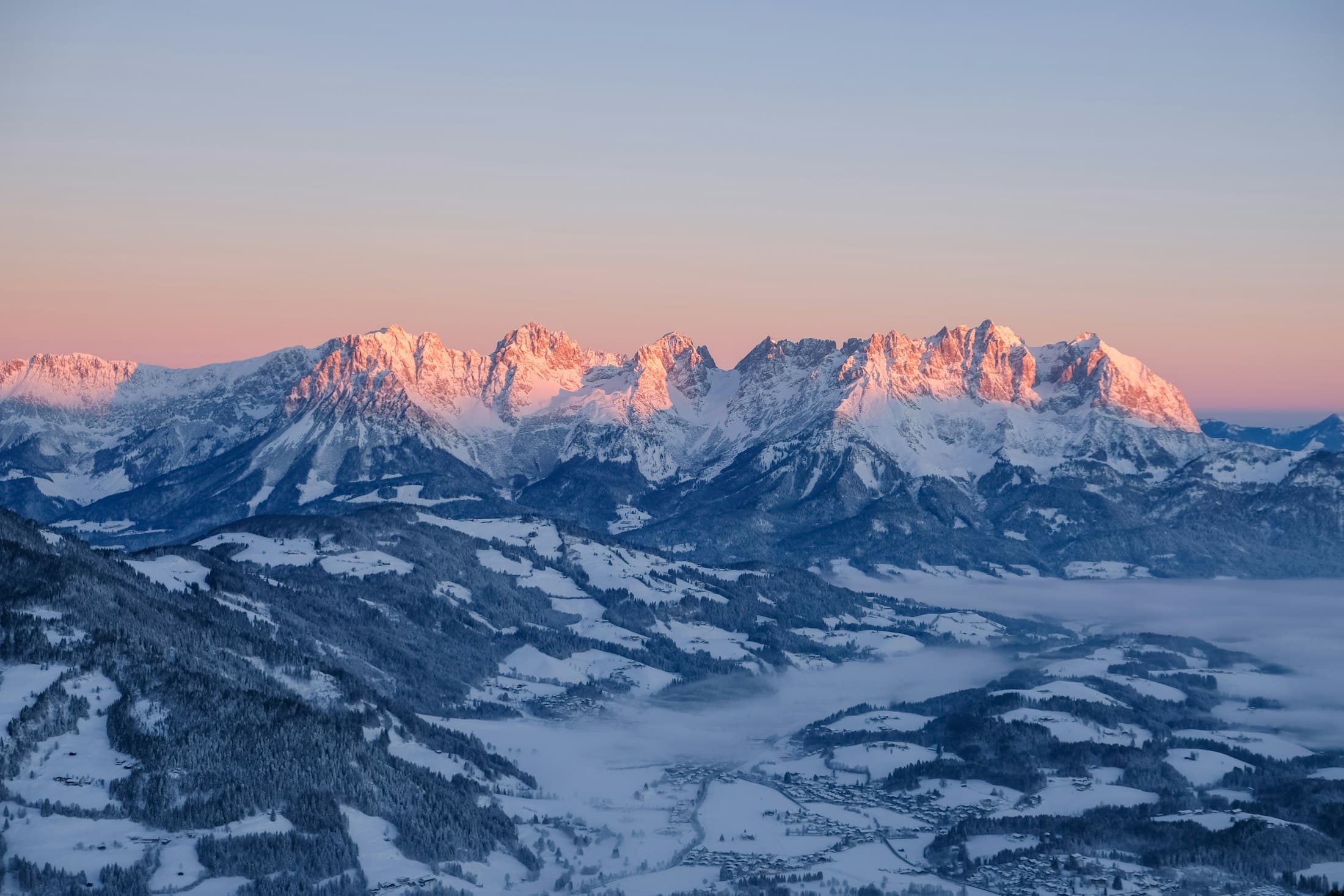
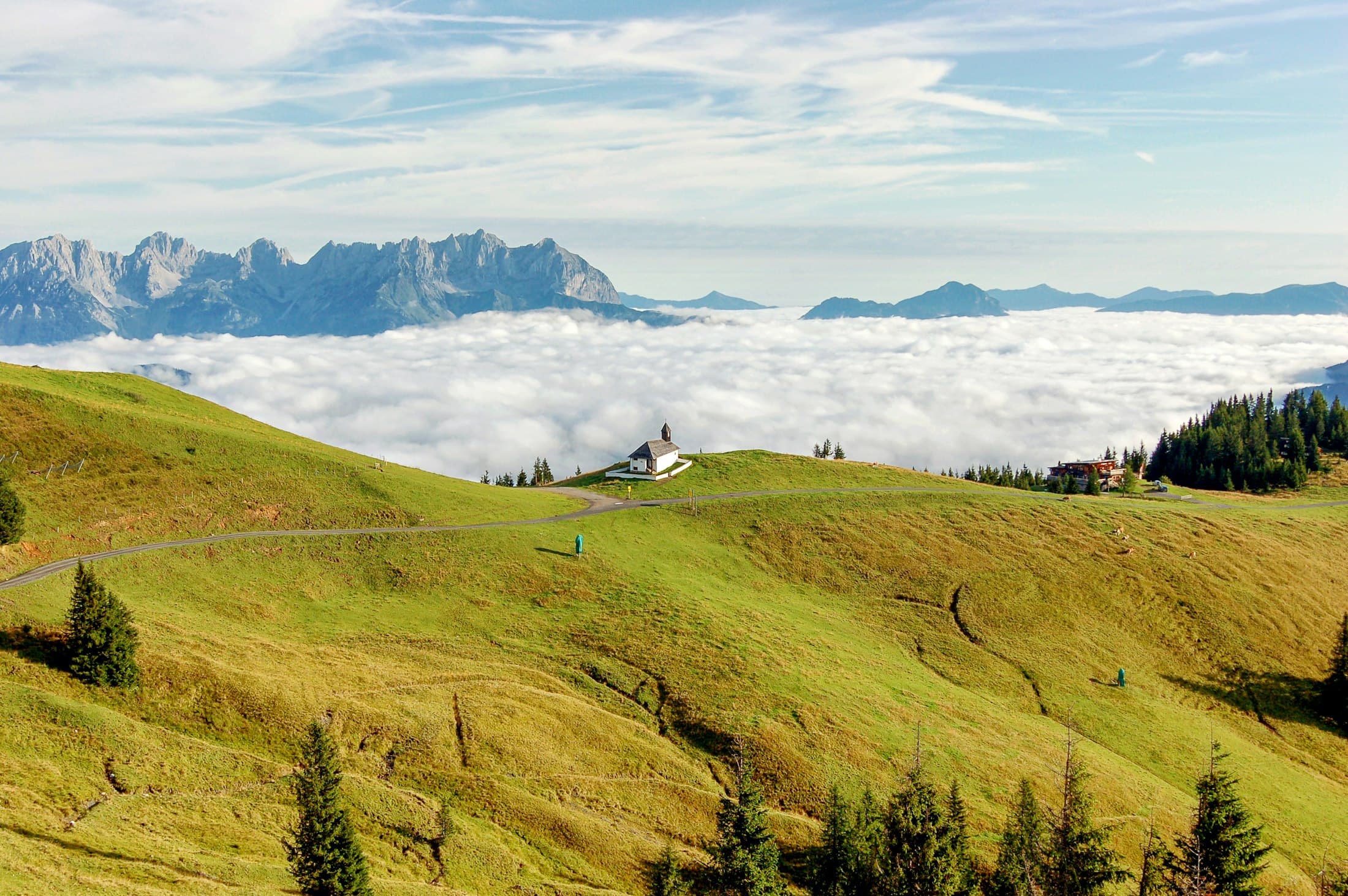
The Hahnenkammbahn climbs about 800 m in eight minutes, its cabins named after the race’s winners. Above the top station, at 1,732 m, stands the St. Bernhard chapel, built by Clemens Holzmeister in 1961, with meadows rolling away towards the Wilder Kaiser; on some autumn mornings the valley lies under a sea of fog.
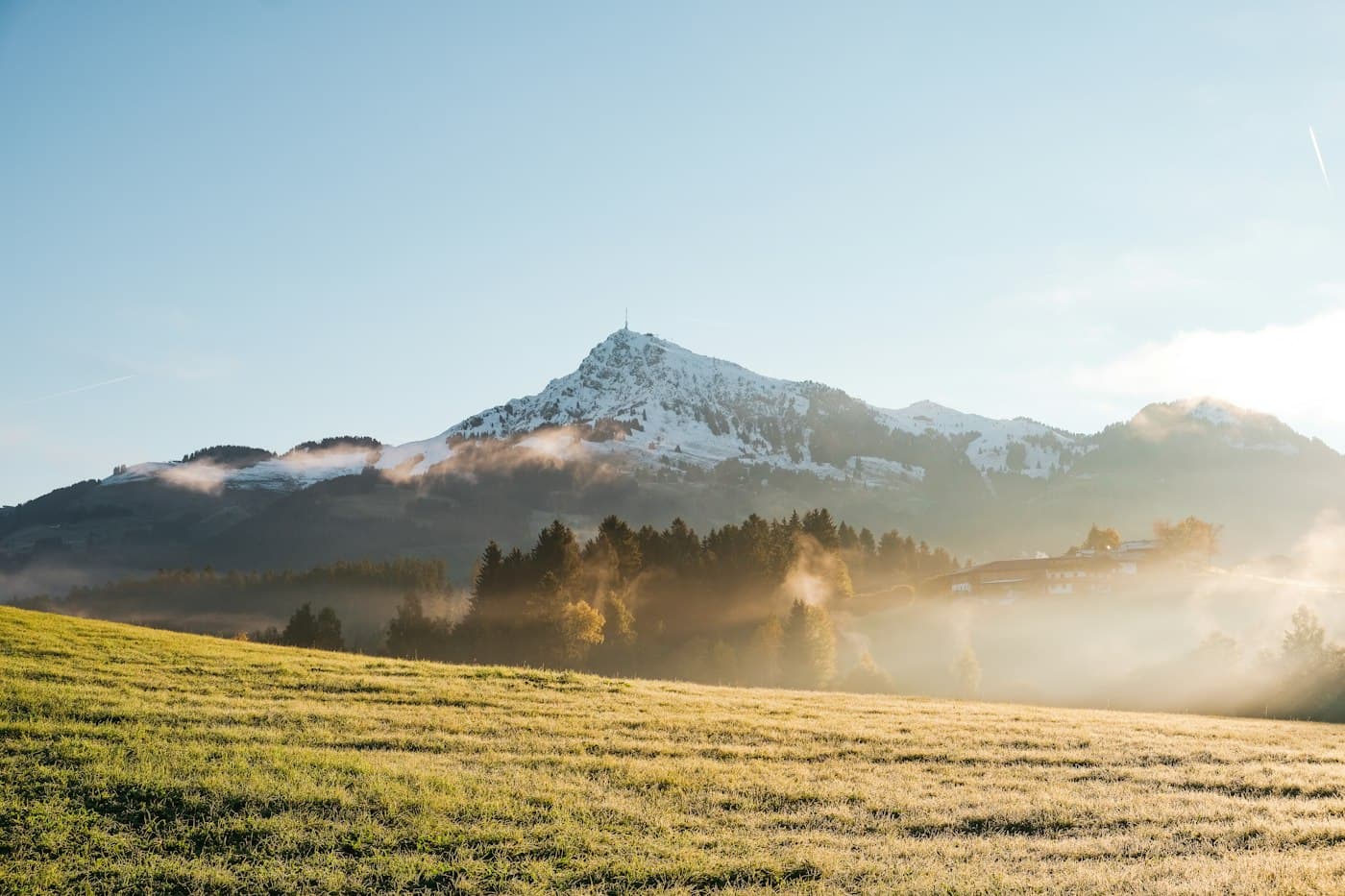
The 1,996 m peak across the valley, with an alpine flower garden of about 400 species at 1,800–1,900 m and benches facing the Wilder Kaiser. A toll road climbs to the Alpenhaus at 1,670 m, open day and night from late May to early November — the way up for a sunset session after the lifts close. On 15 June 2027 the sun sets at about 21:10, with golden hour from 20:23 to 21:34; on 15 September, from 18:44 to 19:43. Down in town the mountains hide it earlier.
A small moor lake 2 km west of town, with the Kaiser mountains behind it and stretches of shore under nature protection. Land Tirol measured it at around 24 °C in July and early August 2026, and the town lido opens from late May to early September, weather permitting — but on 30 September 2026 the town banned swimming because of blue-green algae, so check before planning photos in the water.
Through the year
Kitzbühel is wet in summer. GeoSphere Austria’s data for its station, averaged over 1991–2020, give average highs of 22.5 °C in June, 24.3 °C in July and August and 19.5 °C in September, but 159 to 173 mm of rain a month from June to August, on about 15 days each, with thunder on about six days in July; September is drier, at 121 mm on 12 days. From December to February there is snow on the ground on most days. The town is fullest in winter — February brought 111,000 overnight stays in 2025, August 86,000, November 21,000 — and its big dates fill it further: race week on the Hahnenkamm from 18 to 24 January 2027, when access roads close, the Alpenrallye from 2 to 5 June, the European Triathlon Championships from 11 to 13 June and the tennis from 11 to 24 July.
Tyrol & Innsbruck, month by month
Practical
Salzburg airport is about 81 km away, roughly an hour and a half by car; Innsbruck is about 70 minutes, Munich about an hour and three-quarters. Kitzbühel has three railway stations — the main one, ten minutes’ walk from the centre, Kitzbühel Hahnenkamm, right by the gondola, and Kitzbühel Schwarzsee, 200 m from the lake — and the train from Innsbruck takes about 70 minutes with a change at Wörgl. From November to mid-April, winter tyres are compulsory in winter conditions.
Cars stay out of the old town. Pfarrau and Voglfeld are free car parks; the short-stay zones charge on weekdays from 8:00 to 18:00, and there are garages at the Hahnenkamm and Fleckalm lift stations. Putting anything up in the street — even a welcome sign — needs a permit under the road traffic act, so leave decorations to your venue.
Austro Control’s rules apply: registration for any drone with a camera, insurance, at most 120 m above ground, no flights over crowds and the landowner’s consent to take off. The Schwarzsee lies inside the zone of the Kitzbühel heliport, where a flight needs Austro Control’s authorisation, and during the 2026 races a temporary flight restriction covered the whole town.
Any Standesamt in Austria can marry you, wherever you live: it first checks your documents with you both in person, at most six months before the wedding, and there is no waiting period afterwards. A church wedding alone has no legal effect.
Questions
Not with the Kitzbühel registry: its four places are the Rathaus, the town museum, the farmhouse museum at Hinterobernau and Schloss Kaps. Up on the mountain or by the lake you can hold a free ceremony after the legal one — it has no legal weight, but no limits on place either.
The Rathaus wedding room seats 30; the museum’s hall 50, with 20 more standing; the farmhouse parlour at most 25; Schloss Kaps about 60, plus standing room. Only the Rathaus costs nothing beyond the registry fees.
Yes, if at least one of you is Catholic: your home parish prepares the file and issues the permission to marry in Kitzbühel, you attend a marriage-preparation seminar, and you contact the Kitzbühel parish at least six months ahead.
Hahnenkamm race week, 18 to 24 January 2027, when access roads close (in 2026 a flight restriction covered the town too); Christmas and New Year; and the big summer events — the Alpenrallye in early June, the European Triathlon Championships in mid-June and the tennis in July — unless you want the bustle.
Yes: from June to August it rains on about half the days, with thunderstorms on five or six days a month. Keep an indoor option for every outdoor moment, and consider September, which is drier and still mild, with average highs near 20 °C.
Austria
Plan
Not sure yet?
The place, the date, the guests, the photos you like. Our concierge checks who is free and fits, and comes back with photographers to choose from.