In short
- Spain’s classic elopement backdrops are Mallorca’s Serra de Tramuntana and Cap de Formentor, the Costa Brava’s coves and Cap de Creus, Granada’s Alhambra and its viewpoints, Seville’s palaces, Teide above the clouds, Lanzarote’s volcanic coast and the Basque cliffs of Gaztelugatxe and Zumaia.
- A wedding photo session inside the Alhambra costs €141 plus VAT, must be requested at least 15 days ahead, allows at most four people and only five named courtyards and gardens (public price order in force since 1 August 2025).
- Seasonal car bans shape the plan: in 2026 the road to Cap de Formentor was closed to private cars from 15 May to 18 October, 10:00–22:00, and the road to the Cap de Creus lighthouse every day in July and August, 09:30–21:30, with buses instead.
- San Juan de Gaztelugatxe needs a free booked ticket on controlled days — every day from 15 June to 20 September in 2026 — with a cap of 1,462 visitors a day; drones are banned there.
- Professional photography in Teide National Park needs the Cabildo de Tenerife’s authorisation, asked at least a month ahead, and drones are banned there; across Spain, drones fall under Real Decreto 517/2024.
In this guide
This is a list of real places, not a mood board. For each one you get what it looks like, how you get there, when the light is right, which rules we could confirm on an official page, and the region page to read next. For whether your elopement can also be your legal wedding, start with getting married in Spain — for most couples from abroad it is a symbolic ceremony, which is exactly what frees the place and the hour.
Two things decide more than the place itself. The hour: at nearly every famous viewpoint, sunrise is the empty version and sunset the crowded one — the best time to marry in Spain has sunrise, sunset and golden hour for every month of 2027. The rules: a few portraits are one thing; a ceremony with chairs, guests or a drone is another, and monuments, natural parks and some beaches have their own permits.
Rules that apply almost everywhere
- Drones. Spain’s drone rules are Real Decreto 517/2024 (in force since 25 June 2024) on top of the EU’s: in the open category a drone flies no higher than 120 m and within the pilot’s sight; the operator must be registered with AESA if the drone weighs 250 g or more or carries a camera; flying in urban areas — which include beaches with facilities and city parks — must be notified to the Ministry of the Interior at least five calendar days ahead. Many protected areas forbid drones outright.
- National parks. Spain’s National Parks Law (Ley 30/2014, article 7.3.e) treats flights below 3,000 m over a national park as incompatible with it, except with express authorisation, and each park sets its own rules for professional photography — Teide and the Picos de Europa both ask for prior authorisation.
- Protected areas in the Balearics. Photo, film and drone shoots in Mallorca’s protected natural areas need the Govern de les Illes Balears’ authorisation, with a daily fee of €120 for one to four people (€480 for five to twenty) and a decision that can take up to six months; family events on private property are exempt. The rules don’t say whether a two-person elopement session counts — ask the Govern’s protected-areas service before you plan.
- Beaches, squares and streets. A few portraits rarely need anything; an arch, chairs or a group usually needs the town hall’s permission. Seville, for example, exempts a hand-held photo shoot with no installations from a filming licence but still asks for it to be notified.
Mallorca
1. Son Marroig and Sa Foradada — Deià
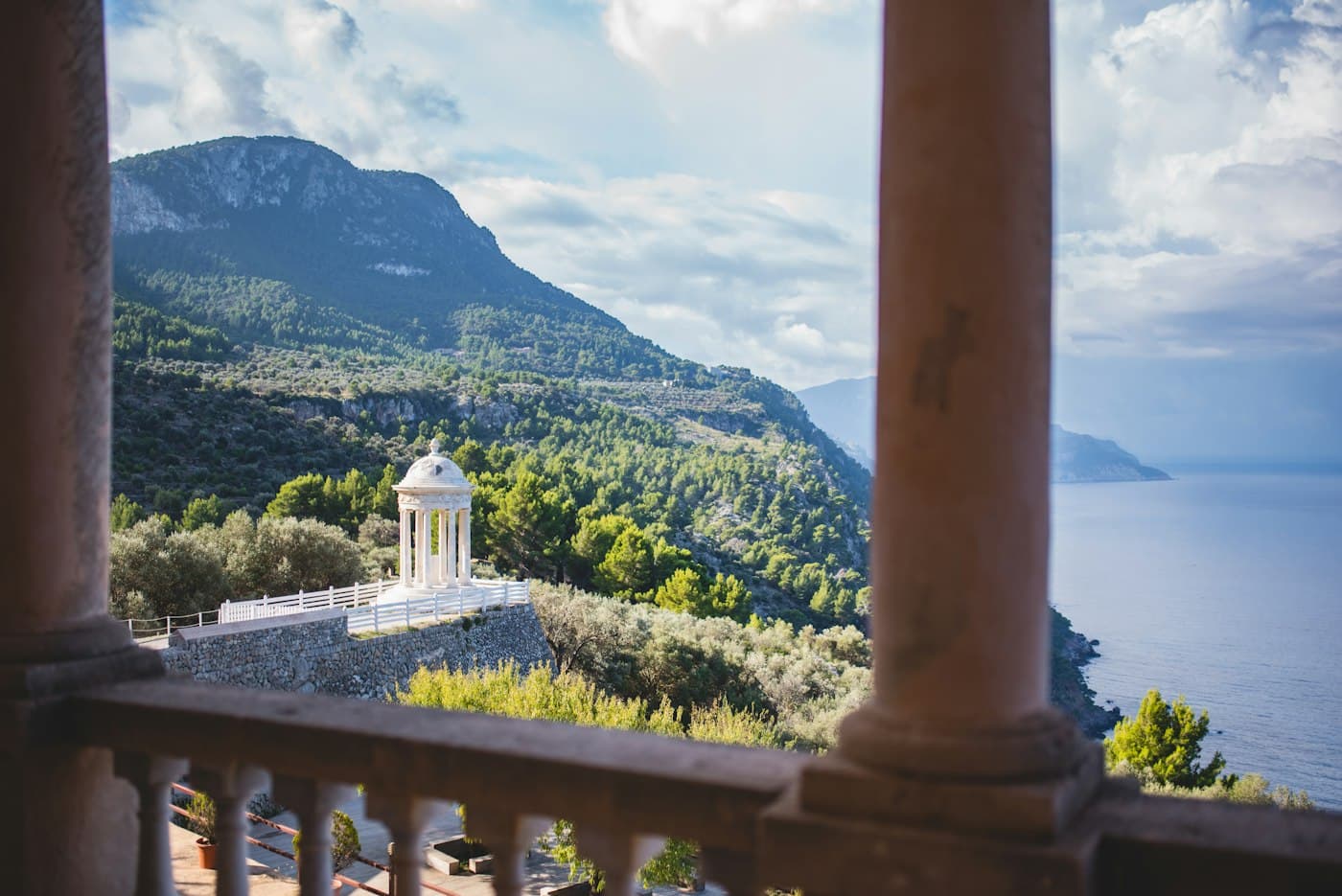
The estate of the Archduke Ludwig Salvator of Austria on the Tramuntana coast — part of the UNESCO-listed cultural landscape — with terraces high over the sea, a round marble temple in the garden and the Sa Foradada peninsula below. It is a museum and also a wedding venue (wedding venues in Spain).
- Getting there: on the road between Valldemossa and Deià. The museum opens Monday to Saturday, 09:30–14:00 and 15:30–16:30, closed on Sundays, with adult tickets at €4; its arched outdoor terrace is closed from October to April (as of October 2026).
- Light: the Tramuntana coast faces north-west, so the sun sets towards the sea — but after the museum has closed. A sunset ceremony is something to arrange with the estate, which itself suggests timing weddings to the sunset.
- Rules: private property — ask the estate before any ceremony or photo session.
- Region: Mallorca & the Balearics.
2. Cap de Formentor
Mallorca’s north-eastern tip: a long, narrow headland of cliffs and pines ending at a lighthouse, with Formentor beach on the way.
- Getting there: in 2026 the Ma-2210 was closed to private cars from km 8.7 (Formentor beach) to the lighthouse (km 19.6) between 15 May and 18 October, 10:00–22:00. Inside those hours you go by TIB bus 334 (Alcúdia – Port de Pollença – lighthouse, every 35 minutes), by bike or on foot; taxis only reach the beach section, and people with reduced mobility can ask the DGT for a permit three working days ahead. Fines run from €100 to €200. Check the Consell de Mallorca’s Formentor page for your year’s dates.
- Light: the cape points north-east — a sunrise place, and before 10:00 you can still drive to the lighthouse in season.
- Rules: narrow road and sheer drops; stay behind the walls at the viewpoints.
- Region: Mallorca & the Balearics.
3. Es Trenc
A long, undeveloped white-sand beach on Mallorca’s south coast, with dunes and the Salobrar de Campos salt pans behind it — all inside the Es Trenc–Salobrar de Campos natural park, 3,768 hectares of land and sea.
- Getting there: entry is free, from sa Ràpita, Ses Covetes, Colònia de Sant Jordi or the Na Tirapel car park, which the park’s law (Ley 2/2017) caps at 400 spaces; buses L508, L517 and L518 serve the area.
- Light: the coast faces south-west, so the sun sets over the sea.
- Rules: don’t walk on the dunes; commercial photo shoots and groups of more than 40 need written authorisation from the park office in Campos; drones are allowed only for science and park management; dogs are banned from March to October.
- Region: Mallorca & the Balearics.
Catalonia and the Costa Brava
4. Calella de Palafrugell and the Camí de Ronda
A fishing village of white houses and arcades — Les Voltes — around the Port Bo beach, about 190 m long, where the boats are still pulled up on the sand. The square and the fishermen’s streets have been protected as a Cultural Asset of National Interest since 1995, and the village has held havaneres singing for over 50 years. The Camí de Ronda, the old coast path, runs on to Llafranc in about half an hour.
- Getting there: by car via Palafrugell; Girona airport is the closest to the Costa Brava.
- Light: the coast faces east and south-east — sunrise over the sea, and warm early light on the arcades.
- Rules: public beach and streets; for anything beyond portraits, ask the Ajuntament de Palafrugell. Summer days are busy; early morning is quiet.
- Region: Barcelona & Catalonia.
5. Cap de Creus and Cadaqués
The easternmost point of the Spanish mainland: wind-carved rock, a lighthouse and coves inside the Cap de Creus Natural Park, with the white village of Cadaqués a few kilometres away.
- Getting there in season: in 2026 private cars were banned, by camera, on the road from Cadaqués to the lighthouse every day in July and August and from 1 to 13 September (09:30–21:30), and on set spring and autumn days (09:30–19:00). Park free at Corral d’en Morell in Cadaqués (120 spaces) and take the shuttle: €7 return, €5 for ages 6–14 and over 65, €4 one way. Walking and cycling are always allowed. Check the Generalitat’s calendar for your date.
- Light: the first sunrise in mainland Spain — the obvious hour for vows here.
- Rules: the cape is an integral nature reserve: stay on the marked paths.
- Region: Barcelona & Catalonia.
Andalusia
6. The Alhambra — Granada
The Nasrid palaces, courtyards and gardens under the Sierra Nevada. You cannot marry inside, but you can have a wedding photo session there — by prior authorisation from the Patronato de la Alhambra y Generalife.
- The fee: €141 plus VAT per session, set by the public-price order published in the BOJA on 25 July 2025 and in force since 1 August 2025.
- The request: at least 15 days ahead, on the Patronato’s form, naming everyone — at most four people. Bring the authorisation and your original ID.
- Where and when: only the Patio de los Arrayanes, the Patio de los Leones, Lindaraja, the Partal and the Jardines Bajos; in a morning slot (08:30–14:00) or an afternoon one (14:00 to closing, 20:00 in summer and 18:00 in winter), with an assigned time to enter the Nasrid Palaces. No tripods.
- Region: Andalusia.
7. The Albaicín viewpoints: San Nicolás and San Cristóbal — Granada
Across the valley from the Alhambra, the Mirador de San Nicolás gives the classic view of the palace with the Sierra Nevada behind; the Mirador de San Cristóbal, higher up, looks over the Albaicín’s roofs as well. Both are public, free and always open.
- Light: the Alhambra lies south-east of San Nicolás, so at sunset the sun is behind you and lights the palace walls face-on — the famous moment, and the busiest one. At sunrise the square is empty and the palace is backlit.
- Rules: public squares; for anything beyond portraits, ask the Ayuntamiento de Granada.
- Nearby: the city’s own palaces, the Carmen de los Mártires and the Palacio de los Córdova, host civil ceremonies and events (getting married in Spain).
- Region: Andalusia.
8. Seville: the Real Alcázar and the Plaza de España
The Alcázar is Seville’s royal palace, with Mudéjar courtyards and great gardens; the Plaza de España is a vast semicircle of brick and tiles around a canal. Both are among the most photographed places in Spain.
- The Alcázar: a wedding photo session costs €80 — free if one of you was born in or lives in Seville — and is booked by email at least a month ahead. At most five people including the two of you and the photographers, for one hour, entering by the Patio de Banderas and staying in the visitor areas. Opening hours: 09:30–17:00 from October to March, 09:30–19:00 from April to September.
- The Plaza de España: under Seville’s filming bylaw, a photo shoot with a hand-held camera, no installations, nothing cordoned off and no blocking of people or traffic needs no municipal authorisation but must be notified to the city’s film office; anything bigger needs a filming licence. The city tightened its rules for private events in the square in autumn 2026, so check before you plan anything more than portraits.
- Light: Seville’s July and August afternoons average 36 °C (AEMET) — go at sunrise.
- Region: Andalusia.
9. Cabo de Gata–Níjar Natural Park — Almería
A volcanic coast of dark headlands and pale coves in the far south-east of Spain — the beaches of Mónsul and the wide bay of Los Genoveses among them.
- Getting there in summer: in 2026 the Junta de Andalucía regulated car access to Genoveses, Barronal, Mónsul, Media Luna and Cala Carbón from 20 June to 27 September, with a limited car park and a shuttle bus; outside those dates you can drive in.
- Light: south-facing beaches with low side light at both ends of the day.
- Rules: it is a natural park; photo and film shoots in Andalusia’s protected areas are authorised by the Junta, and wedding shoots are among the requests it handles.
- Region: Andalusia.
The Canary Islands
10. Teide National Park — Tenerife
Spain’s highest mountain, 3,715 m, in a national park since 1954 and a UNESCO World Heritage Site since 2007: nearly 19,000 hectares of lava, crater floor and rock towers such as the Roques de García, often above a sea of clouds.
- Rules: professional photography and filming need the authorisation of the Cabildo de Tenerife, asked at least a month ahead, with a refundable deposit of €300 to €5,300; ask whether your session counts. Drones are prohibited except for park management, research and emergencies.
- The summit: the last stretch to the peak (the Telesforo Bravo path) needs a personal permit, booked on Tenerife ON 56 days ahead from Mondays at 07:00, in slots that include sunrise (06:00–09:00) and sunset (18:00–22:00), for 50 people a slot.
- Light: the clouds usually sit below you, and the sunset over them is the reason to come; the high peaks are cold, and in winter can see snow.
- Region: Canary Islands.
11. Lanzarote: Papagayo, La Geria and the Mirador del Río
Lanzarote is a volcanic island of black lava, white villages and César Manrique’s buildings. Three places to know: the golden coves of Punta de Papagayo in the south, inside the Los Ajaches natural monument; La Geria, where vines grow in hollows dug into volcanic gravel, each behind a crescent of stone against the wind; and Manrique’s Mirador del Río, a viewpoint built into the northern cliffs.
- Papagayo: non-residents pay €3 per car to drive in, by card only (Yaiza town council).
- Mirador del Río: open daily 10:00–17:00, adults €9 — so not a sunset spot. Photo sessions at any of the island’s Manrique sites (CACT) need authorisation at least ten working days ahead.
- Light: soft late-afternoon light on the gravel and vines of La Geria; the cliffs of the north in the morning.
- Region: Canary Islands.
The Basque Country and the North
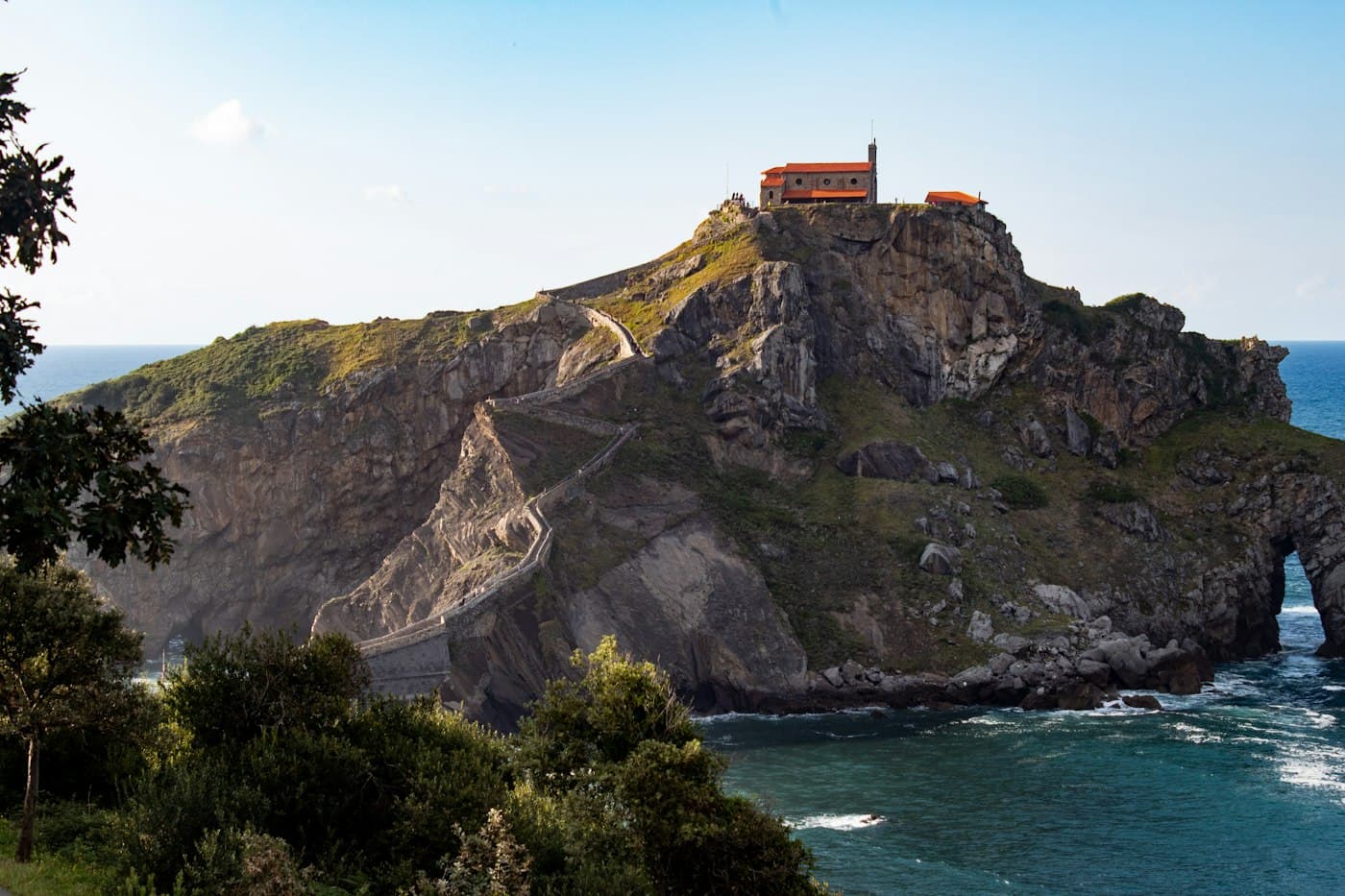
12. San Juan de Gaztelugatxe — Bermeo, Bizkaia
A hermitage on a rocky islet off the Bizkaia coast, reached by a stone bridge and a long stair — one of the most photographed places in the north.
- Booking: on controlled days you need a free ticket, capped at 1,462 visitors a day. In 2026 those were Easter (28 March – 12 April), weekends in May and June, every day from 15 June to 20 September, and set autumn and holiday dates. Up to ten tickets per booking; if you don’t show up within 60 minutes the booking is cancelled and you can’t book for a year. 24 June, 31 July, 29 and 31 August and 30 December are kept for local celebrations.
- Getting there: allow about two and a half hours for the visit; in summer bus A3517 runs from Bilbao.
- Rules: no drones, no climbing, no noise.
- Region: Basque Country & the North.
13. Zumaia: the flysch and Itzurun beach — Gipuzkoa
Cliffs of tilted rock layers running into the sea like the pages of a book — the flysch of the Basque Coast Geopark, a UNESCO Global Geopark since 2015 between Deba, Mutriku and Zumaia. Zumaia says the layers record over 50 million years.
- Getting there: Itzurun beach is a walk from Zumaia’s centre; the Geopark runs one-hour boat trips along the cliffs for €19.
- Light: Itzurun faces north-west, so summer sunsets fall over the sea; the rock platform appears only at low tide — check the tide table for your date.
- Rules: a protected coast; keep to the paths and off the cliff edges.
- Region: Basque Country & the North.
14. San Sebastián: Monte Urgull and Monte Igueldo
The two hills at either end of the bay of La Concha: Urgull above the old town, Igueldo at the western end with its old funicular.
- Opening hours: Urgull is gated at night — open 08:00–21:00 from May to September and 08:00–19:30 from October to April. In 2027 that puts sunset before closing only from 23 August to 30 September and from 13 October to 27 March (our calculation).
- Light: from Urgull you look west towards Igueldo and the sunset; from Igueldo you look east over the whole bay and the city in evening light.
- Rules: public parks; for anything beyond portraits, ask the city.
- Region: Basque Country & the North.
15. Lagos de Covadonga — Picos de Europa, Asturias
Two glacial lakes, Enol and Ercina, high in the Picos de Europa National Park above Covadonga.
- Getting there: private cars are banned on the lakes road on set dates — in 2026 including Easter, May weekends and from 1 June to 18 October with exceptions. The bus costs €9 for adults and €3.50 for children aged 4–11; from October the last bus up leaves at 16:00 and the last one down at 19:05.
- Rules: commercial photography needs the park’s prior authorisation, and drones are prohibited without it.
- Light: mountain weather changes fast — mist over the lakes is common, and lovely in photos.
- Region: Basque Country & the North.
The fifteen at a glance
| Place | Region | Best light | Permit or booking (as of October 2026) |
|---|---|---|---|
| Son Marroig & Sa Foradada | Mallorca | Sunset | Private estate: ask; museum closes 16:30 |
| Cap de Formentor | Mallorca | Sunrise | Cars banned 10:00–22:00, mid-May to mid-October |
| Es Trenc | Mallorca | Sunset | Written authorisation for commercial shoots; no drones |
| Calella de Palafrugell | Catalonia | Sunrise | Town hall for anything beyond portraits |
| Cap de Creus | Catalonia | Sunrise | Cars banned on set days; shuttle |
| The Alhambra | Andalusia | Morning or afternoon slot | €141 + VAT, 15 days ahead, 4 people |
| San Nicolás & San Cristóbal | Andalusia | Sunset (busy), sunrise (empty) | Public viewpoints |
| Real Alcázar & Plaza de España | Andalusia | Early morning | Alcázar €80, a month ahead; Plaza: notify the film office |
| Cabo de Gata | Andalusia | Morning, evening | Car access regulated in summer; Junta authorises shoots |
| Teide | Canary Islands | Sunset above the clouds | Cabildo authorisation a month ahead; no drones |
| Lanzarote | Canary Islands | Late afternoon | Papagayo €3 a car; CACT sites 10 working days ahead |
| Gaztelugatxe | Basque Country | Morning, evening | Free ticket on controlled days; no drones |
| Zumaia flysch | Basque Country | Summer sunset, low tide | Protected coast |
| Urgull & Igueldo | Basque Country | Sunset | Urgull gated at night |
| Lagos de Covadonga | Asturias | Morning mist | Car ban on set dates; park authorisation |
Questions couples ask
Where is the best place to elope in Spain?
It depends on the landscape you want: Mallorca’s Serra de Tramuntana and Cap de Formentor for mountains over the sea, the Costa Brava’s coves and Cap de Creus for the Mediterranean, Granada’s Alhambra viewpoints and Seville for Moorish palaces, Teide or Lanzarote for volcanic landscapes, and Gaztelugatxe or Zumaia for the green Atlantic north. Choose the season with the light and weather of each region in mind.
Can we have our wedding photos taken inside the Alhambra?
Yes, with prior authorisation from the Patronato de la Alhambra: €141 plus VAT per session, requested at least 15 days ahead, for at most four people, in five named spaces (the Arrayanes and Leones courtyards, Lindaraja, the Partal and the Jardines Bajos). Tripods are not allowed. You cannot hold the wedding ceremony itself inside the monument.
Do we need a permit to elope in Spain?
For portraits on a public beach or in a street, usually not; for a ceremony with set-up, a group or a drone, usually yes, from the town hall or the park. Monuments and national parks have their own rules: the Alhambra and Seville’s Alcázar charge for wedding photo sessions, and Teide requires authorisation a month ahead for professional photography.
Can we fly a drone at our elopement in Spain?
Only within Real Decreto 517/2024: a registered operator, no higher than 120 m, in sight, with flights in urban areas notified to the Ministry of the Interior five days ahead. Many protected places ban drones outright, including Teide National Park, San Juan de Gaztelugatxe and the Es Trenc natural park.
How do we get to Cap de Formentor in summer?
In 2026 the road was closed to private cars from 15 May to 18 October between 10:00 and 22:00, from Formentor beach to the lighthouse. Take TIB bus 334 from Alcúdia or Port de Pollença, cycle or walk, or drive in before 10:00 — which also suits a sunrise elopement on this north-east-facing cape.
Do we need to book San Juan de Gaztelugatxe?
On controlled days, yes: a free ticket from the Diputación de Bizkaia’s booking site, with up to 1,462 visitors a day. In 2026 that covered Easter, weekends in May and June, every day from 15 June to 20 September and set autumn dates. Drones are banned, and a few days a year are kept for local celebrations.
Next: what a small day costs — what a wedding photographer costs in Spain — and our elopement packages. Or tell us your date and place and see which photographers are free.
Sources
- Son Marroig — Opening hours (opens in a new tab) · sonmarroig.com
- Son Marroig — Bodas (opens in a new tab) · sonmarroig.com
- Consell de Mallorca — Formentor: access 2026 (opens in a new tab) · formentor.conselldemallorca.es
- Govern de les Illes Balears — Authorisation for photo and film shoots in protected natural areas (opens in a new tab) · intranet.caib.es
- Govern de les Illes Balears — Use of drones in protected areas (opens in a new tab) · caib.es
- Govern de les Illes Balears — Parque natural Es Trenc–Salobrar de Campos (opens in a new tab) · caib.es
- BOE — Ley 2/2017 (Es Trenc–Salobrar de Campos natural park) (opens in a new tab) · boe.es
- Visit Palafrugell — Les Voltes and Port Bo (opens in a new tab) · visitpalafrugell.cat
- Costa Brava tourism board — Port Bo beach (opens in a new tab) · costabrava.org
- Generalitat de Catalunya, Parcs Naturals — Cap de Creus: how to get there (opens in a new tab) · parcsnaturals.gencat.cat
- Generalitat de Catalunya — Cap de Creus access regulation, FAQ 2026 (opens in a new tab) · parcsnaturals.gencat.cat
- Patronato de la Alhambra y Generalife — Special services (wedding photo sessions) (opens in a new tab) · alhambra-patronato.es
- Patronato de la Alhambra — Public price order 2025 (opens in a new tab) · alhambra-patronato.es
- BOJA no. 142, 25 July 2025 (opens in a new tab) · juntadeandalucia.es
- Real Alcázar de Sevilla — Plan your visit (photo sessions) (opens in a new tab) · alcazarsevilla.org
- Ayuntamiento de Sevilla — Bylaw on audiovisual filming (opens in a new tab) · urbanismosevilla.org
- Junta de Andalucía — Cabo de Gata beach access regulation 2026 (opens in a new tab) · juntadeandalucia.es
- MITECO — Parque Nacional del Teide (opens in a new tab) · miteco.gob.es
- Gobierno de Canarias — Teide National Park: authorisations (opens in a new tab) · gobiernodecanarias.org
- Gobierno de Canarias — Teide National Park: summit permits (opens in a new tab) · gobiernodecanarias.org
- Ayuntamiento de Yaiza — Playas de Punta del Papagayo (opens in a new tab) · yaiza.es
- CACT Lanzarote — Mirador del Río (opens in a new tab) · cactlanzarote.com
- Turismo Lanzarote — Filming permits at CACT sites (opens in a new tab) · film.turismolanzarote.com
- Hello Canary Islands — The protected landscape of La Geria (opens in a new tab) · hellocanaryislands.com
- Diputación Foral de Bizkaia — San Juan de Gaztelugatxe (opens in a new tab) · bizkaia.eus
- Diputación Foral de Bizkaia — Gaztelugatxe 2026 calendar (opens in a new tab) · bizkaia.eus
- Basque Coast Geopark — About the geopark (opens in a new tab) · geoparkea.eus
- Basque Coast Geopark — Essential flysch boat trip (opens in a new tab) · geoparkea.eus
- Zumaia — The natural environment: tidal plain and cliffs (opens in a new tab) · zumaia.eus
- San Sebastián Turismoa — Monte Urgull (opens in a new tab) · sansebastianturismoa.eus
- Turismo Asturias — Access to the Covadonga lakes (opens in a new tab) · turismoasturias.es
- Parque Nacional de los Picos de Europa — Plan your visit (opens in a new tab) · parquenacionalpicoseuropa.es
- BOE — Real Decreto 517/2024 on drones (UAS) (opens in a new tab) · boe.es
- AESA — Drone operations in the open category (opens in a new tab) · seguridadaerea.gob.es
- BOE — Ley 30/2014 de Parques Nacionales (opens in a new tab) · boe.es