In short
- A symbolic ceremony has no legal effect in Spain, and for most couples from abroad it is the only ceremony on offer: a civil wedding needs a prior file at a notary or Civil Registry where one of you is domiciled (Ley 20/2011, art. 58), so couples who both live abroad marry legally at home and celebrate in Spain.
- Anyone can lead it — a professional celebrant, a friend, a relative — and it can be in any language, at any hour, wherever you are allowed to gather.
- Spain’s beaches are public: the Ley de Costas keeps them free for common uses such as walking and bathing, but activities of special intensity or profitability, and setting up removable installations or movable goods, need prior authorisation (arts. 31 and 51).
- Who grants it depends on the region: Catalonia, Andalusia, the Canary Islands, the Balearic Islands and Galicia have taken over coastal permits from the State; elsewhere it is the State’s Costas office — and the town hall’s own bylaws apply on top.
- Celebrants in Spain mostly quote on request; one ceremony officiant listed on Bodas.net, Spain’s largest wedding portal, starts at €250 (September 2026), and in Portugal and Italy published starting prices run from €400 to €450.
In this guide
- Why is a symbolic ceremony the usual route in Spain?
- What makes it symbolic, and is that allowed?
- How it works, step by step
- Who can lead it, and what does it cost?
- How long is it, and what happens in it?
- Where you can hold it
- What it frees up for the day’s timing
- What it changes for the photographs
- Questions couples ask
- Sources
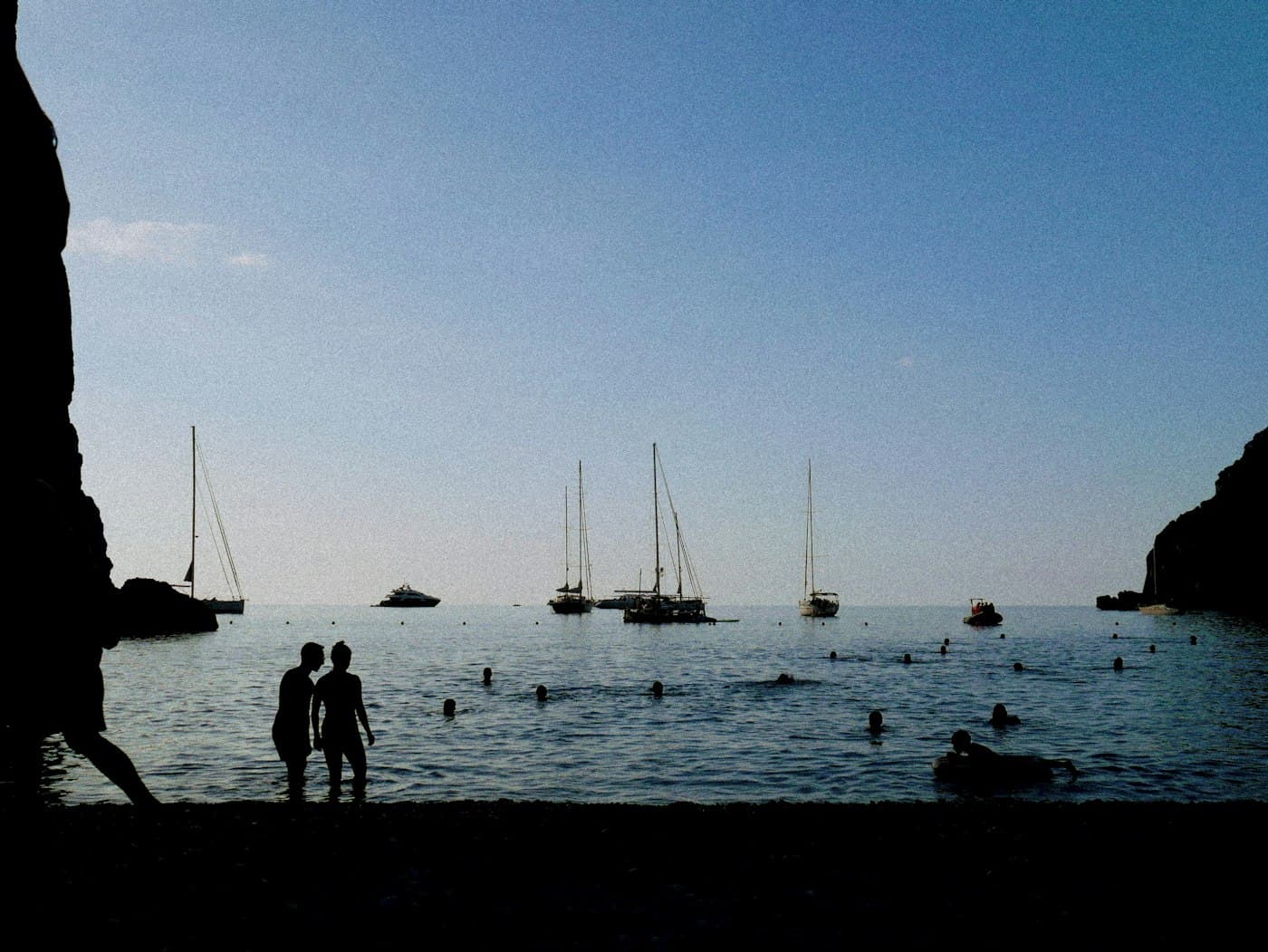
Spain is one of the easiest countries in Europe to celebrate a wedding in and one of the hardest to marry in legally if neither of you lives there. So most couples who come from abroad don’t try: they sign the legal papers at home — in a short appointment with a handful of people, if they like — and keep the day in Spain for the ceremony they actually want, in their own words and language, at the hour and in the place they choose. This guide explains how that works, where you may hold it, and what it changes for the day and for the photographs.
Why is a symbolic ceremony the usual route in Spain?
Because of one rule. Article 58.2 of the Civil Registry Law gives the file that must come before a civil wedding to “the notary of the place of domicile of either of the spouses”, or to the Civil Registry of one partner’s domicile. Without a home in Spain, no notary or registry can open it — Madrid’s Civil Registry, for example, takes appointments only when at least one partner’s habitual domicile is in the city. Faiths with agreements with the State need the same file first. The one legal exception is a Catholic wedding, which has civil effect without that file, through your home parish and diocese: getting married in Spain explains it.
| Civil wedding in Spain | Legal at home + symbolic in Spain | |
|---|---|---|
| Who can do it | Couples where one partner is domiciled in Spain (or is Spanish, through a consulate) | Anyone |
| Legal effect | Yes, from the day | From the legal ceremony at home; none from the one in Spain |
| Papers | A prior file with a notary or the Civil Registry, two witnesses, sworn translations; then a year to marry | Whatever your home registry asks for |
| Language | Usually Spanish | Any language, or several |
| Who leads it | A mayor or councillor, a notary or a court registrar | A celebrant, a friend, a relative — anyone |
| Where and when | The town hall’s own rooms and slots — in Palma, Friday 17:30–18:30 and Saturday 11:30–12:30, about 15 minutes each | Any day, any hour, wherever you are allowed to gather |
Spain itself marries mostly civilly — of the 175,364 marriages of couples living in Spain in 2024, 83.6% were civil (INE) — and couples who live in Spain can split the day the same way: a short civil ceremony on a weekday, and the ceremony with all the guests on another day, somewhere else.
What makes it symbolic, and is that allowed?
It is allowed; it is simply not a marriage. Spanish law makes a marriage only through the civil and religious forms above. A celebrant on a clifftop, a friend reading your story under the olive trees, vows on a beach at dawn — all of these are ceremonies with no legal effect, and no Spanish law says who may lead one or what it must contain. A “certificate” signed at the end is a keepsake.
What the law does govern is the place. A finca or a hotel decides for its own land; a beach, a square, a park or a natural area has an owner or an authority of its own, and an organised ceremony there — chairs, an arch, music, a few dozen guests — is a use of it that may need permission. More on that below.
How it works, step by step
- Decide the order. Some couples marry legally a few days or weeks before they travel; others sign afterwards. The legal date is the one on your certificate — decide which date you will call your anniversary.
- Book the legal part at home. Find out how much notice your registry needs and how long it stays valid (below), so the dates fit the trip.
- Choose who leads the ceremony in Spain, and where. If the place is public — a beach, a square, a park — ask what permission it needs before you announce it.
- Write the ceremony together. Welcome, your story, readings, vows, the rings, the kiss — with no legal wording required, every part is your choice.
- Walk through it with your photographer. Where you stand, where the light comes from, where the guests sit, and what happens in the first minute after the kiss.
The legal part at home: two examples
Notice periods are set by each country, and they decide how early you need to start. Two examples from official pages, as of October 2026:
| Where you marry legally | Notice | Cost to note | Source |
|---|---|---|---|
| England and Wales | Give notice at a register office at least 29 days before; the ceremony must be within 12 months of giving notice | A registrar at a register office costs £62 | GOV.UK |
| Ireland | At least 3 months’ notice to a Registrar, for civil, religious and secular marriages | €200 notification fee, non-refundable | Citizens Information |
Elsewhere — the United States, Canada, Australia, Germany, France — the rules are set by the state, province or country, and sometimes by the town. Your local registry office’s page is the only reliable answer.
Who can lead it, and what does it cost?
Because the ceremony has no legal effect, the person leading it needs no licence or registration in Spain. Couples choose one of three:
- A professional celebrant — in Spain often called an oficiante or maestro de ceremonias. They write the ceremony with you from your answers to their questions, keep it moving on the day and know where to stand so they don’t block the photos.
- A friend or relative. Personal and free, but give them the preparation a professional would have: a script, a rehearsal, and a microphone if there are more than a few dozen guests or the sea is loud.
- Nobody but the two of you. Some elopements have no officiant at all — just vows read to each other, sometimes with only the photographer there. See where to elope in Spain.
Spanish celebrants rarely publish prices; most quote once they know the date, the place and the language. One ceremony officiant listed on Bodas.net, Spain’s largest wedding portal, shows from €250 (Albacete, listing updated September 2026). For comparison, Lisbon planners publish from €400 plus travel and from €450 for a celebrant (Lisbon Wedding Planner, Wedding Portugal), and Italy’s largest wedding portal puts the usual range at €400 to €1,000 (Matrimonio.com, February 2026). When you compare quotes, ask what is included: the meetings to write the script, travel, a rehearsal, a sound system, a printed keepsake.
How long is it, and what happens in it?
As long as you want — but guests standing in the sun or the wind are your measure, and 20 to 30 minutes is a good length to plan for. A common running order:
- The entrance — one of you, or both together, with the music you chose.
- The welcome, in your languages if your families don’t share one.
- Your story, told by the celebrant from what you have shared — how you met, why here.
- Readings or words from a friend or a parent.
- A ritual, if you like one: a sand ceremony, a handfasting, a glass of wine shared, a ring warming passed among the guests.
- The vows and the rings.
- The kiss, and the walk back out — the moment for confetti or petals, where the place allows them.
Where you can hold it
Almost anywhere you are allowed to be: a finca, a cortijo or a hacienda courtyard, a vineyard, a hotel terrace above the sea, a cove, a mountain viewpoint. Venues that host weddings have their own ceremony spots and know their own rules — see wedding venues in Spain. Public places are where couples get caught out.
Beaches: the Ley de Costas
Every beach in Spain is public, state-owned coast — the dominio público marítimo-terrestre — and “beaches shall not be for private use” (Reglamento General de Costas, art. 65). Article 31 of the Ley de Costas keeps them “free, public and free of charge” for common uses: walking, being there, bathing and the like, with no works or installations. Article 51 then puts two things under prior authorisation: activities of special intensity, danger or profitability, and occupying the beach with removable installations or movable goods. A ceremony with chairs, an arch, a sound system and a planner paid to set them up can be either; two people and a photographer usually are neither. The Reglamento adds a separate route for events of general or tourist interest on urban beaches, applied for by the town hall (art. 66) — some towns have declared weddings events of local tourist interest to use it.
| Where the beach is | Who grants coastal permits | Since |
|---|---|---|
| Catalonia | The Generalitat (Departament de Territori) | 1 November 2007 (RD 1404/2007) |
| Andalusia | The Junta de Andalucía | 1 April 2011 (RD 62/2011) |
| Canary Islands | The Gobierno de Canarias | 1 January 2023 (RD 713/2022) |
| Balearic Islands | The Govern’s Direcció General de Costes i Litoral | 1 July 2023 (RD 994/2022) |
| Galicia | The Xunta de Galicia | 1 July 2025 (RD 394/2025) |
| Everywhere else (Valencia, Murcia, the Basque Country, Asturias…) | The State’s Costas office for the province | — |
- The town hall decides too. It keeps the beach clean and safe, runs its seasonal services, and is consulted on every coastal permit (Ley de Costas, art. 115) — and many towns have beach bylaws of their own. Los Alcázares, on the Mar Menor in Murcia, is one with clear rules: it allows civil wedding ceremonies on beaches it designates, once it holds the State’s authorisation (granted for 2024–2028), at weekends only and never in July or August, with no catering, no confetti, rice or petals, no loudspeakers that disturb the neighbours, and everything removed straight after.
- Allow time. The Balearic Govern takes up to four months to decide on an authorisation, and no answer means no; its permit for photo and film shoots on the coast asks for at least a month’s notice, two in protected areas.
- Or let a venue do it. A beach club or a hotel with its own beach concession knows what it may do on its stretch of sand, and asks for you.
Natural parks, national parks and monuments
- The Balearics’ protected areas: photo, film and drone shoots need the Govern de les Illes Balears’ authorisation, at €120 a day for one to four people, with a decision that can take up to six months.
- Teide National Park, Tenerife: special events need authorisation at least a month ahead (more than 50 people go to public consultation, and a deposit of €6 per participant, at least €1,000, is set); professional photography needs a permit of its own, from €300; drones are prohibited as a general rule.
- Monuments such as the Alhambra charge for wedding photo sessions and ask for the request in advance. Where to elope in Spain goes place by place.
Squares, streets and parks
Town squares, city parks and viewpoints belong to the town hall. A few portraits rarely need anything; a ceremony with chairs, an arch, music or guests occupies public space, and the town hall is the one to ask — Seville, for example, exempts a hand-held photo shoot with no installations from a filming licence but still asks for it to be notified.
What it frees up for the day’s timing
A civil ceremony follows the town hall’s slots; a symbolic one can follow the light. In summer the midday sun in Spain is high and hard, and a ceremony in the late afternoon puts the portraits in the softer light before sunset. Sunsets come late by the clock: on 15 June 2027 the sun sets at 21:47 in Madrid, 21:46 in Seville, 21:26 in Barcelona, 21:18 in Palma and 21:00 in Las Palmas (IGN). The best time to marry in Spain has every month.
| Ceremony time | What it means for the photos |
|---|---|
| Morning | Soft light and empty coves or viewpoints; a long gap before dinner to fill |
| Midday to mid-afternoon | Hard overhead light and squinting in summer; look for open shade, a pergola or a cloister |
| Late afternoon or early evening | Warm, low light; portraits run straight into the golden hour, then a late Spanish dinner |
| Sunset or after | Beautiful skies but little time — the light goes quickly, so do the family photos before |
What it changes for the photographs
- You choose where you face. With no registrar’s desk, you can stand with the light falling across you rather than behind you, and with the sea or the hills — not a wall — behind the celebrant.
- The celebrant can step aside for the kiss, so the photo isn’t of a third head between you. Ask them in advance.
- A ritual adds quiet moments. A ring warming or a handfasting gives the photographer pictures of the people around you, not only of the two of you.
- An unplugged ceremony — guests asked to put their phones away — is easy when you write the script. The celebrant can say it before you walk in.
- The legal ceremony at home deserves a photo too. Even a few frames by a friend keep the two days in one story.
Tell your photographer early that the ceremony is symbolic: they will plan their position, the order of the day and the family photos differently from a town hall or a church. If you haven’t found one yet, browse photographers — in Mallorca and the Balearics, Andalusia, the Canary Islands or anywhere in Spain — or tell us about your day and see who is free.
Questions couples ask
Is a symbolic wedding in Spain legally binding?
No. It has no legal effect in Spain or anywhere else, so couples who choose it marry legally at home, before or after. In Spain a marriage is made only in the civil form — which needs a prior file where one partner is domiciled — or in a religious form with civil effect, such as a Catholic wedding.
Why do foreign couples have symbolic weddings in Spain?
Because a civil wedding in Spain needs a prior file at a notary or Civil Registry where one of the couple is domiciled (Ley 20/2011, article 58), so couples who both live abroad usually cannot have one. They marry legally at home and hold the ceremony they want in Spain, in their own language and at the hour they choose.
Who can officiate a symbolic wedding in Spain?
Anyone. Because the ceremony has no legal effect, no licence is needed: a professional celebrant (an oficiante or maestro de ceremonias), a friend or a relative can lead it, or you can simply read your vows to each other.
Do we need a permit for a symbolic ceremony on a beach in Spain?
Often, yes, for an organised ceremony. Beaches are public under the Ley de Costas: common uses are free, but activities of special intensity or profitability and setting up removable installations or movable goods need prior authorisation — from the regional government in Catalonia, Andalusia, the Canary and Balearic Islands and Galicia, from the State’s Costas office elsewhere — and the town hall’s bylaws apply too. Ask both months ahead, or choose a venue with its own beach concession.
How much does a wedding celebrant cost in Spain?
Most celebrants in Spain quote on request. One ceremony officiant listed on Bodas.net shows from €250 (September 2026); in Portugal, published starting prices are €400 plus travel and €450, and Italy’s largest wedding portal gives €400 to €1,000. Ask whether travel, the script meetings, a rehearsal and sound are included.
Can a symbolic ceremony in Spain be at sunset?
Yes: with no town-hall timetable, the hour is yours. On 15 June 2027 the sun sets after 21:00 in Madrid, Seville, Barcelona, Palma and Las Palmas (IGN); the light goes quickly after, so plan family photos and portraits before it.
Sources
- BOE — Ley 20/2011 del Registro Civil, article 58 (consolidated) (opens in a new tab) · boe.es
- Comunidad de Madrid — Appointment to open a marriage file (updated 8 October 2026) (opens in a new tab) · sede.comunidad.madrid
- BOE — Ley 22/1988 de Costas, arts. 31, 51, 53 and 115 (consolidated, last updated 11 December 2015) (opens in a new tab) · boe.es
- BOE — Reglamento General de Costas, RD 876/2014, arts. 60, 65, 66 and 110 (consolidated, last updated 20 April 2024) (opens in a new tab) · boe.es
- BOE — RD 1404/2007, coastal management transferred to Catalonia (opens in a new tab) · boe.es
- BOE — RD 62/2011, coastal management transferred to Andalusia (opens in a new tab) · boe.es
- BOE — RD 713/2022, coastal management transferred to the Canary Islands (opens in a new tab) · boe.es
- BOE — RD 994/2022, coastal management transferred to the Balearic Islands (opens in a new tab) · boe.es
- BOE — RD 394/2025, coastal management transferred to Galicia (opens in a new tab) · boe.es
- Govern de les Illes Balears — Direcció General de Costes i Litoral (opens in a new tab) · caib.es
- Govern de les Illes Balears — Authorisation to occupy the coast for certain activities (opens in a new tab) · caib.es
- Govern de les Illes Balears — Authorisation for audiovisual productions on the coast (opens in a new tab) · caib.es
- Generalitat de Catalunya — Authorisation to occupy the coast (updated 24 March 2025) (opens in a new tab) · tramits.gencat.cat
- BORM no. 30, 7 February 2023 — Los Alcázares beach bylaw (arts. 41–43) (opens in a new tab) · borm.es
- MITECO — Authorisation AUT01/23/30/0111: weddings on Los Alcázares beaches, 2024–2028 (opens in a new tab) · miteco.gob.es
- Gobierno de Canarias — Teide National Park: authorisations (opens in a new tab) · gobiernodecanarias.org
- Govern de les Illes Balears — Photo and film shoots in protected natural areas (opens in a new tab) · intranet.caib.es
- Ayuntamiento de Sevilla — Bylaw on audiovisual filming (opens in a new tab) · urbanismosevilla.org
- Ajuntament de Palma — Celebración de matrimonios civiles (updated 28 April 2025) (opens in a new tab) · seuelectronica.palma.cat
- INE — Movimiento Natural de la Población 2024, definitive data (19 November 2025) (opens in a new tab) · ine.es
- GOV.UK — Marriages and civil partnerships: give notice (opens in a new tab) · gov.uk
- GOV.UK — Marriages and civil partnerships: plan your ceremony (opens in a new tab) · gov.uk
- Citizens Information (Ireland) — Notification requirements for marriage (edited 24 September 2024) (opens in a new tab) · citizensinformation.ie
- Bodas.net — María García Morcillo, maestra de ceremonias (listing updated September 2026) (opens in a new tab) · bodas.net
- Lisbon Wedding Planner — Symbolic wedding ceremony package (opens in a new tab) · lisbonweddingplanner.com
- Wedding Portugal — Prices (opens in a new tab) · weddingportugal.com
- Matrimonio.com — Matrimonio simbolico (updated 27 February 2026) (opens in a new tab) · matrimonio.com
- IGN, Observatorio Astronómico Nacional — Sunrise and sunset times by province (opens in a new tab) · astronomia.ign.es