In short
- In Liechtenstein only a civil wedding at the Civil Registry Office (Zivilstandsamt) in Vaduz makes you married; a religious ceremony may take place only once the marriage certificate has been shown (Marriage Act, art. 3), and a symbolic ceremony has no legal effect.
- You can marry in Liechtenstein only if one of you is a Liechtenstein citizen or has permanent residence there: two foreigners who live abroad can’t, even while on holiday in the country (Civil Registry Office, as of November 2026).
- The documents go to the office in the original, in person, no sooner than six months and no later than three weeks before the date; foreign ones may be no more than six months old and, unless in German or English, are translated into German by a recognised agency.
- Your intention to marry is made public for 14 days; the office then marries you in its wedding room on a Wednesday or a Friday, before two witnesses aged 18 or over, in German, in about 20 to 25 minutes, and never after 18:00, at weekends or on public holidays (Ordinance to the Marriage Act, art. 12).
- Same-sex couples have been able to marry since 1 January 2025; the office charges CHF 150 to prepare a wedding and CHF 100 to hold it (fee ordinance, as of November 2026).
In this guide
- Can we marry legally in Liechtenstein if neither of us lives there?
- Legal or symbolic: what counts in Liechtenstein
- Step by step, if one of you is a Liechtenstein citizen or lives in Liechtenstein
- The documents
- Where and when the ceremony happens
- Same-sex couples
- Sign at home, celebrate in Liechtenstein
- A church wedding in Liechtenstein
- What it costs
- After the wedding
- A timeline, in relative terms
- Where your photographer fits in
- Questions couples ask
- Sources
Liechtenstein is an easy country to celebrate in and a closed one to marry in if neither of you has a tie to it. One rule explains it: the Civil Registry Office in Vaduz, the only one in the country, marries a couple only if one of the two is a Liechtenstein citizen or lives in Liechtenstein. That leaves couples from abroad two routes — a civil wedding in Vaduz, open to couples with a Liechtenstein partner or a partner who lives there, or a legal marriage at home and a church or symbolic ceremony in the Rhine valley or the mountains above it. This guide covers both, and couples who live in Liechtenstein will find the same rules here; the office’s own pages are in German.
Can we marry legally in Liechtenstein if neither of us lives there?
No, unless one of you is a Liechtenstein citizen. The Civil Registry Office says it plainly: to marry in the Principality, the bride or the groom must either hold Liechtenstein citizenship or have permanent residence in Liechtenstein, two foreigners who live abroad can’t marry there, and neither can two foreigners who are in the country only on holiday. The ordinance on the marriage register points the same way: it records the weddings of Liechtenstein citizens and of foreigners who live in the country (Ordinance to the Marriage Act, art. 22).
| Your situation | Legal wedding in Liechtenstein? | What you do |
|---|---|---|
| Two foreigners, both living abroad | No | Marry at home, or where the law lets you; celebrate in Liechtenstein |
| Two foreigners on holiday in Liechtenstein | No | The same |
| One of you a Liechtenstein citizen, wherever you live | Yes | Your documents to the Civil Registry Office in Vaduz |
| One of you with permanent residence in Liechtenstein | Yes | The same; the notice is also posted in your municipality |
| One of you from outside the EU, the EEA and Switzerland, the other a citizen or resident | Yes | First a promise of marriage at a Swiss embassy or consulate abroad, which sends the papers on to Vaduz |
What counts is citizenship or permanent residence. Having family in Liechtenstein, or working there while living across the border in Switzerland or Austria, doesn’t by itself meet the rule. If you aren’t sure where you stand, ask the office before you plan anything else.
Legal or symbolic: what counts in Liechtenstein
| Civil wedding | Church or other religious wedding | Symbolic ceremony | |
|---|---|---|---|
| Legal weight | It is the marriage | None; it may only follow the civil wedding | None |
| Who | A registrar of the Civil Registry Office | A minister of your faith | Anyone you choose |
| Where | The office’s wedding room in Vaduz; elsewhere only on a medical certificate | As the church or community decides | Anywhere the owner allows |
| When | Wednesdays and Fridays; never after 18:00, at weekends or on public holidays | As the parish decides | Any day |
| Who can | Couples with a Liechtenstein citizen or a resident of Liechtenstein | Couples already married civilly | Anyone |
| Papers | Documents three weeks to six months ahead; a 14-day notice | The marriage certificate | None from Liechtenstein |
| Same-sex couples | Since 1 January 2025 | Ask the community | Always |
You must both be 18 or over — a court can, exceptionally and for serious reasons, declare a younger partner able to marry, with the consent of their legal representative — and capable of judgement. Neither of you may still be married or in a registered partnership with someone else, and you may not marry a relative in the direct line, a full or half sibling, an uncle or aunt, a niece or nephew, or an adoptive parent or child (Marriage Act, arts. 9–14). Each partner’s capacity to marry follows the law of their own country, and the form of the wedding follows Liechtenstein’s (Private International Law Act, arts. 17–18). The registrar refuses the notice when one of you plainly wants not a life together but a way around the rules on foreigners’ admission and residence, and hears you both first (Marriage Act, art. 17).
Step by step, if one of you is a Liechtenstein citizen or lives in Liechtenstein
- Ask the office early. The Civil Registry Office (Zivilstandsamt) is at St. Florinsgasse 3 in Vaduz. It asks every couple to find out early which documents they need, because they vary with nationality and civil status.
- Look at the dates. For couples who live in Liechtenstein, the office shows its free wedding dates for the next six months online and takes requests there; others ask the office.
- Gather the documents (below), with translations where needed. Foreign documents may be no more than six months old, so don’t order them too early.
- Hand them in, in the original and in person, at an appointment, no sooner than six months and no later than three weeks before the date you want. The Marriage Act also allows the application by a written declaration with officially certified signatures (art. 16): ask the office whether it accepts that from you.
- Sign the application for the notice (Verkündungsgesuch) together once the file is complete: your signatures confirm everything in it.
- The notice. Your intention to marry is made public for 14 days — at the office in Vaduz and in your Liechtenstein municipality, says the office; on the authority’s website, says the Marriage Act (art. 15). Within those days anyone with an interest can object in writing that one of you isn’t able to marry or that a legal impediment stands in the way (arts. 18–21). With no objection, the office tells you the wedding can take place, and the notice holds for six months (Ordinance, arts. 10–11).
- Marry in the wedding room, with your two witnesses. The registrar asks each of you whether it is your free and own will to marry the other; when you have both said yes, your marriage is made by your mutual consent “by virtue of the law” (Ordinance, art. 14). You, your witnesses and the registrar then sign the register.
- Take the marriage home (below).
The documents
The office sets the list for each couple, depending on nationality and civil status. The ordinance gives the frame (Ordinance to the Marriage Act, art. 1b):
- Birth and civil status: a birth certificate and a certificate of civil status for each of you.
- A past marriage or partnership: the final court judgment of divorce, dissolution or annulment, or the death certificate of a late spouse or registered partner.
- Residence and citizenship: proof of your ordinary residence and nationality, where the other documents don’t show them. A Liechtenstein citizen brings a confirmation of residence from their municipality; facts the office’s own registers already hold needn’t be proved again.
- Under 18: the court’s decision declaring the partner able to marry, and the legal representative’s certified consent.
- From outside the EU, the EEA and Switzerland: the partner gives a promise of marriage at a Swiss embassy or consulate abroad, so that the office receives the documents for the preparation from there. Ask the office for the details first, to avoid delays.
- Age and language: foreign documents may be no more than six months old, and those not in German or English must be translated into German by a recognised translation agency.
- Apostille: the office’s pages don’t say which countries’ documents need one. Liechtenstein has been party to the Apostille Convention since 17 September 1972 (HCCH): ask the office whether yours need it.
- Hard to get: the office can excuse a document that can’t be obtained, or only with great difficulty (art. 1b).
- Visa: Liechtenstein and Switzerland have the same entry rules; anyone who needs a visa applies to the Swiss representation where they live, and the Swiss authorities decide.
Where and when the ceremony happens
- In the wedding room of the Civil Registry Office in Vaduz, and nowhere else: the Marriage Act says the wedding takes place publicly in the wedding room, and elsewhere only when a medical certificate shows that one of you can’t come to the office because of illness (art. 25). The law allows no other place — no castle hall, no garden.
- When: on Wednesdays and Fridays (Civil Registry Office), and never after 18:00, on a Saturday, a Sunday or a public holiday (Ordinance, art. 12).
- Witnesses: two, aged 18 or over, men or women; they sign the register with you.
- Language: the ceremony is held in German. If you don’t understand it, you bring an interpreter: the office points to the list of interpreters licensed in Liechtenstein, and asks you to contact it if your language isn’t on the list. Its older English page, machine-translated, says ceremonies can also be held in English on request where possible, so ask.
- How long: about 20 to 25 minutes.
- Two couples at once: a double wedding, or several couples at the same time, is possible if you ask for it (Ordinance, art. 12); talk to the office in good time.
- Your name: before the wedding you tell the registrar which of your two surnames you will bear as the family name (Ordinance, art. 13a); more under “After the wedding”.
Same-sex couples
Since 1 January 2025 the Marriage Act defines marriage as the full and undivided union of life of “two people” (zweier Menschen), as the law of 16 May 2024 worded it (LGBl. 2024 Nr. 261), and same-sex couples marry on the same terms as everyone else, the citizenship-or-residence rule included. Since that date no new registered partnerships are entered: the Partnership Act now governs only those registered before, which the partners can turn into a marriage at any time by a joint declaration at the office — before two witnesses in the wedding room, if they ask (Partnership Act, arts. 1 and 32a). Ask at home how your country will treat a Liechtenstein marriage.
Sign at home, celebrate in Liechtenstein
This is the route for every couple without a Liechtenstein citizen or a home in Liechtenstein. You marry legally where you live, a few days or weeks before the trip or after it, and the ceremony in Liechtenstein is the one your guests remember.
- Nothing to file in Liechtenstein: no documents, no notice, no witnesses.
- Or marry next door. Switzerland lets foreigners who live abroad marry at a Swiss registry office with the permission of the canton’s supervisory authority (Federal Office of Justice), and Austria lets people with neither Austrian citizenship nor a home in Austria marry at any of its registry offices (oesterreich.gv.at). See getting married in Switzerland and getting married in Austria.
- Bring the certificate if the ceremony is religious, and ask the parish early whether a certificate from home will do: the law allows a religious ceremony only once the marriage certificate has been shown (Marriage Act, art. 3).
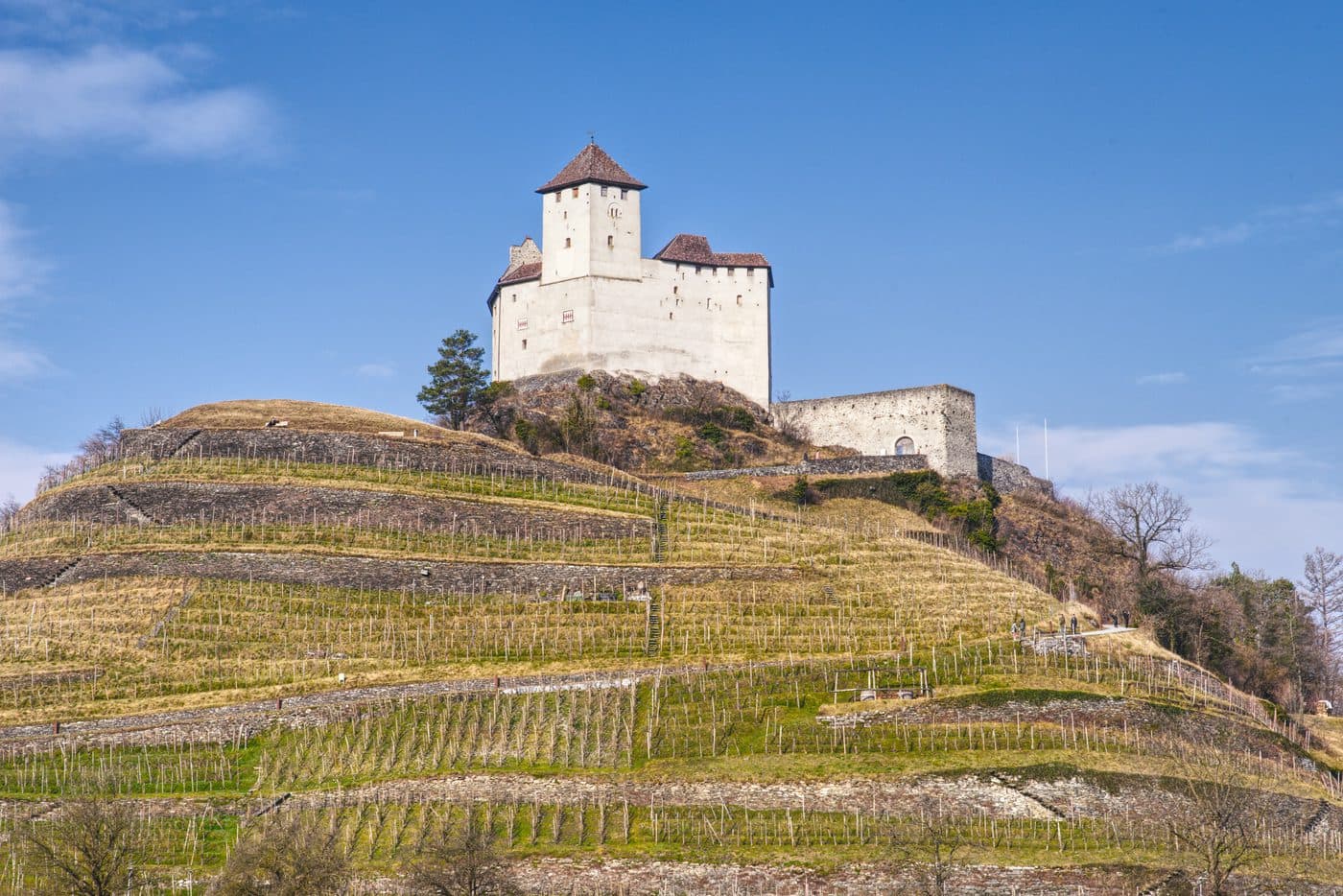
- Choose the place and the hour: the vineyards under Vaduz Castle, the Rhine dam path, a meadow at Masescha or above Malbun, wherever the owner or manager agrees, at the hour the light is best.
- Check the drone rules (below) before you plan aerial shots: the castle and the government buildings below it are a no-fly zone.
- Choose the date you celebrate. The legal date is the one on the certificate from home; the Liechtenstein day can be the one you keep.
A church wedding in Liechtenstein
“The religious marriage ceremony may only be performed once the marriage certificate has been presented,” says the Marriage Act (art. 3), and a religious marriage has no legal effect of its own: a marriage is made when the registrar declares it (art. 26). The office tells couples to show the priest its certificate, which it issues for weddings held in Liechtenstein and for the marriages abroad of Liechtenstein citizens that it has registered. A couple married abroad should therefore ask the parish and the office early whether their certificate from home will do. Each church sets its own steps, papers and timing: talk to the parish early, and to your home parish if it has to prepare and send a file.
What it costs
The Civil Registry Office’s fees are set by the government’s fee ordinance (ZSA-GebV, in this version since 1 January 2025), the same for everyone:
| What | Fee (November 2026) |
|---|---|
| Preparing the wedding (the notice procedure) | CHF 150 |
| Holding the wedding | CHF 100 |
| Cancelling or moving the date less than two working days before | CHF 100 |
| Marriage certificate (Eheschein), international | CHF 30 |
| Extract from the family register | CHF 40 |
| Certification of an extract, on top | CHF 10 |
| Certificate of capacity to marry, for a Liechtenstein citizen marrying abroad | CHF 50 |
| Recognition of a marriage made abroad | CHF 150 |
| Urgent work, on request | 50% on top; 100% outside the office’s counter hours |
| Translations, interpreter, lawyer | Not published: the provider’s price |
Work without a set fee is charged by the hour, at CHF 100 to 250, and the office can ask anyone who lives abroad to pay its fees in advance (ZSA-GebV, arts. 4 and 7).
After the wedding
- The certificate: you sign the register straight after the ceremony, and the office hands you a marriage certificate if you ask (Ordinance, art. 15); the international one costs CHF 30.
- Your surname: Liechtenstein citizens follow Liechtenstein’s name law. You choose one of your two surnames as the family name, the one your children take; the spouse whose name it isn’t may add their own before or after it with a hyphen, and if you choose none, each keeps their own (Civil Registry Office). A foreign spouse asks their own country what it allows.
- Residence: a foreign spouse without a home in Liechtenstein can obtain a residence permit when the spouse who lives there applies for family reunification (Civil Registry Office).
- Property: unless you agree otherwise, Liechtenstein has separation of property during the marriage — each of you keeps what you bring and what you acquire — and marriage contracts are drawn up by lawyers based in Liechtenstein, before or after the wedding (National Administration). For an international couple another country’s law may apply: the Private International Law Act lets you choose in writing between the law of the country where you both live, or will live, and either partner’s national law (art. 20). Ask a lawyer before the wedding.
- At home: your country will ask for the certificate, perhaps with an apostille or a translation; ask your registry how to record the marriage before you leave.
- Married abroad, with a Liechtenstein citizen or resident among you? The marriage is reported to the office and recognised there, for CHF 150; a marriage made outside the EU, the EEA and Switzerland is reported through the Swiss representation in that country first.
A timeline, in relative terms
| When | Legal in Liechtenstein (one of you a citizen or resident) | Symbolic (married at home) |
|---|---|---|
| A year to six months before | Ask the office which documents your nationalities need and whether an apostille is needed; a partner from outside the EU, the EEA and Switzerland asks a Swiss embassy or consulate about the promise of marriage | Ask the owner or manager of the place; check FOCA’s drone map if you want aerial shots |
| Six months before | Order documents and translations; the file can go in from now | Plan the legal wedding at home, or in Switzerland or Austria |
| Three weeks before, at the latest | Documents handed in and application signed; the 14-day notice runs | Marry legally at home, if before the trip |
| The day | The wedding room, a Wednesday or a Friday, two witnesses, about 20 to 25 minutes | Your ceremony, any day |
| After | The certificate; registration at home | Nothing to register in Liechtenstein |
Where your photographer fits in
- A short ceremony to a timetable: about 20 to 25 minutes in the wedding room, on a Wednesday or a Friday. Your photographer needs to be in place before you walk in; ask the office beforehand what it allows during the ceremony.
- Light: on 21 June the sun sets at about twenty past nine in Vaduz and it isn’t dark until about ten; on 21 December it sets at about twenty-five to five. These times assume a flat horizon: the valley’s mountain walls, and Malbun’s, hide the sun sooner (NOAA solar equations).
- Weather: summer is the wettest season, with rain (1 mm or more) on 13 or 14 days a month in Vaduz and 15 or 16 in Malbun from June to August (MeteoSwiss climate normals, 1991–2020), and thunderstorms with heavy rain, hail and strong gusts are common in spring and summer. Spring brings the foehn, a warm, dry wind down the Rhine valley that often reaches storm strength. Plan a covered fallback for every outdoor moment.
- Drones: Liechtenstein applies Swiss aviation law, and with it the EU drone rules Switzerland adopted in January 2023, under the Swiss Federal Office of Civil Aviation (FOCA). The operator registers where they live in the EU, Norway or Iceland, and otherwise in Switzerland — Liechtenstein’s residents included; holds liability insurance of at least CHF 1 million for a drone over 250 g; and flies in sight, below 120 m, never over a crowd and with Remote ID on. Around Vaduz Castle and the government and parliament buildings no drone may fly without an exemption from the national Office of Building Construction and Spatial Planning (Amt für Hochbau und Raumplanung), which FOCA’s drone map says to request five days ahead; near the Balzers heliport, drones over 250 g are banned. Check the drone map and the daily airspace bulletin (DABS) before every flight.
- Then read how to choose a wedding photographer and the rain plan.
Questions couples ask
Can foreigners get legally married in Liechtenstein?
Only if one of you is a Liechtenstein citizen or has permanent residence in Liechtenstein. Two foreigners who both live abroad can’t marry legally there, even while on holiday in the country, so they marry at home, or in neighbouring Switzerland or Austria, whose rules let couples from abroad marry, and hold a church or symbolic ceremony in Liechtenstein.
Where do civil weddings take place in Liechtenstein?
Only in the wedding room of the Civil Registry Office in Vaduz, the one office for the whole country, on Wednesdays and Fridays. A wedding elsewhere is allowed only if a medical certificate shows that one of you can’t come to the office because of illness.
How far ahead do we hand in the documents?
No sooner than six months and no later than three weeks before the date, in the original and in person, at an appointment. Foreign documents may be no more than six months old. After you sign the application, your intention to marry is made public for 14 days, and the notice then holds for six months.
Do we need witnesses to marry in Liechtenstein?
Yes: two, aged 18 or over, men or women. They attend the ceremony and sign the register with you and the registrar.
Can we marry in English in Liechtenstein?
The ceremony is held in German; if you don’t understand it, you bring an interpreter, and the office points to the list of interpreters licensed in Liechtenstein. Its older English page says English is possible on request where possible, so ask the office before you plan around it.
Is a church wedding in Liechtenstein legally binding?
No. The Marriage Act allows a religious ceremony only once the marriage certificate has been shown, and the marriage itself is made at the Civil Registry Office. A couple married abroad should ask the parish and the office early whether their certificate from home will do.
Can same-sex couples marry in Liechtenstein?
Yes, since 1 January 2025, on the same terms as everyone else, the citizenship-or-residence rule included. No new registered partnerships have been entered since then; partners registered before can turn their partnership into a marriage at the office at any time.
How much does a civil wedding in Liechtenstein cost?
The Civil Registry Office charges CHF 150 to prepare the wedding and CHF 100 to hold it, and CHF 30 for an international marriage certificate (fee ordinance, as of November 2026). Translations, an interpreter or a lawyer are paid at their own prices.
Next: the regions — Vaduz & the Rhine Valley, Malbun & the Liechtenstein Alps or all of Liechtenstein — and the wedding day timeline. When you have a date, see the wedding photographers in Liechtenstein or tell us about your day, and see who is free.
Sources
- gesetze.li — Ehegesetz (EheG), version of 1 April 2026: arts. 1–3, 9–27 (opens in a new tab) · gesetze.li
- gesetze.li — Verordnung zum Ehegesetz (Verkündung, Trauung und Führung des Eheregisters), version of 1 January 2025 (opens in a new tab) · gesetze.li
- gesetze.li — Gesetz vom 16. Mai 2024 über die Abänderung des Ehegesetzes (LGBl. 2024 Nr. 261), in force 1 January 2025 (opens in a new tab) · gesetze.li
- gesetze.li — Partnerschaftsgesetz (PartG), version of 1 January 2025: arts. 1, 32a–32d (opens in a new tab) · gesetze.li
- gesetze.li — Verordnung über die Einhebung von Gebühren durch das Zivilstandsamt (ZSA-GebV), version of 1 January 2025 (opens in a new tab) · gesetze.li
- gesetze.li — Gesetz über das internationale Privatrecht (IPRG): arts. 17, 18, 20 (opens in a new tab) · gesetze.li
- Liechtenstein National Administration, Civil Registry Office — Heirat / Trauung / Eheschliessung (11 April 2023) (opens in a new tab) · llv.li
- Civil Registry Office — Voraussetzungen Heirat (1 August 2025) (opens in a new tab) · llv.li
- Civil Registry Office — Erforderliche Dokumente (8 June 2026) (opens in a new tab) · llv.li
- Civil Registry Office — Aufnahme des Verkündungsgesuchs (17 July 2023) (opens in a new tab) · llv.li
- Civil Registry Office — Trauung (18 July 2024) (opens in a new tab) · llv.li
- Civil Registry Office — Wedding ceremony, in English (17 December 2023) (opens in a new tab) · llv.li
- Civil Registry Office — Free wedding ceremony dates (17 December 2023) (opens in a new tab) · llv.li
- Civil Registry Office — Erhältliche Dokumente (17 July 2023) (opens in a new tab) · llv.li
- Civil Registry Office — Nach der Heirat (17 July 2023) (opens in a new tab) · llv.li
- Civil Registry Office — Namensführung nach der Eheschliessung (17 July 2023) (opens in a new tab) · llv.li
- Liechtenstein National Administration — Legal matrimonial property regime (17 December 2023) (opens in a new tab) · llv.li
- HCCH — Apostille Convention, status table (opens in a new tab) · hcch.net
- Federal Office of Justice (Switzerland) — Eheschliessung und die «Ehe für alle», FAQ 1.1 (opens in a new tab) · bj.admin.ch
- oesterreich.gv.at — Eheschließung in Österreich ohne Wohnsitz (1 January 2026) (opens in a new tab) · oesterreich.gv.at
- Liechtenstein National Administration, Office of Building Construction and Spatial Planning — Zivilluftfahrt (11 June 2026) (opens in a new tab) · llv.li
- FOCA — Flight rules for drones (brief guide of 14 September 2026) (opens in a new tab) · bazl.admin.ch
- FOCA — Registration as a drone operator (opens in a new tab) · bazl.admin.ch
- FOCA — Frequently asked questions on drones (opens in a new tab) · bazl.admin.ch
- FOCA — Geographical flight restrictions (the drone map and DABS) (opens in a new tab) · bazl.admin.ch
- MeteoSwiss — Climate normals 1991–2020 per measured parameter (Vaduz, Malbun, Davos) (opens in a new tab) · meteoswiss.admin.ch
- MeteoSwiss — Föhn (opens in a new tab) · meteoschweiz.admin.ch
- MeteoSwiss — Gewitter (opens in a new tab) · meteoschweiz.admin.ch