In short
- A symbolic ceremony — a rito simbolico — has no legal effect in Italy: the law knows civil marriage before a comune’s registrar, Catholic and other religious weddings with civil effect, and, for same-sex couples, the civil union of Law 76/2016. Couples who choose it marry legally at home, or at the town hall, before or after.
- Unlike Spain and France, Italy lets two foreigners who don’t live there marry legally — yet the civil rite is in Italian, with an interpreter if needed, only in places and time slots the comune has set aside, and the hall alone costs €500 to €9,200 (US Embassy range).
- That is why couples often split the day in two: a short civil ceremony at the town hall, or the legal wedding at home, and the ceremony they care about — their words, their language, at the hour they choose — as a symbolic one at the villa.
- Anyone can lead it. Italy’s largest wedding portal puts a celebrant at €400 to €1,000 (Matrimonio.com, February 2026), and some comuni rent their own rooms for symbolic ceremonies — Verona from €100 for a promise on Juliet’s balcony to €400 for an hour in Juliet’s House.
- Beaches are state maritime property (demanio marittimo) run by regions and comuni, and an organised ceremony on public sand needs their permission: Sardinia’s 2025 guidelines rule out handing public beach to private parties for personal ceremonies, so most beach ceremonies happen on a beach club’s own concession.
In this guide
- What is a symbolic ceremony in Italy?
- Why choose it, when Italy allows a legal wedding?
- Two ceremonies: the comune in the morning, the villa at sunset
- How it works, step by step
- Who leads it, and what does it cost?
- How long is it, and what happens in it?
- Where you can hold it
- What it frees up for the day’s timing
- What it changes for the photographs
- Questions couples ask
- Sources
Italy is the exception among the big wedding countries of southern Europe: two people who don’t live there can marry legally, with a nulla osta from home and a short declaration at the comune a few days before. And yet many couples who could do it hold a symbolic ceremony instead — or as well. This guide explains why, what a symbolic ceremony is in Italian law, who can lead it and what it costs, where it can be held, and what it changes for the day and for the photographs. For the legal routes themselves, start with getting married in Italy.
What is a symbolic ceremony in Italy?
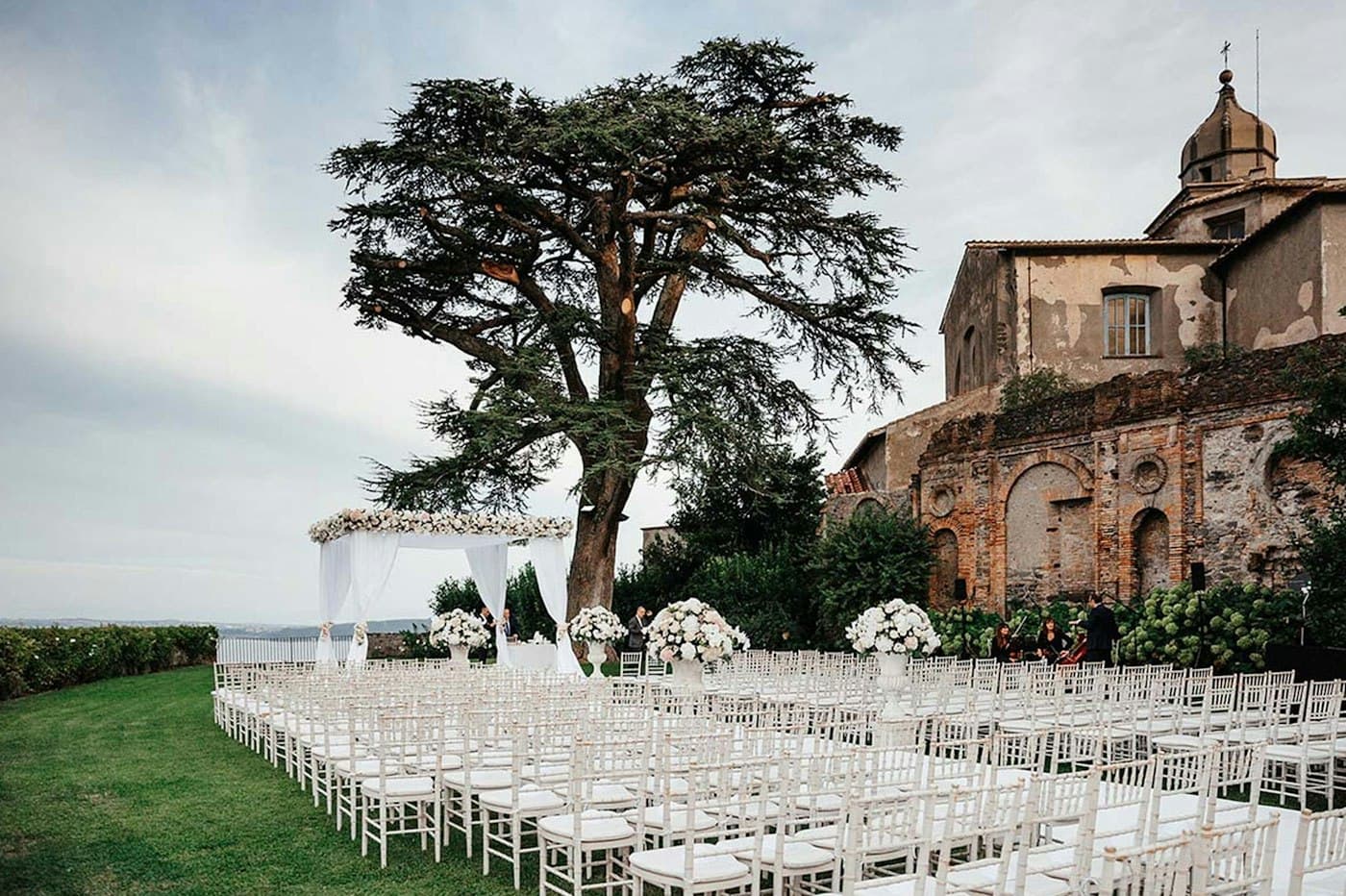
Any ceremony that is not one of the forms Italian law recognises. A marriage is legally made in Italy before the comune’s registrar (the sindaco or someone they delegate), at a Catholic wedding whose act is then transcribed in the civil register, or before a minister of another faith the state has approved; same-sex couples form a civil union before the registrar. A celebrant on a terrace above the sea, a friend reading your story in an olive grove, vows by a lake at dawn — all of these are ceremonies with no legal effect. Italian planners call them a rito simbolico, a cerimonia simbolica or, when the celebrant isn’t religious, a rito laico.
No-one in Italy registers it, licenses it or checks it, and a “certificate” signed at the end is a keepsake. That is also its freedom: the words, the language, the length, the person who leads it and the order of things are entirely yours.
Why choose it, when Italy allows a legal wedding?
Because the legal ceremony comes with conditions that the one you imagined may not meet. Side by side, as of October 2026:
| Civil wedding at an Italian comune | Legal at home + symbolic in Italy | |
|---|---|---|
| Legal effect | Yes, from the day | From the legal ceremony at home; none from the one in Italy |
| Papers | A nulla osta from your country (art. 116), translated into Italian; a declaration at the comune 2–3 days before | Whatever your home registry asks for |
| Language | Italian; an interpreter you arrange if either of you doesn’t understand it — and a witness can’t be the interpreter | Any language, or several |
| Who leads it | The sindaco or someone they delegate | A celebrant, a friend, a relative — anyone |
| Where | The town hall, or a place the comune has set aside for weddings on a lasting basis (Interior Ministry circular 10/2014) | Anywhere you are allowed to gather |
| When | The comune’s days and slots — in Florence, Saturdays are for residents | Any day, any hour |
| What it costs the couple | The hall: €500 to €9,200 (US Embassy); Florence charges two foreign citizens living abroad €3,250 to €8,190, Ravello €650 to €850 | Nothing to the state; the celebrant’s fee, if you hire one |
The place is the usual sticking point. A villa can host a legal civil ceremony only if the comune has made it one of its wedding places — Ravello, for instance, lists Palazzo Tolla and the Giardini della Principessa di Piemonte, while Villa Cimbrone, a hotel, hosts other rites and symbolic ceremonies but neither civil nor Catholic ones. If the terrace you fell for isn’t on the comune’s list, the ceremony there will be symbolic whatever you do.
Same-sex couples
Italy does not open marriage to same-sex couples; it offers a civil union under Law 76/2016. Couples who want to be married, not in a civil union, often marry at home — or in a country such as Portugal or Spain — and celebrate in Italy with a symbolic ceremony that looks and feels exactly like a wedding. Ask your own country how it treats either before you choose: getting married in Italy has the details of the civil union.
Two ceremonies: the comune in the morning, the villa at sunset
Some couples do both, and comuni provide for it: Sermoneta’s rules allow a symbolic ceremony for couples who want to repeat, somewhere other than the town hall, the marriage they have just celebrated officially. The legal part is a short civil ceremony at the town hall — the same day, the day before, or at home weeks earlier — with two witnesses and the family; the symbolic one is the ceremony everyone came for, at the venue, at the hour the light is best. Tell your photographer which is which when you book: a civil ceremony is short and runs to the comune’s timetable, and a symbolic one can be timed to the light.
How it works, step by step
- Decide where the legal part happens. At home before or after the trip, or at an Italian comune — in which case read getting married in Italy for the nulla osta and the declaration.
- Decide which date you will call your anniversary. The legal date is the one on your certificate; many couples keep the Italian day as the one they celebrate.
- Choose the person who leads the ceremony in Italy, and the place. If the place is public — a beach, a square, a park — ask what permission it needs before you announce it.
- Write the ceremony together. Welcome, your story, readings, vows, the rings, the kiss — with no legal wording required, every part is your choice.
- Walk through it with your photographer. Where you stand, where the light comes from, where the guests sit, and what happens in the first minute after the kiss.
The legal part at home: examples
Notice periods are set by each country, and they decide how early you need to start. As of October 2026, from official pages:
| Where you marry legally | Notice | Cost or limit to note | Source |
|---|---|---|---|
| England and Wales | Give notice at a register office at least 29 days before; the ceremony must be within 12 months of giving notice | A registrar at a register office costs £62 | GOV.UK |
| Ireland | At least 3 months’ notice to a Registrar | €200 notification fee, non-refundable | Citizens Information |
| Italy, for residents | Banns posted for at least eight days; the wedding from the fourth day after | If it isn’t celebrated within 180 days, the banns lapse (Civil Code, art. 99) | Ministero della Giustizia; Civil Code |
Elsewhere — the United States, Canada, Australia, Germany, France — the rules are set by the state, province or country, and sometimes by the town. Your local registry office’s page is the only reliable answer.
Who leads it, and what does it cost?
Because the ceremony has no legal effect, the person leading it needs no licence or registration in Italy. Couples choose one of three:
- A professional celebrant. They write the ceremony with you from your answers to their questions, keep it moving on the day, and know where to stand so they don’t block the photos. Some work in English as well as Italian — ask.
- A friend or relative. Personal and free, but give them the preparation a professional would have: a script, a rehearsal, and a microphone if there are more than a few dozen guests or the sea is loud.
- Nobody but the two of you. Some elopements have no officiant at all — just vows read to each other, sometimes with only the photographer there. See where to elope in Italy.
Italy’s largest wedding portal puts the usual fee for a celebrant at €400 to €1,000 (Matrimonio.com, updated February 2026). One celebrant in the province of Varese publishes €400 plus VAT for a standard ceremony and €450 plus VAT all-inclusive, with candles or sand for a ritual and travel within 50 km included, and the SIAE music-rights fee extra (Il Celebrante — the page carries a 2020 copyright, so ask whether it still applies). Some comuni also rent their own rooms for ceremonies with no legal effect: Verona’s “Sposami a Verona” charges €400 for a 60-minute ceremony in Juliet’s House, €200 in the Museo degli Affreschi and €100 for a promise on Juliet’s balcony (tariffs of December 2024); Sorrento takes 10% off its wedding-room fees for symbolic weddings, at which no registrar is present and no document is issued (tariffs from January 2025).
How long is it, and what happens in it?
As long as you like, but your guests standing in the sun are the measure: 20 to 30 minutes is a good length to plan for, and the comuni that rent rooms for symbolic ceremonies book them by the hour — Verona’s slot in Juliet’s House is 60 minutes. Matrimonio.com gives the usual running order:
- The entrance, with the music you chose.
- The celebrant’s welcome, in your languages if your families don’t share one.
- Readings — by friends, parents, or the celebrant telling your story.
- The vows and the rings.
- A symbolic rite: the sand ceremony, two colours of sand poured into one jar; candles; planting a tree, often an olive; a handfasting with ribbons; a glass of wine shared; roses.
- The close — the kiss, and the walk back out.
In Italy the rite has a particular charm when it borrows from the place: an olive sapling planted at a masseria in Puglia, a glass of the estate’s wine in Tuscany. Ask your venue what it allows — candles in a dry garden, petals on a terrace, rice on an old stone courtyard are not welcome everywhere.
Where you can hold it
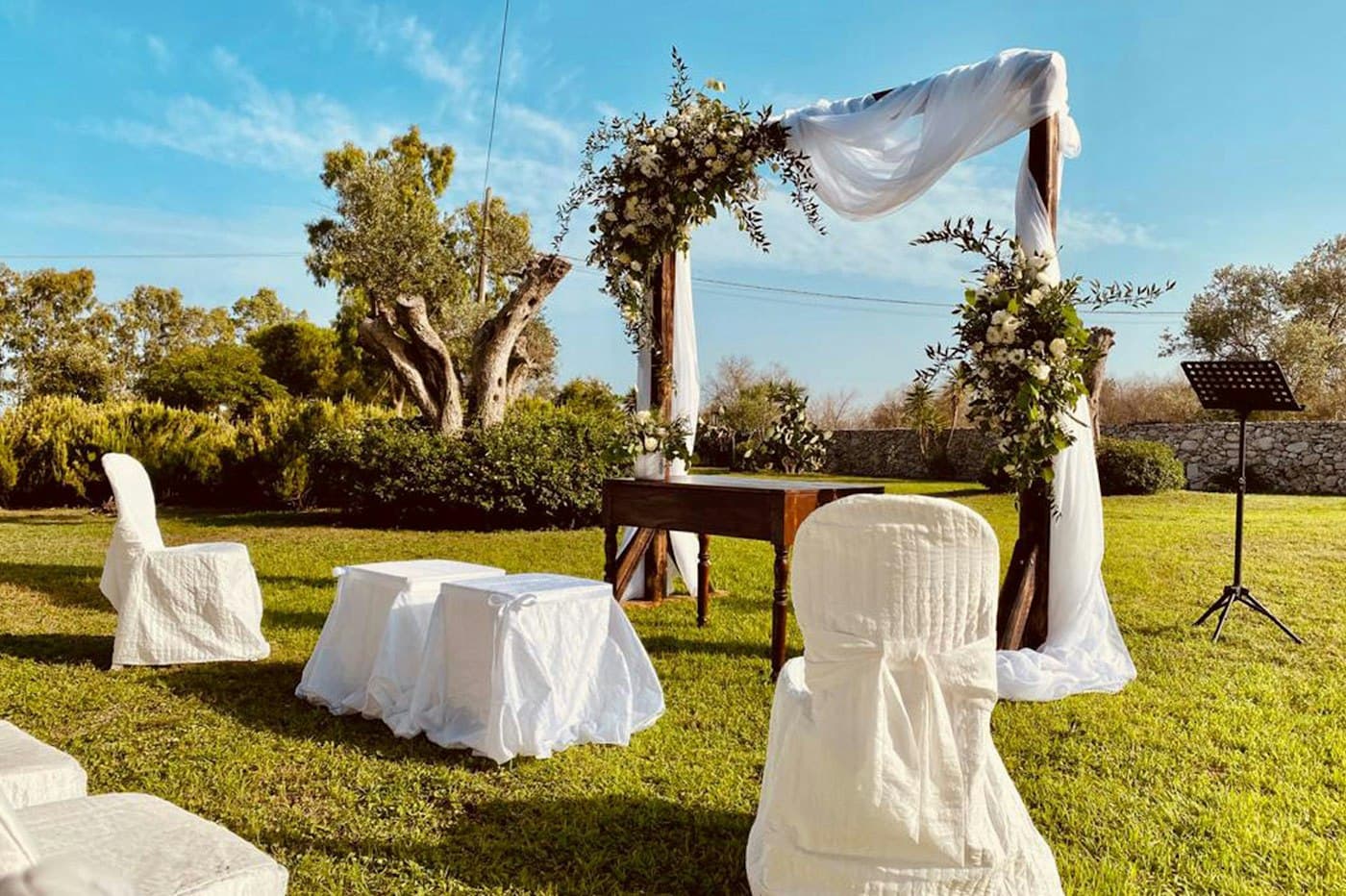
Almost anywhere you are allowed to be: a villa garden, a masseria’s courtyard, a vineyard, a terrace over the sea, a lake shore, a mountain meadow, a beach. Venues that host weddings have their own ceremony spots and their own rules, and decide for their own land. Public places are where couples get caught out.
- Beaches are state maritime property — the demanio marittimo, which takes in “the shore, the beach, the ports” (Codice della Navigazione, art. 28) — and their management passed to the regions in 1998 (D.Lgs. 112/1998, art. 105). Some handed it on to the comuni — Tuscany did from 2001 — while Sardinia grants beach concessions itself. So the rules differ by region and by town. Sardinia’s 2025 guidelines allow weddings on the sand only in areas each comune sets aside for them, under a concession, and rule out assigning public beach to private parties for parties, events or ceremonies “of an exclusively personal nature”; Finale Ligure, in Liguria, forbids organising events on its beaches unless the comune has accepted a certified notice (SCIA) through its business desk (beach order of April 2026). A few comuni have made beaches places for legal civil weddings — Cabras, in Sardinia, set up civil-registry offices on four of its beaches in 2022. For most couples the practical route is a beach club or a hotel lido: its concession covers its own stretch of sand, and it knows what it may host.
- Squares, streets and parks are the comune’s. A ceremony with chairs, an arch, music or guests occupies public land and needs its permit — Rome, for instance, counts even a photographer’s tripod as one square metre of public land, at €1.84 per m² per day in 2026 multiplied by location factors, and asks for requests about 30 days ahead.
- Lake shores are public too. On Lake Como, the comuni manage the lake’s state property together through the Autorità di Bacino del Lario e dei Laghi minori, which grants the concessions to use it. A lakeside villa’s garden or landing is the villa’s decision; a public shore, a pier or a lido is the authority’s and the comune’s.
- Parks, monuments and protected areas have their own rules. Gran Paradiso National Park asks for an application at least 15 days ahead for professional photography, at €500 a day under its 2011 regulation, and allows no drones for amateur filming; South Tyrol allows no drones in any of its seven nature parks, wedding videos explicitly included; the Colosseum’s archaeological park charges €1,000 for a professional photo shoot; Taormina’s archaeological park has its own form for wedding photos. Where to elope in Italy goes place by place.
What it frees up for the day’s timing
A civil ceremony happens in the comune’s slots; a symbolic one can be set by the light. In summer the midday sun is high and hard all over Italy, and a ceremony in the late afternoon puts the portraits in the softer light before sunset. On 15 June 2027 the sun sets at 21:01 in Venice, 20:59 in Florence, 20:47 in Rome and 20:27 in Bari; on 15 September, at 19:26 in Florence and 19:02 in Bari. The best time to marry in Italy has every month for six cities.
| Ceremony time | What it means for the photos |
|---|---|
| Morning | Soft light and empty viewpoints or beaches; a long gap before dinner to fill |
| Midday to mid-afternoon | Hard overhead light and squinting in summer; look for open shade, a pergola or a loggia |
| Late afternoon | Warm, low light; portraits can run straight into the golden hour, then the aperitivo and dinner |
| Sunset or after | Beautiful skies but little time — the light goes quickly, so do the family photos before |
What it changes for the photographs
- You choose where you face. With no registrar’s desk, you can stand with the light falling across you rather than behind you, and with the lake, the sea or the hills — not a wall — behind the celebrant.
- The celebrant can step aside for the kiss, so the photo isn’t of a third head between you. Ask them in advance.
- A ritual adds quiet moments: a sand ceremony, a handfasting, a glass of wine shared — or a moment for the families — gives the photographer pictures of the people around you, not only of the two of you.
- An unplugged ceremony — guests asked to put their phones away — is easy when you write the script. The celebrant can say it before you walk in.
- The legal ceremony deserves a photo too. If it happens at a comune the day before, or at home weeks earlier, even a few frames keep the two days in one story.
Tell your photographer early that the ceremony is symbolic: they will plan their position, the order of the day and the family photos differently from a town hall or a church. If you haven’t found one yet, browse photographers — on the Amalfi Coast, Lake Como, in Tuscany or Puglia — or tell us about your day and see who is free.
Questions couples ask
Is a symbolic wedding in Italy legally binding?
No. Italian law recognises civil marriage before a comune’s registrar, Catholic and approved religious weddings with civil effect, and civil unions for same-sex couples. A symbolic ceremony is none of them, so couples who choose it marry legally at home or at the town hall, before or after.
Why have a symbolic ceremony in Italy if foreigners can marry there legally?
Because the civil rite is in Italian, with an interpreter if either of you doesn’t understand it, only in the comune’s own places and time slots, and with a hall fee that ranges from €500 to €9,200 (US Embassy). A symbolic ceremony can be in your language, at any place you are allowed to be and at the hour the light is best.
Can we do both a civil and a symbolic ceremony in Italy?
Yes: a short civil ceremony at the town hall the same day or the day before, with two witnesses and an interpreter if needed, and the symbolic ceremony at the venue for all the guests. Tell your photographer which is which, since the civil one runs to the comune’s timetable.
Who can lead a symbolic ceremony in Italy?
Anyone. Because it has no legal effect, no licence is needed: a professional celebrant, a friend or a relative can lead it, or you can simply read your vows to each other. Comuni that host symbolic ceremonies say the same — Sermoneta’s rules leave the choice of celebrant to the couple and forbid the mayor’s tricolour sash at them.
How much does a celebrant cost in Italy?
Italy’s largest wedding portal gives €400 to €1,000 (Matrimonio.com, February 2026); one celebrant in the province of Varese publishes €400 plus VAT for a standard ceremony. Some comuni rent their own rooms instead: Verona charges €100 to €400 for a symbolic ceremony at Juliet’s House or its museums.
Can we hold a symbolic ceremony on a beach in Italy?
Usually only with permission, and in some regions hardly at all on public sand. Beaches are state maritime property run by regions and comuni: Sardinia rules out assigning public beach to private parties for personal ceremonies, and Finale Ligure in Liguria wants a certified notice for any event. The easy route is a beach club or hotel lido with its own concession.
Sources
- Ministero della Giustizia — Couples of different nationalities: marriage (art. 116, banns) (opens in a new tab) · giustizia.it
- Brocardi — Italian Civil Code, art. 99 (the 180 days after the banns) (opens in a new tab) · brocardi.it
- Ministero dell’Interno — Circular 10/2014: civil weddings at sites other than the town hall (PDF) (opens in a new tab) · dait.interno.gov.it
- Comune di Firenze — Wedding and civil union tariffs from 25 February 2025 (PDF) (opens in a new tab) · servizi.comune.fi.it
- Comune di Firenze — Marriage of non-resident foreigners (updated 21 May 2026) (opens in a new tab) · comune.firenze.it
- Comune di Ravello — Sposarsi con rito civile (opens in a new tab) · comune.ravello.sa.it
- Hotel Villa Cimbrone — Eventi (rites allowed, except Catholic and civil) (opens in a new tab) · hotelvillacimbrone.com
- US Embassy & Consulates in Italy — Getting married in Italy (opens in a new tab) · it.usembassy.gov
- Normattiva — Law 20 May 2016, n. 76 (civil unions) (opens in a new tab) · normattiva.it
- GOV.UK — Marriages and civil partnerships: give notice (opens in a new tab) · gov.uk
- GOV.UK — Marriages and civil partnerships: plan your ceremony (opens in a new tab) · gov.uk
- Citizens Information (Ireland) — Notification requirements for marriage (edited 24 September 2024) (opens in a new tab) · citizensinformation.ie
- Regione Emilia-Romagna — Codice della Navigazione, arts. 28–61 (PDF) (opens in a new tab) · agricoltura.regione.emilia-romagna.it
- Normattiva — D.Lgs. 112/1998, art. 105 (maritime property to the regions) (opens in a new tab) · normattiva.it
- Comune di Pisa — Rules for the use of beaches, art. 1 (Tuscan comuni manage maritime property from 1 January 2001, PDF) (opens in a new tab) · comune.pisa.it
- Regione Sardegna — DGR 22/37 of 23 April 2025, beach-season guidelines (weddings on the sand, point 3) (opens in a new tab) · delibere.regione.sardegna.it
- Comune di Finale Ligure — Beach order no. 120, 23 April 2026 (PDF) (opens in a new tab) · finale-ligure-api.municipiumapp.it
- Comune di Cabras — G.C. 50 of 18 March 2022: civil-registry offices on four beaches (PDF) (opens in a new tab) · cabras-api.municipiumapp.it
- Autorità di Bacino del Lario e dei Laghi minori — Statute (BURL, 30 January 2013, PDF) (opens in a new tab) · municipium-images-production.s3-eu-west-1.amazonaws.com
- Comune di Verona — Sposami a Verona: ceremonies at Juliet’s House and the city’s halls (updated 7 September 2026) (opens in a new tab) · comune.verona.it
- Comune di Verona — Symbolic ceremonies: tariffs (13 December 2024, PDF) (opens in a new tab) · comune.verona.it
- Comune di Sorrento — Tariffs for weddings, civil unions and symbolic weddings from 1 January 2025 (PDF) (opens in a new tab) · comune.sorrento.na.it
- Comune di Sermoneta — Rules for civil weddings, civil unions and symbolic ceremonies (C.C. 65/2023, PDF) (opens in a new tab) · sermoneta-choranext.it
- Matrimonio.com — Matrimonio simbolico (updated 27 February 2026) (opens in a new tab) · matrimonio.com
- Il Celebrante — Costo (price page) (opens in a new tab) · ilcelebrante.it
- Parco Nazionale Gran Paradiso — Rules for photo and video shoots (2011, PDF) (opens in a new tab) · pngp.it
- Parco Nazionale Gran Paradiso — Drones (opens in a new tab) · pngp.it
- Roma Capitale — Authorisation for film and photo shoots (opens in a new tab) · comune.roma.it
- Roma Capitale — Tariffs for photo shoots 2026 (PDF) (opens in a new tab) · comune.roma.it
- KlimaLand South Tyrol — No drones in the nature parks (2 August 2026) (opens in a new tab) · klimaland.bz
- Parco archeologico del Colosseo — Reproductions of the cultural heritage it manages (opens in a new tab) · colosseo.it
- Parco archeologico Naxos Taormina — Wedding photo application form (December 2024) (opens in a new tab) · be.parconaxostaormina.com